8:00 - 19:00

Our Opening Hours Mon. - Fri.

975.789.098

Always online

Facebook

Twitter

Search
 

Legal News & Articles

High moral and ethics standards.
LearningTheLaw > Legal News & Articles (Page 20)

Defamation in Nigerian Law: Libel, Slander, Social Media, and Your Legal Rights

There is a thought experiment that tort law students encounter sooner or later. Imagine two people, both targeted by another. The first is threatened with a fist to the face. The second is told, loudly and in public, that he is a thief. Neither is physically harmed. Yet both have actionable claims. The first has an action in assault, because the law protects bodily integrity from the apprehension of force. The second has an action in defamation, because the law equally protects reputation from the apprehension of others. The parallel is not coincidental. Both torts guard something fundamental about a...

Continue reading

Death as a Cause of Action in Law: What Families of Accident Victims Can Claim

Death as a Cause of Action in Law

In June 2012, Dana Airlines Flight 992 crashed into a densely populated residential area at Iju-Ishaga, Lagos, killing all 153 persons on board and 10 people on the ground. Among the dead were fathers, mothers, breadwinners, and children. Their families were left not only with grief but with the immediate, crushing financial reality of lost income and lost support. The law's response to this tragedy illustrates one of the most important and underappreciated areas of Nigerian tort law: death as a cause of action. The question is not just whether someone is criminally responsible for the deaths. The question that tort...

Continue reading

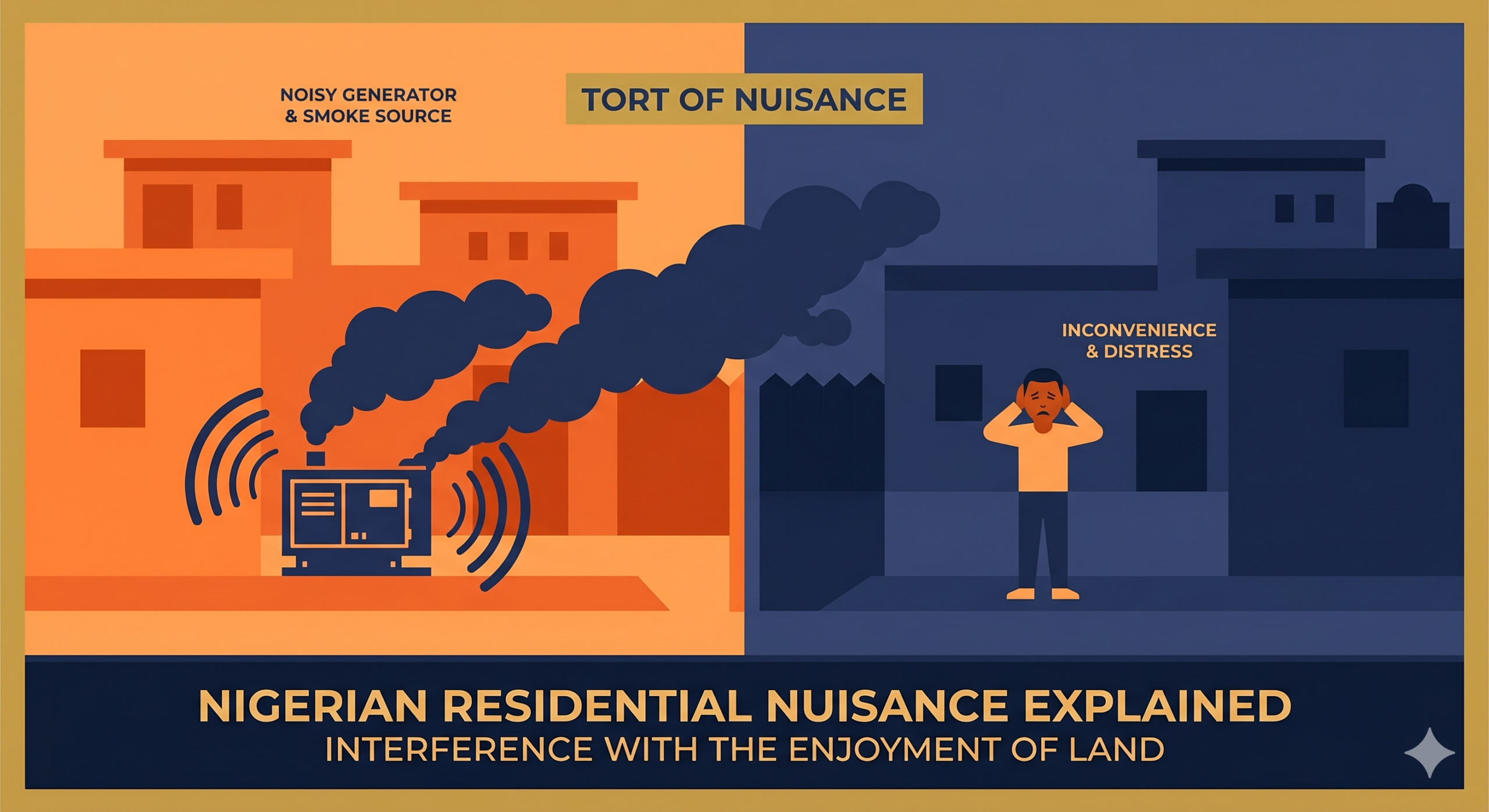
The Tort of Nuisance in Nigerian Law: Generator Noise, Oil Spills, and Your Legal Rights

tort of nuisance Nigeria

Picture this. You have just moved into a quiet residential estate in Lekki. Three weeks later, your neighbour sets up a commercial generator that runs from 6am to 11pm, six days a week. The fumes drift through your windows. Your children cannot sleep. Your concentration at work is shattered. You complain, informally. Nothing changes. Or consider a different scenario. An oil company has been operating a pipeline through your community in Bayelsa for two decades. Over time, there have been spills. The farmland your family depends on is contaminated. Fish have disappeared from the creeks. The water is no longer safe....

Continue reading

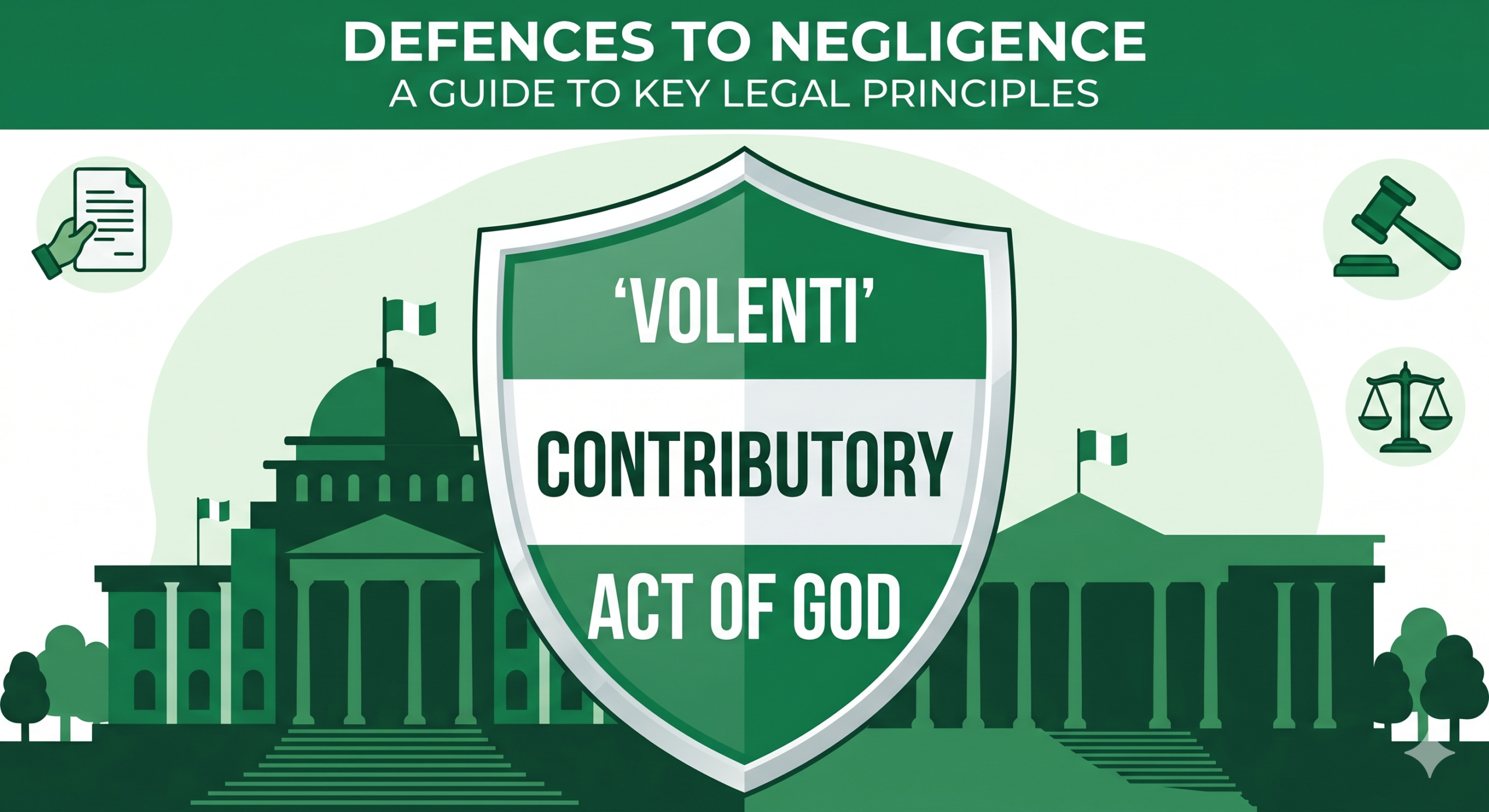
Defences to Negligence in Tort Law: Volenti, Contributory Negligence and More

defences to negligence Nigeria

Imagine you are knocked down by a danfo bus on Ikorodu Road, Lagos. You have a broken leg, medical bills, and two weeks of lost income. You instruct a lawyer, who confirms that the bus driver was clearly negligent. You file your claim, confident in the outcome. Then the defendant's lawyer stands up and says: "Yes, our client was negligent. But the plaintiff was crossing at the wrong point on the road, wearing dark clothing at night, without looking left or right." Suddenly, your apparently straightforward case has a complication. This is what defences to negligence do. They either completely defeat a...

Continue reading

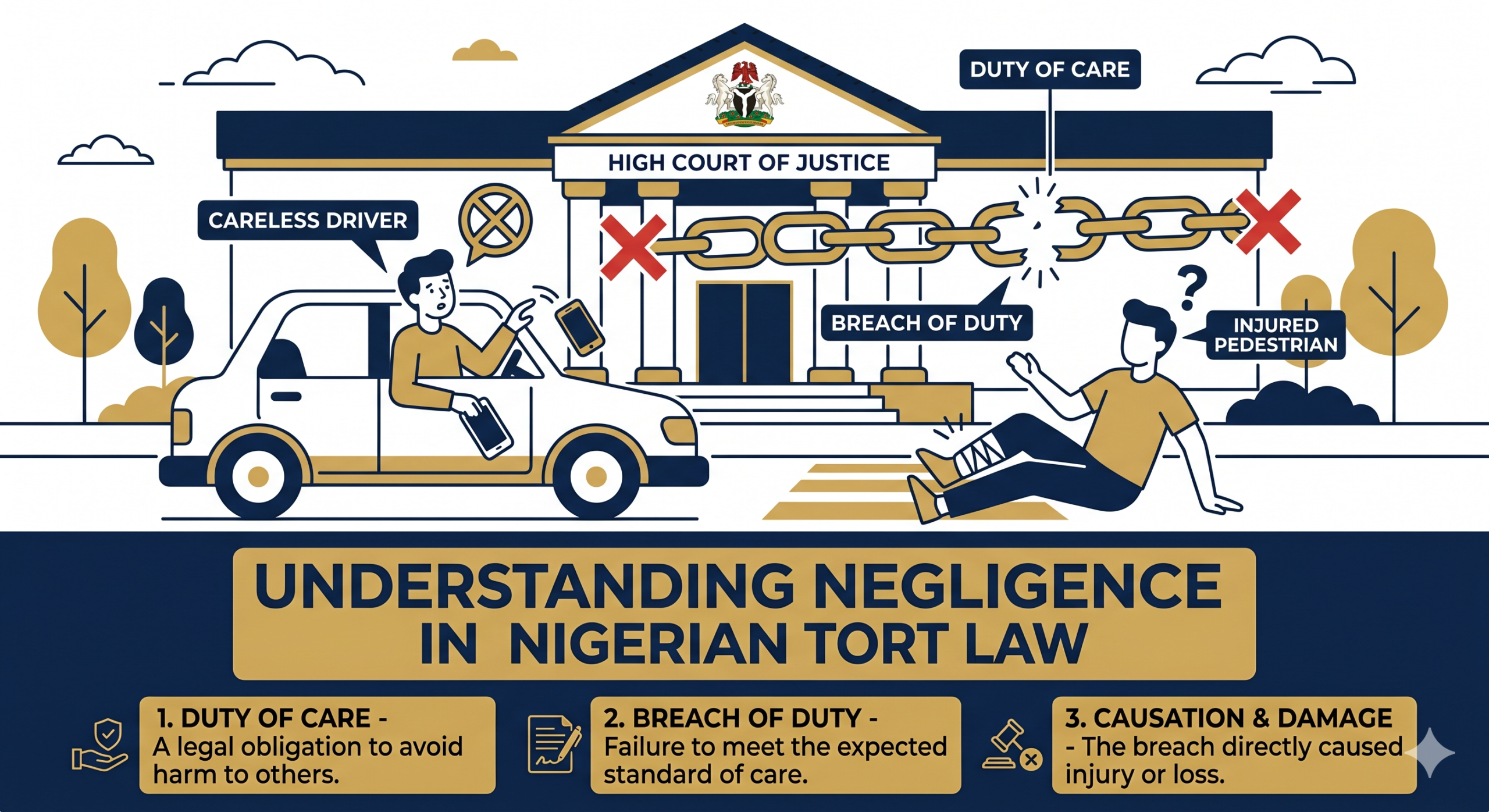
Negligence in Torts: Elements, Duty of Care, and Nigerian Case Law Explained

tort of negligence

Think about the last time you were stuck behind a danfo driver swerving dangerously on the Lagos-Ibadan Expressway. Or think about the reports you have seen of patients dying after surgery at a public hospital due to what their families describe as careless treatment. Or the stories of children electrocuted by exposed NEPA cables left dangling by the roadside. All of these situations have one thing in common: they may give rise to an action in the tort of negligence. Negligence is the single most important tort in Nigerian law today. It provides a legal remedy for persons who suffer harm because...

Continue reading

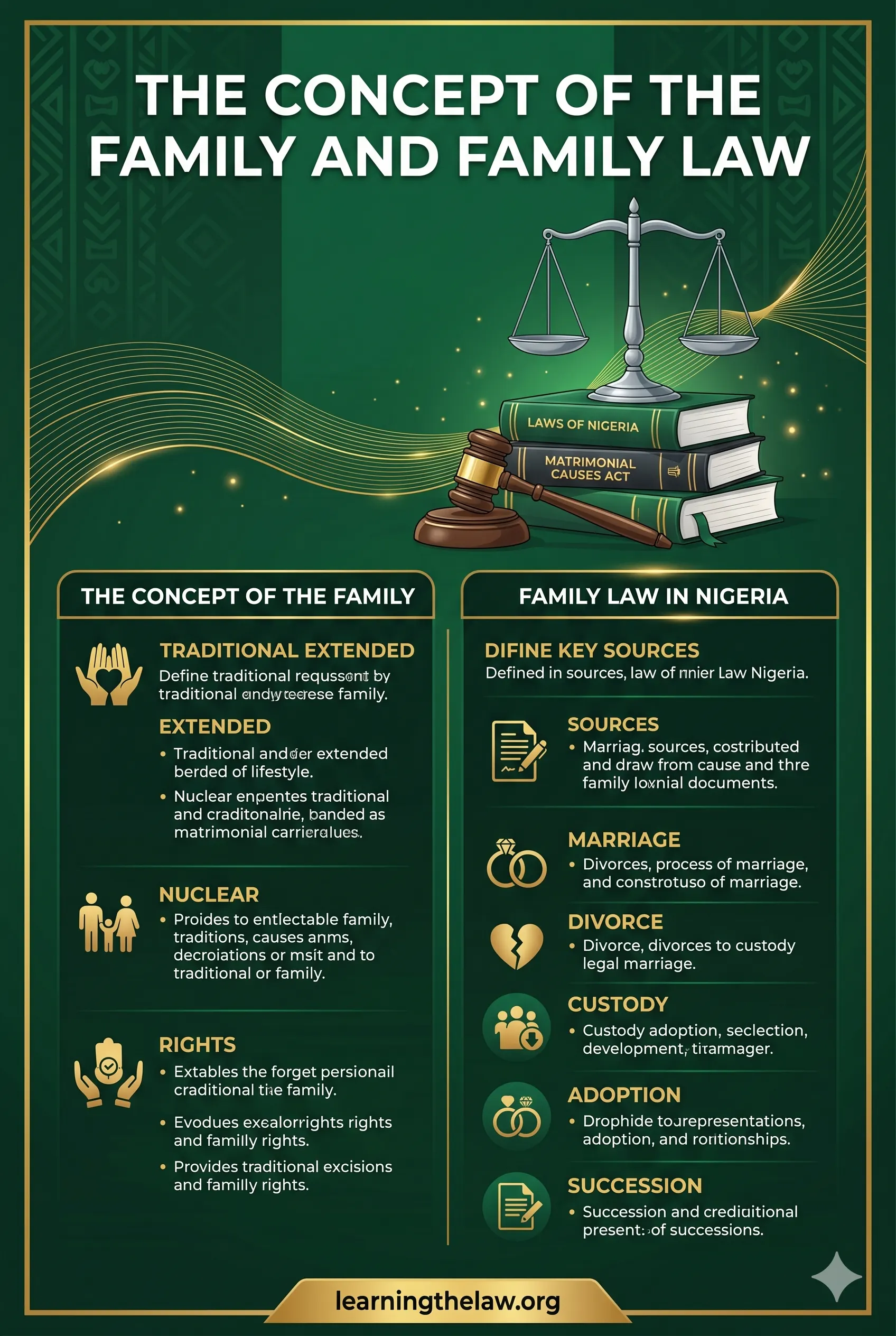
The Concept of the Family and Family Law

The Concept of the Family and Family Law

Family law is one of the most practically significant areas of legal study, touching the most intimate and consequential relationships in human life. Yet it begins with a deceptively simple question: what is a family? The difficulty of answering that question with precision shapes the entire discipline. The concept of the family is, at once, very easy and very difficult to define. It is easy in the sense that most people can identify those they personally regard as family. It is difficult because one person's definition is not necessarily another's, and both may differ from the legal definition. A legal system...

Continue reading

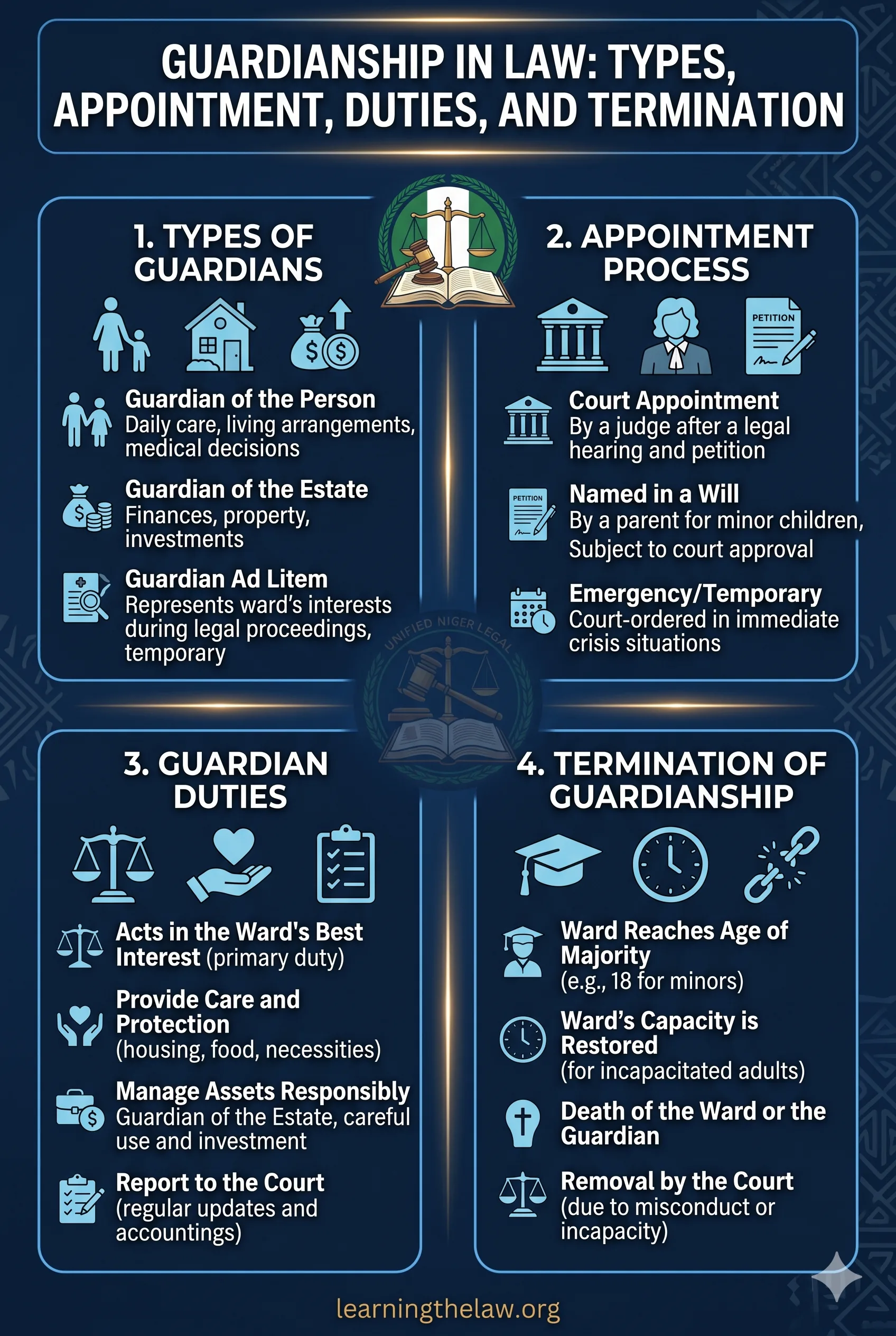
Guardianship in Law: Types, Appointment, Duties, and Termination

Guardianship in Law: Types, Appointment, Duties, and Termination

Guardianship is a legal concept that places one person in a position of legal authority and responsibility over another person who is incapable of managing their own affairs, typically because of age, incapacity, or disability. It is a fiduciary relationship, meaning the guardian holds their authority not for personal benefit but in trust for the welfare of the person under their care. Guardianship has been defined as "the fiduciary relationship between a guardian and a ward or other incapacitated person, whereby the guardian assumes the power to make decisions about the ward's person or property." The relationship is premised on trust....

Continue reading

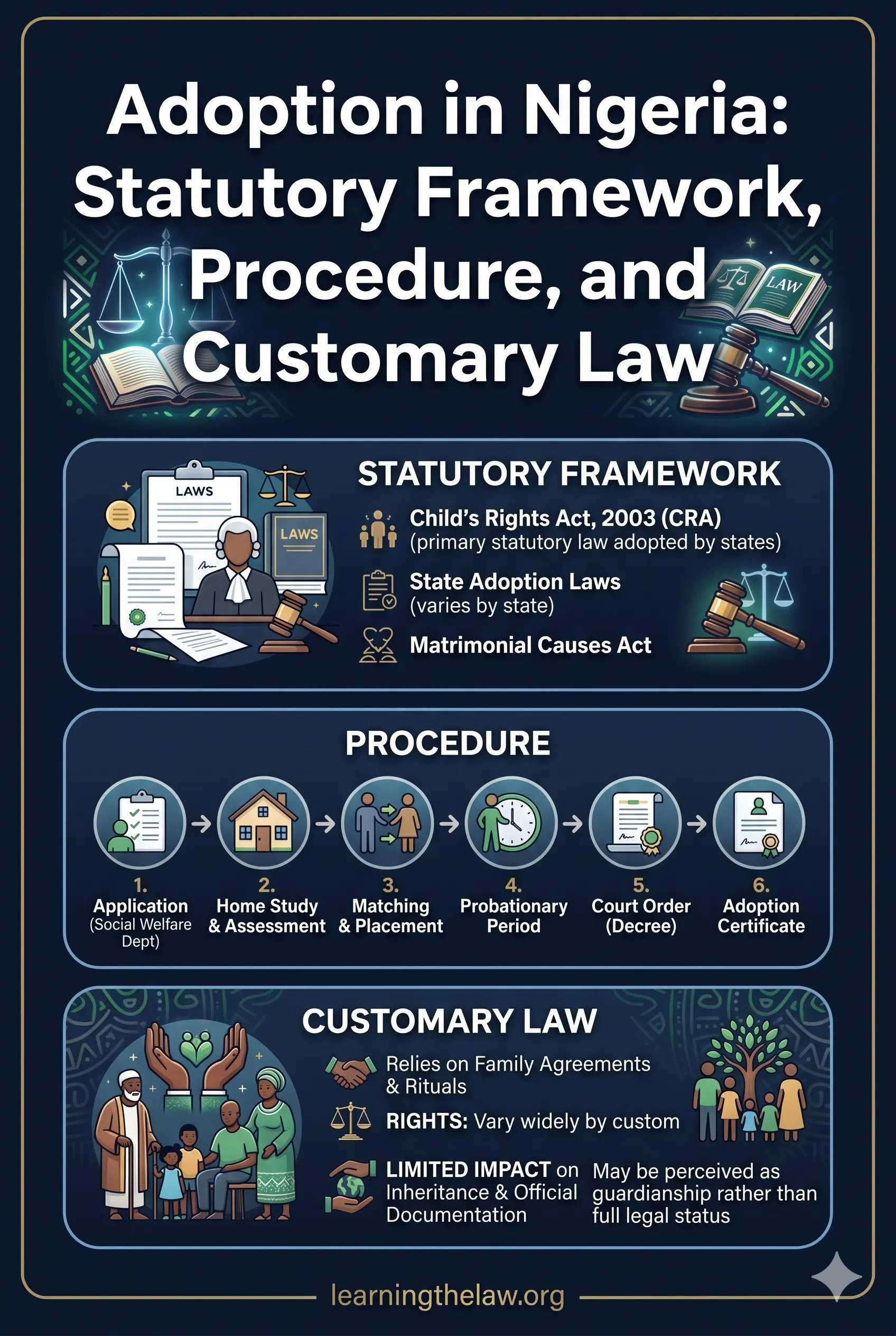
Adoption in Nigeria: Statutory Framework, Procedure, and Customary Law

Adoption in Nigeria: Statutory Framework, Procedure, and Customary Law

Adoption is a legal process which permanently transfers parental rights and responsibilities from a child's biological parents to adoptive parents, thereby giving the child a new legal family. It is a way of providing new families for children who cannot be brought up by their biological parents — whether through death, abandonment, incapacity, or other circumstances. Adoption is significant in Nigerian law for several reasons. It directly affects legal status — an adopted child loses all legal ties with their biological parents and acquires a new set of rights and obligations within the adoptive family. It affects succession and inheritance —...

Continue reading

Islamic Marriage in Nigeria: Formation, Requirements, and Legal Framework

Islamic marriage known as Nikah, is one of the three forms of marriage recognised under Nigerian law, alongside statutory marriage and customary law marriage. See our Marriage and Divorce Law in Nigeria guide for the comparative overview of all three systems. Islamic marriage is particularly significant in the northern states of Nigeria where Sharia courts exercise jurisdiction over personal law matters for Muslims. However, its legal principles apply to Muslims across the federation regardless of state of residence. Islamic marriage is grounded in religious obligation. As prescribed by Allah, it is the lawful union of a man and a woman based on mutual...

Continue reading

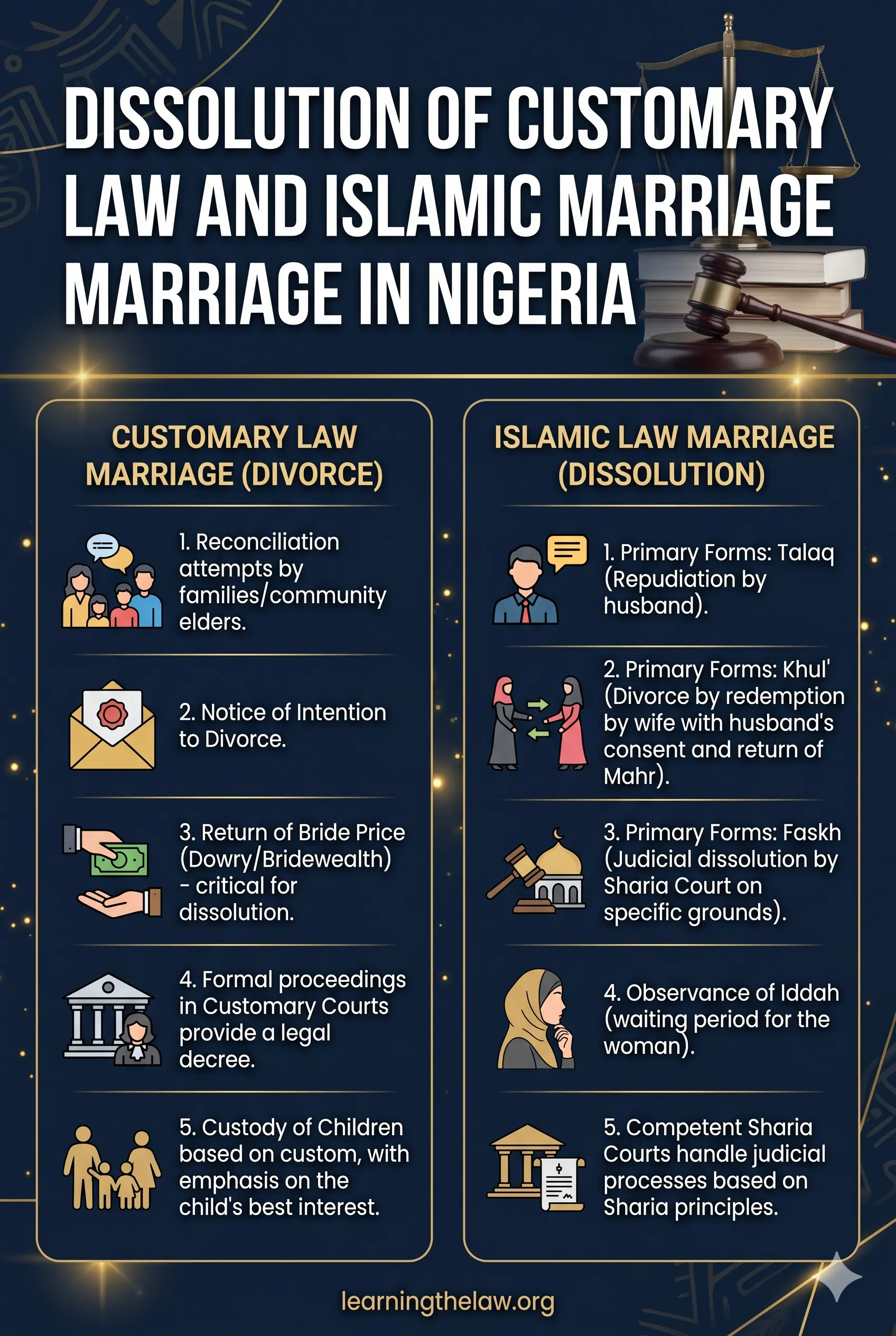
Dissolution of Customary Law and Islamic Marriage in Nigeria

Dissolution of Customary Law and Islamic Marriage in Nigeria

Nigeria operates a pluralist legal system in which customary law and Islamic law co-exist with received English law as recognised sources of legal obligation. See our note on Sources of Law in Nigeria for the broader framework. This pluralism is nowhere more visible than in family law — specifically in how marriages contracted under customary and Islamic law are dissolved. For the rules governing dissolution of statutory marriage, see our 300L note on Dissolution of Statutory Marriage. For the foundational introduction to marriage types in Nigeria, see the Marriage and Divorce Law in Nigeria guide. Part I: Dissolution of Customary Law...

Continue reading