

Guardianship in Law: Types, Appointment, Duties, and Termination
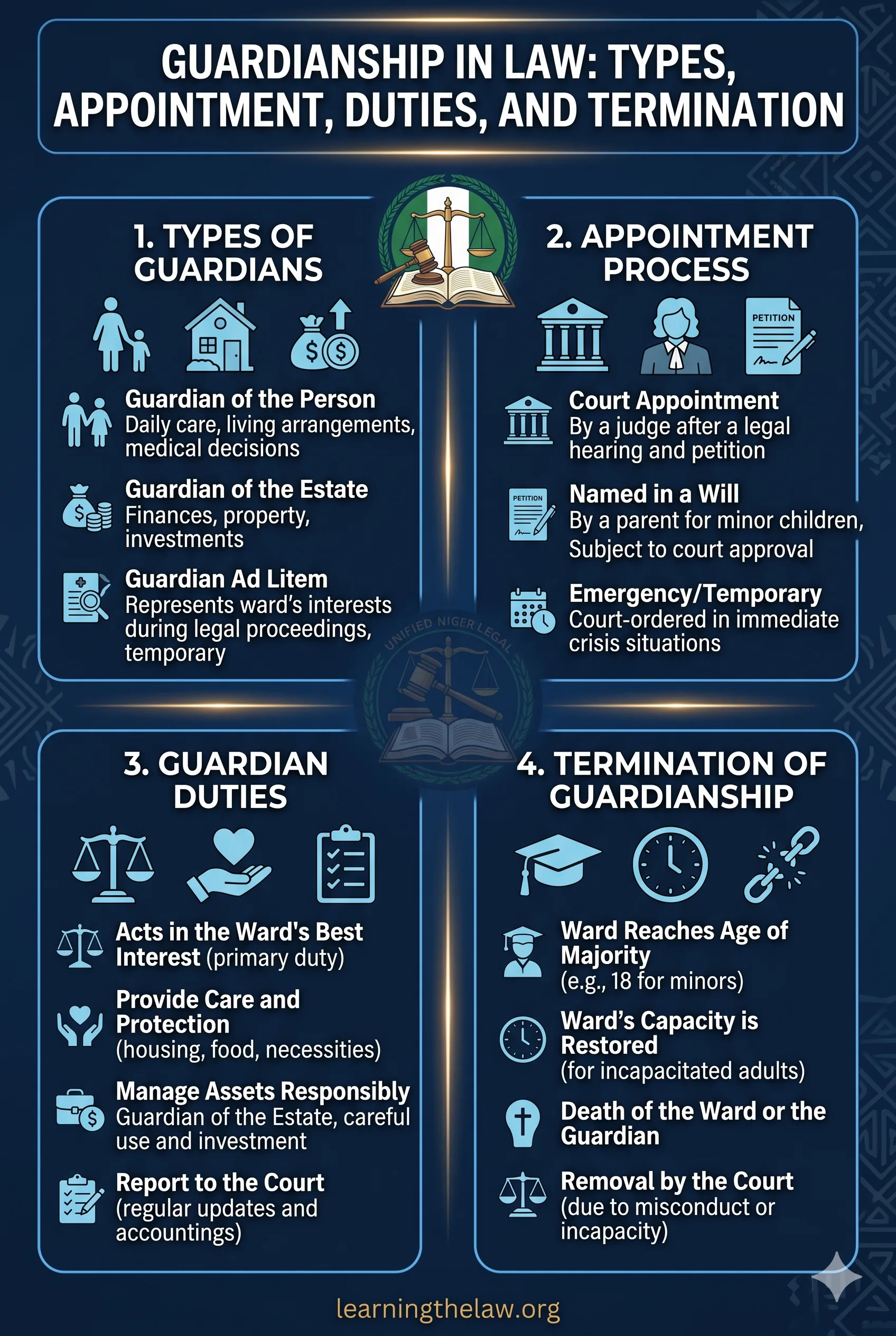
Guardianship is a legal concept that places one person in a position of legal authority and responsibility over another person who is incapable of managing their own affairs, typically because of age, incapacity, or disability. It is a fiduciary relationship, meaning the guardian holds their authority not for personal benefit but in trust for the welfare of the person under their care.
Guardianship has been defined as “the fiduciary relationship between a guardian and a ward or other incapacitated person, whereby the guardian assumes the power to make decisions about the ward’s person or property.” The relationship is premised on trust. A guardian acts not for themselves but for and on behalf of their ward, such that the interest of the ward is the paramount consideration in every decision the guardian takes.
A guardian is a person who has the legal authority and duty to care for another person or property, especially because of the other’s infancy, incapacity, or disability. The distinction between a guardian and a parent is important: the rights and obligations of parents arise from the fact of parenthood itself. A guardian, by contrast, is formally placed in the position of a parent, usually by appointment, and their rights flow from that appointment rather than from any natural relationship. A guardian appointed under law steps into the shoes of a parent, and all the rights and obligations of a parent in respect of the child vest in the guardian.
Guardianship is closely related to but distinct from adoption. Adoption permanently extinguishes the biological parent-child relationship and creates a new one. Guardianship is a temporary or conditional arrangement that does not alter the child’s legal status or family membership. For the full treatment of adoption and the distinction between the two concepts, see our note on Adoption in Nigeria.
The rules on guardianship must also be read alongside the rules on custody under both statutory and customary law. In a statutory marriage, custody is determined by the court with the welfare of the child as the paramount consideration. In customary law, the father has default custodial rights. For the custody framework under both systems, see Dissolution of Customary and Islamic Marriage and Dissolution of Statutory Marriage in Nigeria.
Part I: Guardianship Under Statutory Law
Types of Guardians
Nigerian law recognises three main types of guardians under statutory law: testamentary guardians, court-appointed guardians, and guardians ad litem.
1. Testamentary Guardians
A testamentary guardian is a guardian nominated by a parent’s will to protect the interests of a child until the child reaches the age of majority. This type of guardianship derives its authority from the testamentary instrument, not from any court order.
Appointment by the father:
A father of a child is empowered by deed or will to appoint a guardian or guardians for his children who are under the age of twenty-one and unmarried at the time of his death. The appointment operates for the infancy of the child.
In Re Purnell, the testator appointed two persons by will to act as guardians of his infant daughter and authorised the survivor of those guardians to appoint another person in their place. It was held that the appointment made by the survivor was valid. This case confirms that the power of appointment under a will may be delegated, where the testator expressly provides for it.
On the death of the father:
On the death of the father, the mother of the child acts as guardian, either alone or jointly with any guardian appointed by the father. Where no guardian has been appointed by the father, or where the guardian or guardians so appointed are dead or refuse to act, the High Court may appoint a guardian or guardians to act jointly with the mother.
If guardians have been appointed by both parents, they act jointly after the death of the surviving parent.
Appointment by the mother:
The mother may also, by will or deed, appoint a guardian to act jointly with the father of the child on her death. If on her death the father is found by the court to be unfit to act alone as guardian, the court may confirm the appointment of such guardian made by the mother.
Appointment by a single parent:
A single parent may by deed appoint a person to be the guardian of their child on their death: Section 84(1)-(3) CRA.
Consent of the proposed guardian:
The consent of a person appointed as guardian must be obtained before the appointment takes effect: Section 85 CRA. A person cannot be imposed as guardian without their knowledge and agreement.
Surviving parent as guardian:
The law places both parents on an equal basis with respect to guardianship. A surviving parent has the right to act as guardian of their child, either alone or jointly with any guardian appointed by the other spouse. This principle reflects the equal standing of both parents before the law, regardless of which parent survives.
2. Court-Appointed Guardians
The High Court has statutory power to appoint guardians by virtue of various enactments, including the CRA.
General jurisdiction:
The statutory powers of the High Court in appointing guardians are unlimited. The court may exercise its power in the following circumstances:
- Where the parents of an infant are dead and the infant is in need of care and protection
- Where a parent has abandoned their parental responsibilities or is unfit to act
- Where no guardian has been appointed by the parents, or where a previously appointed guardian is dead or refuses to act
During the lifetime of a parent:
The court may exercise its power to appoint a guardian even while a parent is still alive, if the court is of the opinion that the parent has abandoned their responsibilities or is unfit to act as a guardian. This is an important safeguard for children of living but neglectful or incapable parents.
Paramount consideration:
In every exercise of its guardianship jurisdiction, the court regards the interests of the child as the paramount consideration. This welfare principle governs not only the appointment of guardians but also the court’s supervision of guardianship and any subsequent variation or discharge.
Disqualification:
A person may be disqualified from appointment as guardian if they are of bad character or unfit to protect the moral and physical welfare of the child. The court will scrutinise the proposed guardian’s background, character, and capacity before making an appointment.
Disputes between joint guardians:
Where a dispute arises between two or more persons acting as joint guardians and they are unable to agree on any question affecting the welfare of the child, any of them may apply to the High Court for directions. The court resolves the dispute with the child’s welfare as the governing principle.
3. Guardian Ad Litem
A guardian ad litem is a guardian appointed by a court to appear in a lawsuit on behalf of an incompetent or minor party. It is also known as a special advocate or a special guardian. The role is litigation-specific, not general: the guardian ad litem represents the ward’s interests in the particular proceedings for which they are appointed and does not assume the general parental functions of a full guardian.
The guardian ad litem appears frequently in adoption proceedings. When an application for adoption is made, the court appoints a guardian ad litem for the juvenile to represent the child’s interests throughout the adoption process. See our note on Adoption in Nigeria for the role of the guardian ad litem in that context.
Duties of Guardians
Duty to account:
In respect of the ward’s property, the guardian has a duty to account to the ward for any property of the ward that has come into the guardian’s hands, upon termination of the guardianship. If money is paid to the guardian for the maintenance of the ward, it is presumed that the money was properly expended unless abuse is clearly proved.
In Martins v. Martins, it was held that the list of payments and receipts produced by the defendant should be strictly scrutinised. The defendant was held liable to repay the balance of funds not properly accounted for. This case illustrates the strict fiduciary standard to which guardians are held.
Duty to avoid undue influence:
Gifts made by a ward to a guardian during the guardianship, or soon after its termination, are presumed to have been made under undue influence and may be set aside on that ground. The law recognises the inherent power imbalance between guardian and ward and protects the ward accordingly.
Liability for ward’s acts:
The liabilities of a guardian for the acts of the ward are the same as those of a parent. A guardian may therefore be liable in tort if their failure to exercise proper control over their ward results in injury to a third party.
Termination of Statutory Guardianship
Guardianship may be terminated in the following ways:
Death:
The death of the ward terminates the guardianship automatically. In the case of joint testamentary guardians, the death of one guardian vests the guardianship in the surviving guardian.
Attainment of majority:
The functions of a guardian cease when the ward attains the age of twenty-one years. At majority, the ward has full legal capacity to manage their own affairs and no longer requires a guardian.
Marriage of ward:
It is well settled that guardianship is not terminated by the marriage of a male ward. In relation to a female ward, guardianship is not terminated where the guardian was appointed by the court. However, where a female ward marries, the practical circumstances may lead the court to review the guardianship arrangement.
Resignation:
A guardian, whether appointed by the court or under a will, cannot resign without the leave of court. The court may, on the guardian’s application, release them from the obligation if doing so is in the best interests of the child.
Removal by the court:
The High Court has authority to remove a guardian whenever such removal will promote the welfare and interests of the ward. Removal may be ordered where the guardian has engaged in misconduct or has demonstrated unfitness to discharge their functions. The welfare principle governs this decision as it does all others in guardianship.
Part II: Guardianship Under Customary Law
Recognition and Basis
The institution of guardianship is recognised under various systems of customary law in Nigeria. Customary law guardianship involves the placing of a person in loco parentis in relation to a child, thereby conferring on that person most of the parental rights and obligations that would otherwise vest in the biological parents. The close family ties characteristic of traditional Nigerian society make the extended family the natural environment for guardianship under customary law.
For the broader framework of customary law as a legal system in Nigeria, including the role of customary courts, see our notes on African Customary Law: Sources, Courts and Administration and Sources of Law in Nigeria.
Appointment of Guardians Under Customary Law
By the father:
A father during his lifetime is the natural guardian of his children under customary law. On his death, the right of guardianship devolves on the next in line, specifically a person who is of age and capable of assuming the responsibilities. Where a widow remarries, her new husband may act as the guardian of her children by her former husband.
By the head of family:
Where the surviving mother of an infant cannot undertake the care and protection of the child due to infirmity or other causes, or in the case of an orphan, the head of the child’s extended family is the proper person to appoint a guardian for the infant. This reflects the communal responsibility for children characteristic of Nigerian customary law societies.
By the customary court:
Customary courts have the power to appoint guardians for infants. In the various enactments governing the powers of customary courts on this subject, it is expressly provided that in any matter relating to the guardianship of children, the interest and welfare of the child is of paramount consideration. This welfare principle applies equally in the customary court context as in the High Court.
By the family:
Customary law recognises and gives effect to the close family ties which exist in a traditional society. It is held that under customary law, it is in the best interest of the child to be placed under the guardianship of a blood relation. A conscious effort is therefore made to restrict the appointment of guardians to members of the extended family of the infant. This reflects the communal and relational nature of customary law governance as discussed in African Customary Law: Sources, Courts and Administration.
Termination of Customary Law Guardianship
Death:
The death of the ward or the guardian automatically terminates the guardianship.
Age and puberty:
Customary law does not prescribe a fixed age for the termination of guardianship. It is believed that family ties endure longer under customary law than under English law. As a result, neither the attainment of puberty nor marriage, by itself, terminates guardianship under customary law.
Court order:
The Customary Court, High Court, or Magistrate Court has the power to terminate guardianship where such action is in the best interests of the infant.
Comparative Overview: Statutory vs. Customary Law Guardianship
| Feature | Statutory Guardianship | Customary Law Guardianship |
|---|---|---|
| Source of authority | CRA, ss.82-92; court order; will or deed | Customary law of the community |
| Who appoints | Father/mother by will or deed; High Court | Father, head of family, customary court, family |
| Preference for appointee | Fitness and welfare of child | Blood relation; extended family member |
| Termination by majority | Age 21 | No fixed age; family ties endure |
| Termination by marriage | Male ward: no. Female ward (court-appointed): no | Neither puberty nor marriage automatically terminates |
| Court oversight | High Court throughout | Customary Court, High Court, Magistrate Court |
| Paramount consideration | Welfare of child | Welfare of child (expressly stated in enactments) |
| Resignation | Requires leave of court | Not expressly prescribed |
Guardianship Distinguished from Related Concepts
Guardianship vs. Custody
Custody is the right of physical care and control of a child, typically determined by a court upon the breakdown of a marriage or relationship. A parent awarded custody is not a guardian in the technical sense. Guardianship is a broader concept encompassing both personal and property decisions for the ward, and may subsist independently of any matrimonial proceedings. A guardian may be appointed even where both parents are alive but unfit, and does not require a dissolved marriage as a precondition.
Guardianship vs. Adoption
Adoption permanently transfers legal parenthood and severs biological ties. Guardianship is temporary and functional. An adopted child inherits from the adoptive parents; a ward does not automatically inherit from the guardian. For the full comparison, see our note on Adoption in Nigeria.
Guardianship vs. Fostering
Fostering involves the placement of a child with carers who provide day-to-day care without acquiring parental rights. Fostering is temporary and does not create a legal parent-child relationship. Guardianship, by contrast, vests legal authority in the guardian and creates enforceable rights and duties in relation to the ward’s person and property.
Key Cases Summary
| Case | Point |
|---|---|
| Re Purnell | Power of appointment under a will may be delegated where testator expressly provides for it |
| Martins v. Martins | Strict scrutiny of guardian’s accounts; guardian held liable for unaccounted balance |
Recommended Reading
- Nwogugu, E.I., Family Law in Nigeria (3rd ed.) HEBN Publishers, Ibadan, 2015 — Guardianship: pp.321-324
- Sagay, Itse, Nigerian Family Law, Malthouse Press, Lagos, 1999
- Child Rights Act, Cap C50, LFN 2004 — Sections 82-92
This article is part of the Family Law II (LPP 306) series on learningthelaw.org. For adoption, which is closely related to guardianship, see Adoption in Nigeria. For custody rules under statutory and customary law, see Dissolution of Customary and Islamic Marriage and Dissolution of Statutory Marriage in Nigeria. For the customary law framework underpinning customary guardianship, see African Customary Law: Sources, Courts and Administration and Sources of Law in Nigeria.

Kolawole Adebowale is a law graduate of the University of Ibadan with a specialization in intellectual property law, digital patent enforcement, and software law. His research focuses on the intersection of technology and IP protection in Nigeria’s emerging digital economy, with comparative analysis spanning multiple jurisdictions. He is a member of the Law Students Association of Nigeria (LAWSAN) and the IP Association.