

Dissolution of Customary Law and Islamic Marriage in Nigeria
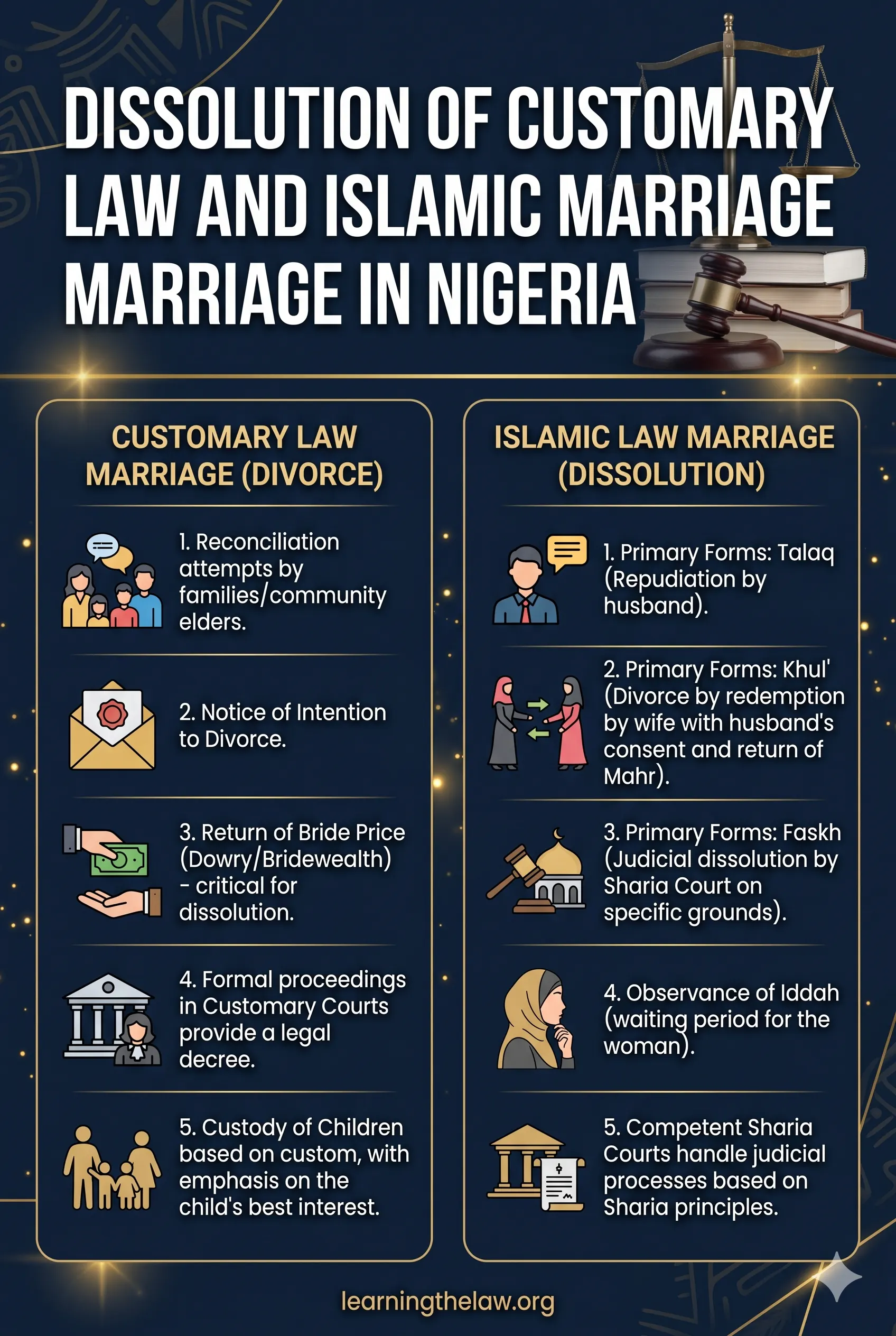
Nigeria operates a pluralist legal system in which customary law and Islamic law co-exist with received English law as recognised sources of legal obligation. See our note on Sources of Law in Nigeria for the broader framework. This pluralism is nowhere more visible than in family law — specifically in how marriages contracted under customary and Islamic law are dissolved. For the rules governing dissolution of statutory marriage, see our 300L note on Dissolution of Statutory Marriage. For the foundational introduction to marriage types in Nigeria, see the Marriage and Divorce Law in Nigeria guide.
Part I: Dissolution of Customary Law Marriage
Nature of Customary Law Marriage
Customary law marriage is a bilateral contract between the husband and his family on one hand, and the wife and her family on the other. This family dimension is not incidental — it is structural. The families of both spouses are parties to the marriage in a real sense, and they remain active throughout its duration. Their mediatory role is considered the bedrock of marital stability under customary law.
For a broader treatment of customary law as a legal system — its sources, validity, and relationship to received law — see our note on African Customary Law: Sources, Courts and Administration.
The Mediatory Role of Families
Before any dissolution is contemplated, the families of both spouses are expected to intervene and attempt reconciliation. Where the spouses fall out, the families will first seek to reconcile them. If reconciliation fails, and if the marriage has broken down irretrievably, the spouses may agree before members of their families to bring the marriage to an end. The families then address collateral questions — principally the refund of bride price.
This mediatory function is a significant feature distinguishing customary marriage dissolution from statutory divorce, which is an exclusively judicial process. Under customary law, the family meeting is not merely a preliminary — it can itself be the mechanism of dissolution.
Methods of Dissolution
Dissolution of a customary law marriage falls into three broad categories:
- Non-judicial dissolution
- Judicial dissolution
- Dissolution by death
1. Non-Judicial Dissolution
Non-judicial dissolution is the most common mode of ending a customary law marriage in Nigeria. It has no equivalent in statutory marriage. The marriage may be dissolved without any recourse to courts, either by:
(a) Mutual agreement of the spouses, usually before members of their families; or
(b) Unilateral action by one of the spouses.
By the husband: A husband may, on his own decision, drive his wife away from the matrimonial home with the intention of ending the marriage. This unilateral act, coupled with a clear intention to dissolve, can operate as divorce under customary law.
By the wife: A wife who has been grossly ill-treated may return to her parents’ home. In such a case, her father or guardian will be required to refund the bride price. A wife may also initiate dissolution through:
- Taking all her personal effects and quitting the matrimonial home, informing her husband the marriage is over;
- Indulging in promiscuity while still in the husband’s house — an act signalling the breakdown of the union;
- Going through the preliminaries of a subsequent customary marriage with another man, with a view to refunding the husband’s bride price.
Important limitation: The mere fact that a spouse has left the matrimonial home is not sufficient. A desire to terminate the marital union must be accompanied by an overt act clearly evincing intention to dissolve, or by an express declaration to the other party. The law will not infer dissolution from ambiguous conduct.
Under some customary law systems, the following constitute deemed divorce:
- A court order granting divorce on application of either party
- Oral repudiation of the wife by the husband in her presence before two adult male witnesses of full capacity
- Written repudiation signed and dated by the husband
2. Judicial Dissolution
Where families have failed to reconcile the spouses, either party may resort to the courts. Judicial dissolution of customary law marriages falls within the exclusive jurisdiction of customary courts to hear and determine matrimonial causes between persons married under customary law.
Judicial action is typically brought in three situations:
- Where there is disagreement on the quantum of bride price to be refunded to the husband
- Where the husband has refused to accept the bride price refund, preventing the wife from remarrying
- Where the wife has refused to vacate the matrimonial home after the husband has sought to terminate the marriage
Unlike statutory divorce — where the sole ground is irretrievable breakdown demonstrated through specified facts (see our note on Dissolution of Statutory Marriage) — customary law imposes no standardised or codified grounds for dissolution. There is no equivalent of Section 15 MCA. Instead, the customs of each locality include accepted reasons upon which marriage may be ended. The court must determine in each case whether the petitioner’s allegations are, in light of local usage, sufficiently grave to justify termination.
Where the court is unsatisfied that the marriage should be dissolved, it may refer the dispute to the local head or other community persons for further reconciliation. Where the court has refused dissolution and the parties thereafter resort to non-judicial divorce — for example, the man drives away his wife or she absconds — that remains a legally recognised avenue under customary law.
Reasons for Dissolution Under Customary Law
There are no legislatively prescribed grounds for divorce under customary law. There are, however, a number of reasons and circumstances which entitle a spouse to dissolve a marriage and which the customary court takes into consideration. These include:
(a) Adultery
Adultery under customary law is defined as sexual intercourse or cohabitation by a married woman with another man while the dowry has not yet been refunded.
The gendered asymmetry in this definition is stark and deliberate. Under customary law, a man is entitled to be unfaithful to his wife — adultery by the husband is generally not a ground for dissolution, since polygamy is permissible and the husband may claim he intends to marry the other woman (provided she is single).
The wife, by contrast, has no such latitude. The adultery of the wife automatically gives the husband a right of action for dissolution. In Loye v. Loye (1981) O.Y.S.H.C.L.R. 140, the husband’s allegation of his wife’s pregnancy by another man ended the marriage.
Exception: A wife may divorce her husband summarily if he commits adultery with a member of her family who falls within the prohibited degrees of marriage. In Tikarewa v. Tikarewa, the wife petitioned for divorce on the ground that her husband had attempted to rape her daughter from a previous marriage — conduct falling within this exception.
How adultery is inferred: Adultery is typically inferred from surrounding circumstances — indecent familiarity, excessive attention to a third party, or unexplained pregnancy during separation. Where there is a confession by one party and the co-adulterer denies it, the court determines the question on the evidence.
This approach to evidence under customary law may be contrasted with the civil standard of proof applicable in statutory divorce — see Case Law and Precedent for the general principles of judicial proof in Nigerian courts.
(b) Cruelty
Cruelty under customary law is defined as wilful and unjustifiable conduct capable of causing damage to life or health, or giving rise to a reasonable apprehension of such danger to the other spouse or the children of the marriage.
Notably, a wife who is quarrelsome not only with her husband but also with co-wives may be regarded as cruel. A woman may herself petition for dissolution on the ground of molestation or enmity from other wives in the household — treating the polygamous household dynamic as a source of actionable cruelty.
(c) Desertion
Desertion under customary law is the abandonment of one spouse by the other without just cause and without consent for an unspecified period before divorce proceedings. Traditionally, a wife cannot leave the matrimonial home without the husband’s express or implied permission.
Critically, desertion alone is generally insufficient. The main point is that there must be an additional matrimonial offence before marriage can be dissolved on the ground of desertion. In Willy Olujide v. Modupe (1959) B Customary Court, Ilesa, the husband petitioned on the grounds that the wife was cruel and had deserted him, staying in another man’s house for several days without consent. The court granted dissolution on both grounds.
(d) Lack of Respect
This is defined as wilful disregard of the customary rights of elders or any member of the family. A husband may divorce his wife on the ground of her lack of respect for him and his family members. Among the Yoruba in particular, disrespect by either spouse to the other’s family has been treated as a serious ground for dissolution.
(e) Impotence
Impotence is sexual incapability and is sometimes taken under customary law to include sterility or barrenness. However, barrenness alone is not a matrimonial offence — unless some other offence was committed by the woman, a customary marriage cannot be dissolved on barrenness alone.
In Abioye v. Abioye, the court dissolved a three-year marriage after the wife proved the husband was impotent and that she could not bear it. Note the contrast with statutory law — under the MCA, impotence is a ground for nullity of marriage (see our note on Void and Voidable Marriages), not divorce. Under customary law, the distinction between nullity and dissolution is not maintained — impotence simply grounds dissolution.
(f) Pregnancy by Another
Where it is proved that the wife was pregnant by another man at the time of marriage, this may lead to dissolution. However, proof of such pregnancy does not automatically dissolve the marriage — it is at the husband’s discretion to seek divorce or to condone the pregnancy. Where the husband condones it and the wife is repentant, both will remain and raise the child together.
(g) Insanity or Serious Illness
Courts will hesitate to dissolve a customary marriage on grounds of insanity or serious illness arising after the marriage. However, dissolution may be granted in exceptional cases:
- Lunacy of either party for three years or more
- Leprosy contracted by either party
- Harmful diseases of a permanent nature impairing fertility
In Adigun v. Adigun, the court dissolved a twenty-year marriage at the suit of the wife, on the ground of the husband’s proven insanity, in compliance with these principles.
(h) Death of the Husband
A wife need not bring a formal action for dissolution on the death of her husband. However, if she does not wish to marry any male member of the late husband’s family, she must apply to court for a formal discharge of the marriage contract. The surviving widow has several options:
- Remain as a member of the husband’s family
- Marry a member of the late husband’s family (Levirate marriage) — with her consent as an essential condition; no fresh bride price is required
- Return to her parents
A son cannot marry his mother in any such arrangement. The death of a wife does not affect the husband’s legal capacity to marry again under customary law — customary marriage is potentially polygamous.
Refund of Bride Price
The refund of bride price is perhaps the most distinctive and consequential feature of customary law marriage dissolution. It is not merely a financial incident of divorce — it is a constitutive element of dissolution itself.
A customary law marriage is not dissolved until the bride price is refunded (or the right to refund is formally renounced). In Registrar of Marriages v. Igbinomwanhia, it was held that under Bini customary law, separation does not constitute divorce. Only refund of bride price ends the marriage. Any child born to the woman before the refund — regardless of who the biological father is — is legally the child of the first husband.
In Eze v. Omeke, it was held that a court order dissolving a customary law marriage without a subsequent order for refund or acceptance of the bride price is meaningless. The bride price determines the legal reality of the marriage, not the court order.
The right to renounce: The husband may renounce his right to claim bride price refund. Any such renunciation must be made formally and unequivocally before both families. From the time of renunciation, the marriage is dissolved — no actual refund is needed.
Who must refund: The primary obligation to refund lies with the father or guardian of the woman — not the woman herself. A woman cannot, on her own volition, return the bride price directly to her husband. Even if she can afford the money, she cannot redeem herself. Where the father or guardian refuses to refund, the wife may petition the court to order the amount paid into court to await the husband’s collection. If the husband refuses to collect it, it may be forfeited to public revenue.
Quantum of bride price: Courts take the following into consideration when determining the quantum repayable:
- Duration of the marriage
- Number of children born during the marriage
- Degree of blame attaching to each party
Illustrative quantum rules (varying by community):
| Circumstance | Amount |
|---|---|
| Marriage consummated | ₦70.00 |
| Marriage lasted less than one year | ₦60.00 |
| Marriage lasted 1–5 years | ₦50.00 |
| Marriage lasted 5 years or more | ₦40.00 |
(These figures reflect historical customary court tariffs and will vary by community and period. They illustrate the principle of reduction over time, not fixed modern amounts.)
Custody of Children Under Customary Law
Under customary law, the father has exclusive custodial rights over the children of the marriage. The wife has no equivalent right. This rule is grounded in the patrilineal nature of most Nigerian communities — children belong to their father’s lineage.
The husband’s family supports the upbringing of their son’s children, overriding the wife’s personal desire to raise her own children on divorce. A wife who wishes to remarry following a custody order must return the children to the ex-husband, to prevent her new husband from claiming ownership over the children.
A woman may have temporary custody of children of tender age. The father typically claims custody once the children reach three to five years of age (in practice, six years).
The welfare principle — paramount in statutory proceedings — is largely disregarded in customary law custody cases. In Ogbu v. Esien, the court awarded an estranged husband custody of five children borne by his wife for another man, on the ground that the marriage symbol had not been refunded. The higher courts, however, feel bound to apply the welfare principle on appeal.
The refund of bride price directly affects custody: where the wife has not refunded the bride price and remarries, any children born to her and her new partner are legally claimed by the first husband — Edet v. Essien.
Maintenance Under Customary Law
During separation: The customary law wife has no right of maintenance against the husband if both parties are living apart after a dispute. It is irrelevant that she was not responsible for the desertion. However, the husband’s legal duty to maintain continues in two specific circumstances:
- Where the wife is pregnant at the time of desertion
- Where the wife is nursing a baby
Failure to maintain in these circumstances creates financial liabilities the husband must discharge before he can claim custody of the child.
After divorce: There is no right of maintenance after customary law divorce. In Adeleke v. Yinka, the Customary Court declared: “Payment of such allowance to a divorced woman is contrary to native law and custom. It is also against natural justice, as a divorced woman is at liberty to remarry another man immediately the marriage is dissolved in the court and it is the duty of the new husband to maintain her.”
Notwithstanding this rule, some judges have expressed the view that the customary law wife should receive financial consideration from the husband on divorce — particularly where the husband divorces his wife while she is pregnant or nursing his child.
Enforcement: Maintenance under customary law is enforced not judicially but socially — through the mediatory role of the families of both spouses. The duty of the family is to settle disputes. It is a social sanction, not a legal one, that compels the husband to maintain his wife. This is a fundamental contrast with statutory law, where maintenance is enforceable by court order.
Part II: Dissolution of Islamic Marriage
Islamic Marriage as a Legal Framework
Islamic marriage (Nikah) is recognised as a valid form of marriage in Nigeria, particularly in the northern states where Sharia courts exercise jurisdiction. Islamic law is one of the recognised sources of law in Nigeria, with its primary source being the Holy Quran and secondary sources including the Hadith. The Maliki school of jurisprudence, founded by Imam Malik of Medina, is the school predominantly applied in Nigeria.
The relationship between Islamic law and broader legal principle — including the tension between religious obligation and state law — is a recurring theme in Nigerian jurisprudence. For a broader discussion of the interplay between law and moral or religious systems, see our note on Law and Morals.
Islamic law encourages the reunion of disputing parties and regards the preservation of the marriage as a moral and religious imperative. Dissolution is permitted only when it has become impossible for the parties to live together in harmony and all attempts at reconciliation have failed.
Pre-Dissolution Reconciliation Process
Before dissolution is permitted, Islamic law prescribes a structured reconciliation process:
- The husband and wife must sit together and discuss the issue in contention effectively.
- If unresolved, immediate family members from both sides are invited for further dialogue. Each side nominates representatives to settle differences.
- If that fails, a period resembling separation follows. The husband may give the wife time for reflection — during this period, the husband is forbidden from having carnal knowledge of the wife, though they must live under the same roof and eat together. The husband must continue to maintain the wife financially. This period may last up to three months.
- A further reason for this waiting period is to ensure the wife is not pregnant or sick — it is not permissible in Islam to divorce a pregnant or sick woman. Where the conflict threatens life, the husband must leave the home pending gestation; the iddah then lasts until the child is born.
- Only after this period, if reconciliation proves impossible, is divorce permitted.
Iddah — The Waiting Period
Iddah is the mandatory waiting period that a wife must observe after dissolution of marriage before she may remarry. It is peculiar to Islam in the context of divorce.
- After divorce or judicial separation: Three months (or three menstrual cycles)
- After the death of the husband: Four months and ten days — during which the widow must avoid adornment, perfume, and fancy clothing, and must remain largely in the home
- After unilateral divorce (Talaq): Three months from the last pronouncement
- After Khul’: One month
The purposes of Iddah are:
- Reconciliation — providing a conducive atmosphere for the parties to reconsider
- Establishing pregnancy — to ascertain whether the woman is pregnant by the husband before she remarries. If pregnant, the waiting period lasts until the birth of the child
- Protection of lineage — preventing confusion of paternity
A woman cannot remarry during the Iddah period. Any marriage contracted during Iddah is void. If the marriage was never consummated, no Iddah is observed — the woman may remarry immediately.
Iddah applies only to women. A man is not required to observe Iddah — it would not be fair to his other wives, and all financial and family obligations resting on the man make a comparable waiting period impractical.
Modes of Dissolution of Islamic Marriage
Islamic law recognises several modes of dissolution. The three most common are Talaq, Khul’, and judicial divorce. The others — ‘Illai, Zihar, Li’an, Fasakh, and Ta’liq — are considered below.
1. Talaq
Talaq means literally “to set free” or “to untie a knot.” It is the procedure by which a husband may unilaterally bring the marriage to an end. It is open only to the husband (or a person delegated by him, or a judge in appropriate circumstances).
Requirements for valid Talaq:
- The husband must have attained puberty, be a Muslim, and be in control of his faculties. Talaq pronounced by a non-Muslim, an immature person, or an insane person is neither valid nor recognised.
- It must be pronounced when the wife is in the state of purity (not menstruating) and before any sexual relations in that period of purity.
- It cannot be pronounced during the Iddah period.
- It takes effect as soon as it is pronounced.
- The three pronouncements should not be made at one sitting — doing so is contrary to Islamic law, though some schools treat three pronouncements at one sitting as irrevocable.
Written and sign Talaq: Where the statement of divorce is in writing, it becomes binding as soon as it is delivered to the woman. A dumb person’s sign, where they cannot express themselves in writing, is treated as a binding statement of divorce.
Classification of Talaq:
(a) Talaq Sunniy (orthodox Talaq): Divorce pronounced in conformity with all Islamic ethics. The husband pronounces one divorce (“I divorce you”) in the presence of two just witnesses, leaving room for reconciliation during the Iddah period. During Iddah, he may revoke the divorce by returning to the wife — revocation must also be in the presence of two just men. If he does not revoke within the Iddah period, the wife is free after the period expires. This is one revocable divorce.
(b) Talaq Bid’iy (non-orthodox Talaq): Divorce pronounced in breach of one or more of the Islamic ethics — for example, pronouncing three divorces at one sitting. Though generally condemned, most jurists treat three pronouncements (however made) as absolute and irrevocable.
The three stages of Talaq:
- First and second divorces: Revocable. The husband retains the right to take his wife back during Iddah without fresh Nikah formalities.
- Third divorce: Absolute and irrevocable. After three talaqs, reconciliation or remarriage between the parties is no longer possible unless:
- The woman marries another man in a genuine marriage (not a Halalah arrangement)
- That second husband divorces her or dies
- She is then free to return to the first husband by a fresh Nikah, with new dowry and consent of the Waliy
2. Al-Khul’ (Divorce by Redemption)
Al-Khul’ is dissolution of marriage at the instance of the wife, where she can no longer cope with her marital obligations. It has been defined as a dissolution in which the woman, her guardian, or a third person seeks the husband’s consent to release his right of marriage over the wife, usually in lieu of compensation paid to him.
Why compensation? The rationale is that the husband incurred expenses winning the wife — dowry, marriage expenses, and related costs. He needs resources to replace the vacuum created by her departure. The compensation is her effort to obtain his cooperation.
Compensation (Khul’ payment): Anything that can constitute Mahr (dowry) can serve as Khul’ payment — cash, kind, or any item of value. Prohibited items (alcohol, musical instruments, pig) cannot serve as compensation. The iddah maintenance may not be dropped unless expressly stipulated in the Khul’ contract. If fault lies with the husband in the fulfilment of his obligations, accepting compensation for Khul’ is forbidden — Muslim jurists hold that husbands must not oppress wives into seeking Khul’ to reclaim property given to them.
When the wife has an absolute right to Khul’:
Regardless of the terms of the marriage contract, a woman maintains the right to seek release in the following circumstances:
- Physical or mental cruelty by the husband
- Maltreatment
- Desertion
- The husband being “missing”
- Cessation of conjugal relations
- Failure to provide maintenance (food, clothing, shelter)
- The husband suffering from an intolerable disease
Distinction from Talaq:
- Talaq does not deprive the wife of her rights under the marriage contract (deferred dower, maintenance). Khul’ drops the deferred dower and maintenance (except iddah maintenance unless otherwise stipulated).
- Talaq is the husband’s right; Khul’ is the wife’s corresponding right.
- Khul’ is based on offer and acceptance — the divorce takes place the moment mutual agreement is reached, not when the compensation is actually paid.
- The woman observes one month of Iddah after Khul’.
The woman need not communicate reasons for seeking Khul’. As the man has the right of Talaq, so is the woman granted the right of Khul’.
3. ‘Illai (Oath of Continence)
In ordinary usage, ‘Illai means an oath. Under Islamic law, it is an oath sworn by a man in the name of God that he will never have sexual relations with his wife, maintained for a period not exceeding four months. It is regarded as a permissible disciplinary measure to correct an erring woman.
Where a man takes such an oath and keeps it beyond four months, the woman acquires the right to seek legal redress in court. The court exercises discretion to dissuade him from abandoning the marriage. If the time lapses and he remains adamant, he is ordered to release her — failure to do so constitutes undue punishment. Such marriage, if dissolved, is treated as revocable — she may be recalled before the expiration of Iddah without fresh Nikah formalities.
4. Az-Zihar (Assimilation)
Zihar occurs where a man compares the back of his wife to that of a person he should not marry — for example, telling her “you are to me as the back of my mother.” This may be expressed indirectly: “your hand is the hand of my sister.” The pronouncement creates a suspension of marital relations and triggers a process of expiation before relations can resume.
5. Li’an (Mutual Imprecation)
Li’an means mutual curse. It operates where a husband alleges his wife committed adultery or denies paternity of a child born to her. The procedure involves both parties invoking the curse of God on themselves if they are lying. The consequence is permanent separation between the parties.
6. Fasakh (Judicial Annulment)
Fasakh is the annulment and dissolution of a marriage by judicial decree, based on issues that hinder continuation of the marriage — for example:
- Marriage between family members (within prohibited degrees)
- Failure of the husband to pay Mahr
- Discovery of a defect that would have prevented the marriage
Fasakh is initiated by judicial process and is closer to nullity in character than to divorce.
7. Ta’liq (Conditional Divorce)
Ta’liq is the postponement of divorce to a future time, contingent on a specified condition. The divorce does not occur when the Ta’liq is pronounced but will happen if the condition is breached. For example, a husband may declare that if he abandons the wife for more than a specified period, the divorce takes effect automatically.
Judicial Divorce Under Islamic Law
Judicial dissolution constitutes one of the modes by which a valid Islamic marriage may be dissolved. Where the parties are unable to resolve their differences through family mediation or the modes above, the court may be called upon to impose separation.
Arbitration process: The court refers the parties to two arbitrators — one from each family. Where this is not possible, the court appoints arbitrators from the neighbourhood of the spouses, who must possess relevant qualifications. The arbitrators’ function is to reconcile the parties; they are not agents of the spouses. Where peaceful resolution proves impossible, they submit a report to the court recommending steps to bring the dispute to an end.
Grounds for judicial divorce:
- Failure to maintain: Islamic law imposes a legal obligation on the husband to provide food, clothing, and accommodation irrespective of the wife’s own resources. Where the husband fails, the court grants him approximately two months to comply. Failure to comply after that period enables the court to dissolve the marriage.
- Cruelty: Where cruelty involves physical ill-treatment or deliberate sexual desertion, the court dissolves the marriage without requiring the wife to refund bride price. Cruelty must be proved by two or more unimpeachable witnesses.
- Desertion
- Impotence
- Incurable disease: Three requirements apply: (i) the petitioner was unaware of the illness before the marriage contract; (ii) upon becoming aware, the petitioner immediately rejected the marriage; (iii) from the date of awareness, the petitioner refused cohabitation.
Custody of Children Under Islamic Law (Hadana)
Under Islamic law, the parents are jointly entitled to custody — known as Hadana. Where the marriage is dissolved by death or divorce, the mother is entitled to custody of young children unless:
- She remarries outside the immediate family of the husband; or
- She shows herself unfit for the maintenance or care of the children
The right to custody in the case of a boy lasts until the attainment of puberty. In the case of a girl, until she marries.
Financial support of the children — during marriage and after divorce — rests solely with the father. This is the children’s right against their father, and courts have the power to enforce child support payments. The amount is open to negotiation in proportion to the husband’s financial means.
Where the couple divorces, the Quran advises consultation in a fair manner regarding children’s future. Infants who are nursing may continue to breastfeed until both parents agree on weaning through mutual consent. Islamic law stipulates that physical custody must go to a Muslim in good physical and mental health best positioned to meet the children’s needs.
Different jurists hold different views on custody allocation — some award to the mother for young children and to the father for older children; others allow older children to express a preference. Generally, it is recognised that young children and girls are best cared for by their mother.
Comparative Overview: Three Systems of Dissolution
| Feature | Statutory | Customary | Islamic |
|---|---|---|---|
| Governing law | MCA, Cap M7 | Local customary law | Quran, Hadith (Maliki school) |
| Sole ground | Irretrievable breakdown | No fixed grounds; community-based reasons | No single ground; multiple modes |
| Non-judicial dissolution | Not available | Available and common | Available (Talaq, Khul’) |
| Wife’s independent right to divorce | Via petition to court | Limited; depends on community | Khul’ (with compensation) |
| Bride price refund | Not applicable | Constitutive element of dissolution | Not applicable |
| Waiting period | 3 months (decree nisi to absolute) | None prescribed | Iddah (3 months or more) |
| Custody default | Welfare of child (court-determined) | Father (patrilineal rule) | Mother for young children; father from puberty |
| Maintenance after divorce | Court-ordered (s.70 MCA) | Generally none | Iddah maintenance only |
| Court jurisdiction | State High Court | Customary Court | Sharia Court (northern states) |
Recommended Cases Summary
| Case | Point |
|---|---|
| Loye v. Loye (1981) O.Y.S.H.C.L.R. 140 | Wife’s adultery (pregnancy by another) ends customary marriage |
| Tikarewa v. Tikarewa | Wife may divorce husband for adultery with her family member |
| Abioye v. Abioye | Impotence as ground for customary dissolution |
| Willy Olujide v. Modupe (1959) | Desertion + cruelty — both grounds upheld |
| Adigun v. Adigun | Insanity of husband proved; 20-year marriage dissolved |
| Registrar of Marriages v. Igbinomwanhia | Separation ≠ divorce; only refund of bride price ends Bini customary marriage |
| Eze v. Omeke | Court order without bride price refund order is meaningless |
| Edet v. Essien | Children born before bride price refund are legally the first husband’s |
| Ogbu v. Esien | Welfare principle disregarded in customary custody; father’s right prevails |
| Adeleke v. Yinka | No maintenance for divorced customary law wife |
| Mesike v. Mesike | Tender-age child to remain with mother until age 3, then return to father |
Recommended Reading
- Nwogugu, E.I., Family Law in Nigeria (3rd ed.) HEBN Publishers, Ibadan, 2015
- Sagay, Itse, Nigerian Family Law, Malthouse Press, Lagos, 1999
- Olomola, O., Family Law and Succession in Nigeria, Princeton Company Limited, Lagos, 2021 — pp.149–173
- Matrimonial Causes Act, Cap M7, LFN 2004
This article is part of the Family Law II (LPP 306) series. For dissolution of statutory marriage under the MCA, see our 300L note on Dissolution of Statutory Marriage. For void and voidable marriages, see Void and Voidable Marriages in Nigeria. For the foundational introduction to Nigerian marriage law, see the Marriage and Divorce Law in Nigeria guide. For the broader framework of customary law as a source of Nigerian law, see African Customary Law: Sources, Courts and Administration and Sources of Law in Nigeria.

Kolawole Adebowale is a law graduate of the University of Ibadan with a specialization in intellectual property law, digital patent enforcement, and software law. His research focuses on the intersection of technology and IP protection in Nigeria’s emerging digital economy, with comparative analysis spanning multiple jurisdictions. He is a member of the Law Students Association of Nigeria (LAWSAN) and the IP Association.