8:00 - 19:00

Our Opening Hours Mon. - Fri.

975.789.098

Always online

Facebook

Twitter

Search
 

Law of Contract

LearningTheLaw > Class Notes  > 200 Level  > Law of Contract

Hadley v Baxendale [1854]: The Rule That Rewards Silence

Hadley & Anor v Baxendale & Ors [1854] EWHC Exch J70, Court of Exchequer (England) Area of Law: Contract Law: Remoteness of Damage, Consequential Loss, Measure of Damages A note for readers new to this case: A miller's crankshaft broke. He hired a carrier to transport it to a manufacturer so a replacement could be made. The carrier delayed delivery by several days. The mill stayed shut longer than it should have. The miller sued for the lost profits. The court said no; the carrier never knew the mill's entire operation depended on that one shaft, so he could not have...

Continue reading
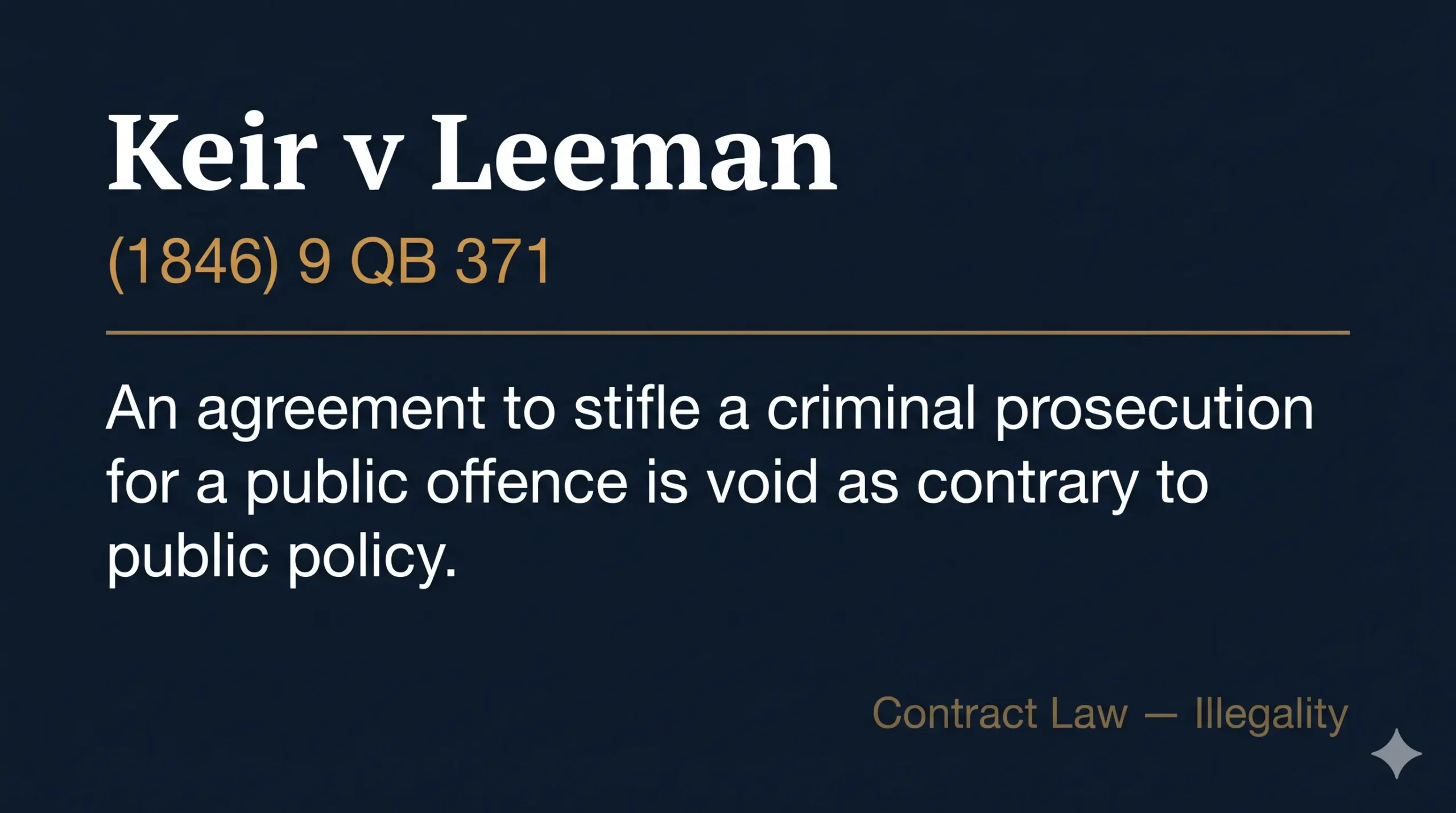
Keir v Leeman (1846) 9 QB 371: When an Agreement to Drop Charges Becomes Illegal

keir-v-leeman-1846-stifling-prosecution

Suppose a creditor has secured a judgment against a debtor, and in the process of enforcing it, the debtor's associates commit riot and attack a police officer. The creditor lays criminal charges. A third party then offers to pay the outstanding debt if the creditor drops the prosecution. The creditor agrees, abandons the charges, and the third party refuses to pay. Can the creditor sue to recover? That is precisely the question resolved in Keir v Leeman (1846) 9 QB 371. The answer was no. The Keir v Leeman agreement to stifle prosecution was held void as contrary to public policy,...

Continue reading

Non Est Factum in Nigerian Law: When Can You Escape a Signed Contract?

Non Est Factum in Nigerian Law: When Can You Escape a Signed Contract?

Have you ever signed a document without fully understanding what it was? Perhaps you were told it was one thing, but it turned out to be something completely different? In Nigerian contract law, there's a legal defense called "non est factum" that can protect you in such situations—but only under very specific circumstances. This guide explains what non est factum means, when you can use it, and how Nigerian courts decide whether someone can escape a contract they signed by mistake. What Does Non Est Factum Mean? Non est factum is a Latin phrase that literally means "it is not my deed." It's...

Continue reading

Mutual Mistake and Common Mistake in Nigerian Contract Law

Imagine you agree to buy a car from someone, and both of you believe the car exists in the seller's garage. Unknown to either of you, the car was stolen the night before. Can this agreement be enforced? This scenario illustrates one of the most important defenses in contract law: mistake. In Nigerian contract law, mistake occurs when one or both parties enter into a contract based on a false belief about important facts. Not every mistake will allow you to escape a contract, but certain types of mistakes are serious enough to make the contract either void (invalid from the...

Continue reading

Privity of Contract in Nigerian Law: Meaning, Exceptions, and Examples

Privity of Contract in Nigerian Law

What is Privity of Contract? Privity of contract is a fundamental common law principle establishing that only parties directly involved in a contract possess rights and obligations under that agreement. The doctrine ensures contractual relationships remain exclusive to signatories, preventing third parties from enforcing or being bound by contractual terms. The Nigerian Supreme Court affirmed this principle in Chuba Ikpeazu v. African Continental Bank (1965) NMLR 374, stating that generally, a contract cannot be enforced by a person who is not party to it, even if made for their benefit. Core Principles of Privity The doctrine operates on three essential foundations: 1. Binding Obligations: Only...

Continue reading

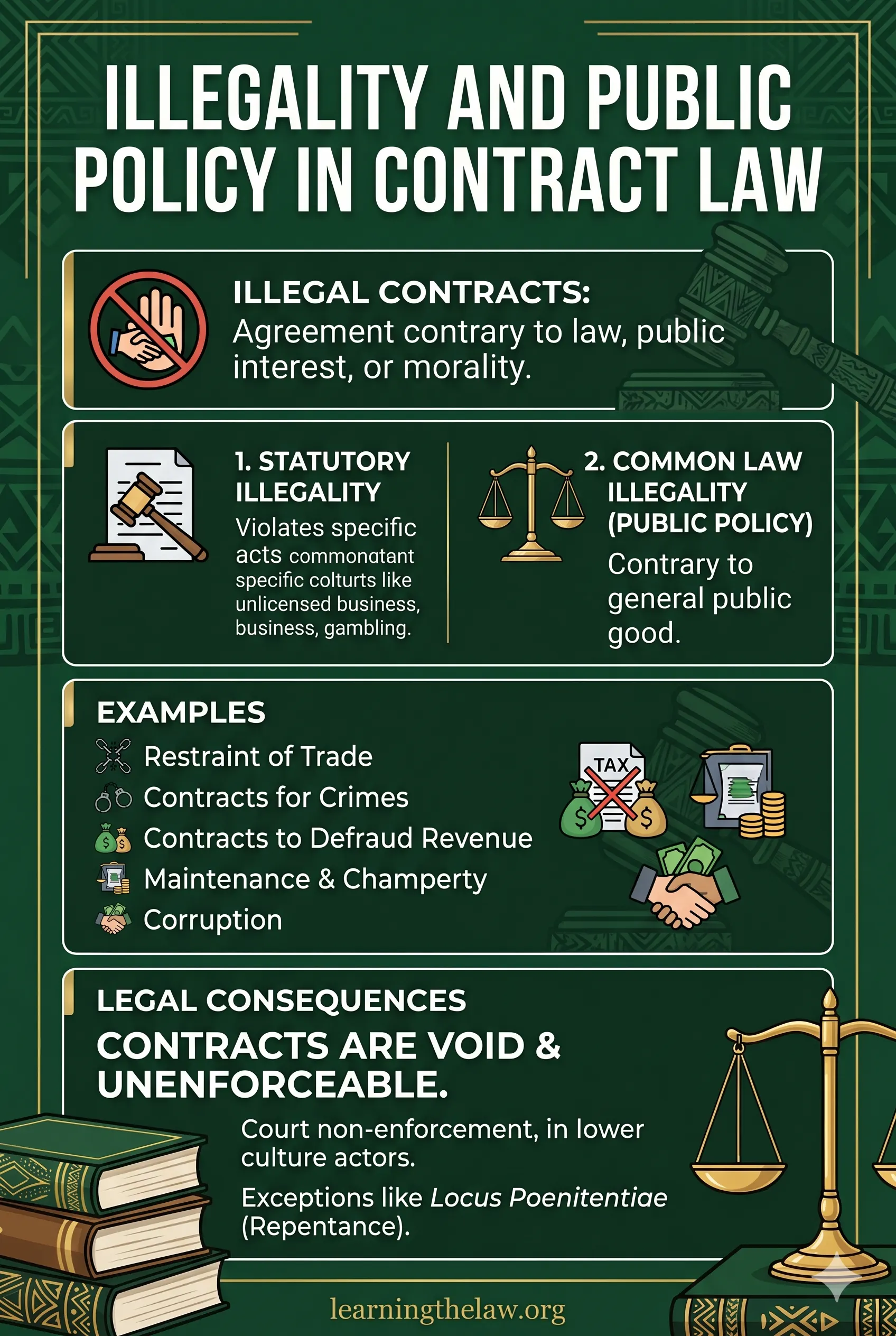
Illegality & Public Policy in Contract Law: Keir v Leeman Cases Explained

Illegality and Public Policy in Contract Law

Not all agreements, even if validly formed, will be enforced by the courts. The law recognises certain categories of contracts that, despite satisfying the basic requirements of offer, acceptance, consideration, and intention to create legal relations, are nonetheless unenforceable because they are either illegal or contrary to public policy. This principle reflects the fundamental truth that contract law exists not merely to facilitate private arrangements, but to serve the broader interests of society. As the Supreme Court of Nigeria declared in Nnadozie v Mbagwu,1 "a contract is illegal if the consideration or the promise involves doing something illegal or contrary to...

Continue reading

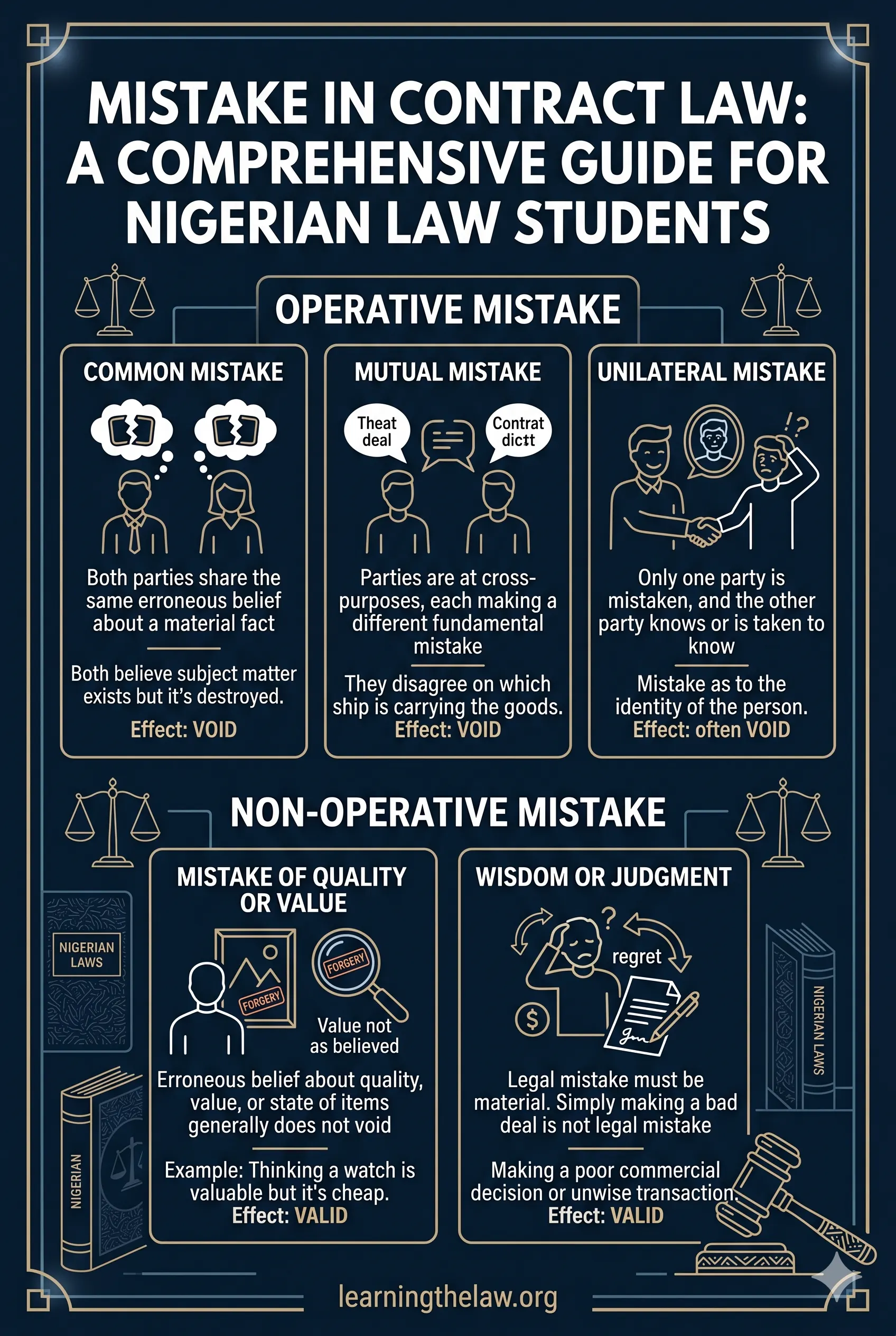
Mistake in Contract Law: A Comprehensive Guide for Nigerian Law Students

Mistake in Contract Law: A Comprehensive Guide for Nigerian Law Students

Mistake is one of the most intricate vitiating factors in contract law, raising fundamental questions about when parties should be bound by their apparent agreements. If one or both parties enter into a contract under some misunderstanding or misapprehension about a fundamental fact, in what circumstances will the law permit them to escape from their obligations? This question lies at the heart of the doctrine of mistake. The importance of mistake in Nigerian contract law cannot be overstated. In our commercial environment, parties frequently make assumptions about the subject matter of their contracts, the identity of those with whom they are...

Continue reading

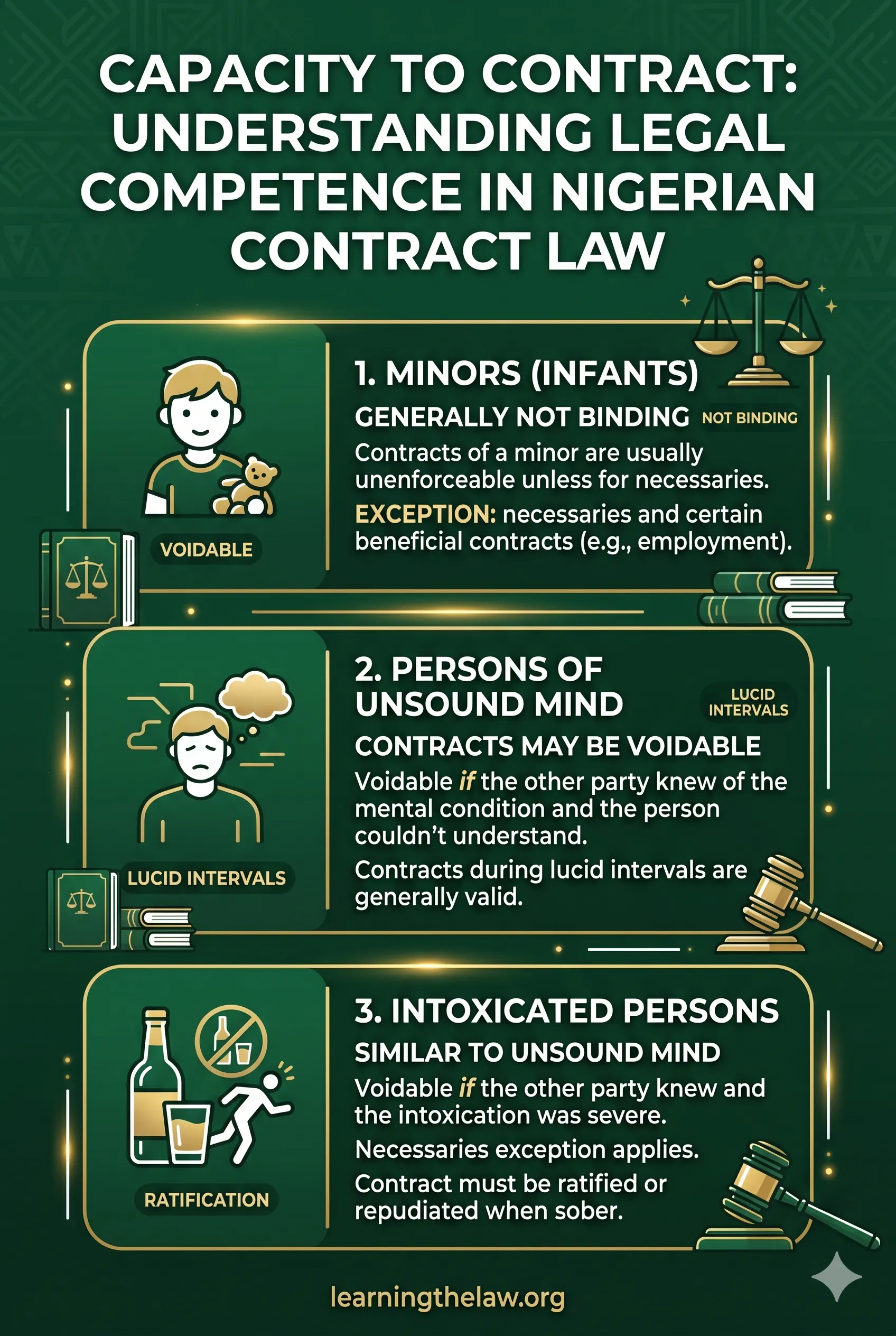
Capacity to Contract: Understanding Legal Competence in Nigerian Contract Law

Capacity to Contract: Understanding Legal Competence in Nigerian Contract Law

The freedom to contract is a fundamental principle of commercial law. However, not everyone possesses the legal capacity to enter into binding contracts. The law recognizes that certain categories of persons—by reason of age, mental condition, intoxication, illiteracy, or legal status—require protection from their own contractual undertakings or from exploitation by others. Consider these scenarios: A 15-year-old purchases a luxury car on credit. An illiterate farmer thumbprints a complex loan agreement he cannot read. A severely intoxicated person signs away property rights. A company director purports to bind the corporation to a contract outside its constitutional objects. Which of these contracts...

Continue reading

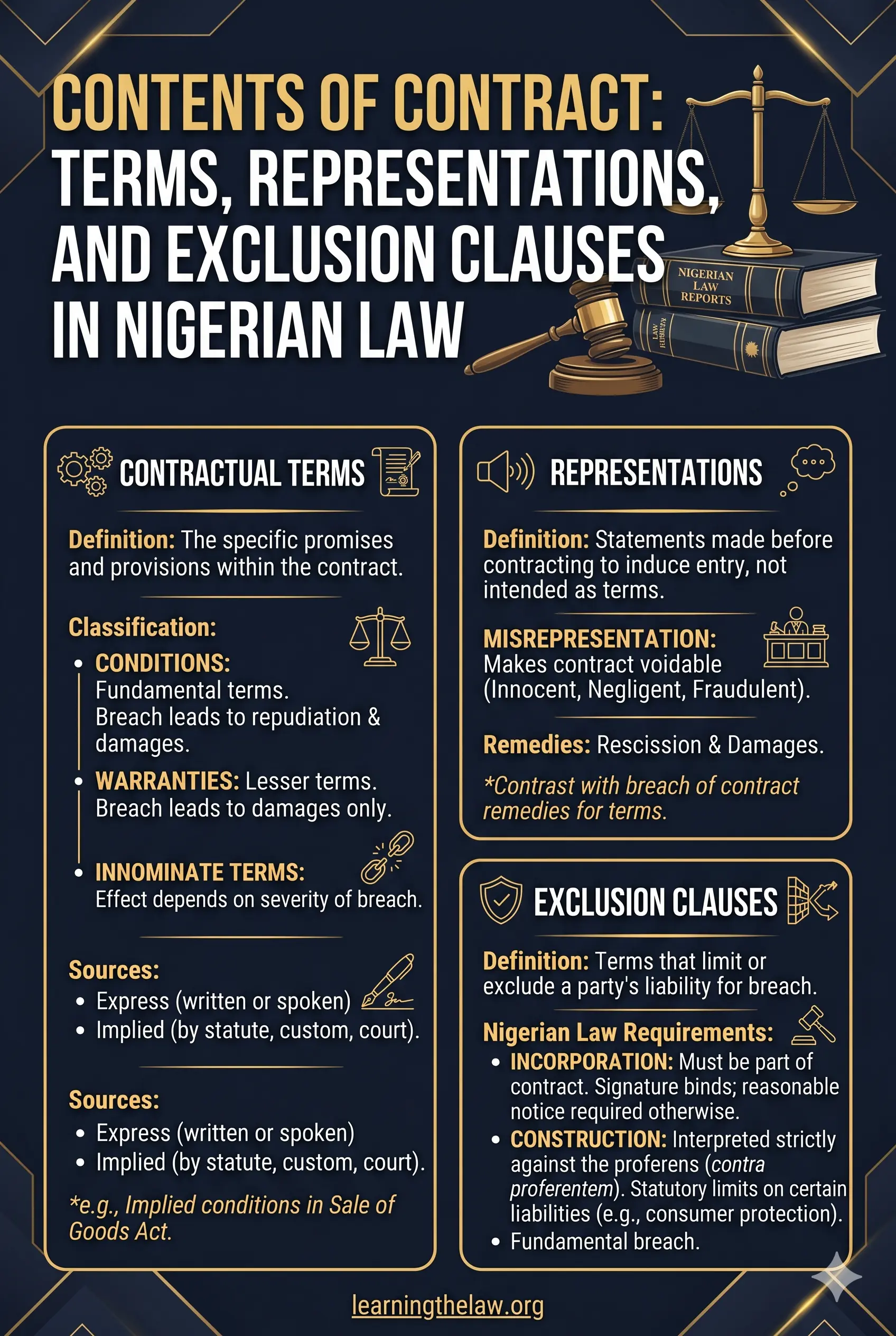
Contents of Contract: Terms, Representations, and Exclusion Clauses in Nigerian Law

Contents of Contract: Terms, Representations, and Exclusion Clauses in Nigerian Law

Once a valid contract has been formed through offer, acceptance, consideration, and intention to create legal relations, the next critical question becomes: what exactly did the parties agree to? The contents of a contract determine the rights and obligations of the parties, the scope of their commitments, and the remedies available for breach. Understanding contract contents is essential for second-year law students because disputes rarely arise from whether a contract exists, but rather from what the contract actually requires. Consider this scenario: A buyer purchases a car from a dealer. The dealer states that "this car is in excellent condition" and...

Continue reading

Privity of Contract: Understanding the Doctrine and Its Exceptions in Nigerian Law

Privity of Contract: Understanding the Doctrine and Its Exceptions in Nigerian Law

The doctrine of privity of contract stands as one of the fundamental principles governing contractual relationships in common law jurisdictions, including Nigeria. This doctrine establishes a clear boundary: only parties to a contract can enforce rights or be bound by obligations arising from that contract. For second-year law students, understanding this principle—and more importantly, its exceptions—is essential to grasping the practical realities of modern contract law. Consider a common scenario: A father enters into a contract with a builder to construct a house for his daughter as a wedding gift. The builder fails to complete the work. Can the daughter sue...

Continue reading

Join our Newsletter

Join 1,000+ law students and professionals. Get our top-rated class notes and legal analysis delivered straight to your inbox every Tuesday and Friday.

We don’t spam! Read our privacy policy for more info.