

Adoption in Nigeria: Statutory Framework, Procedure, and Customary Law
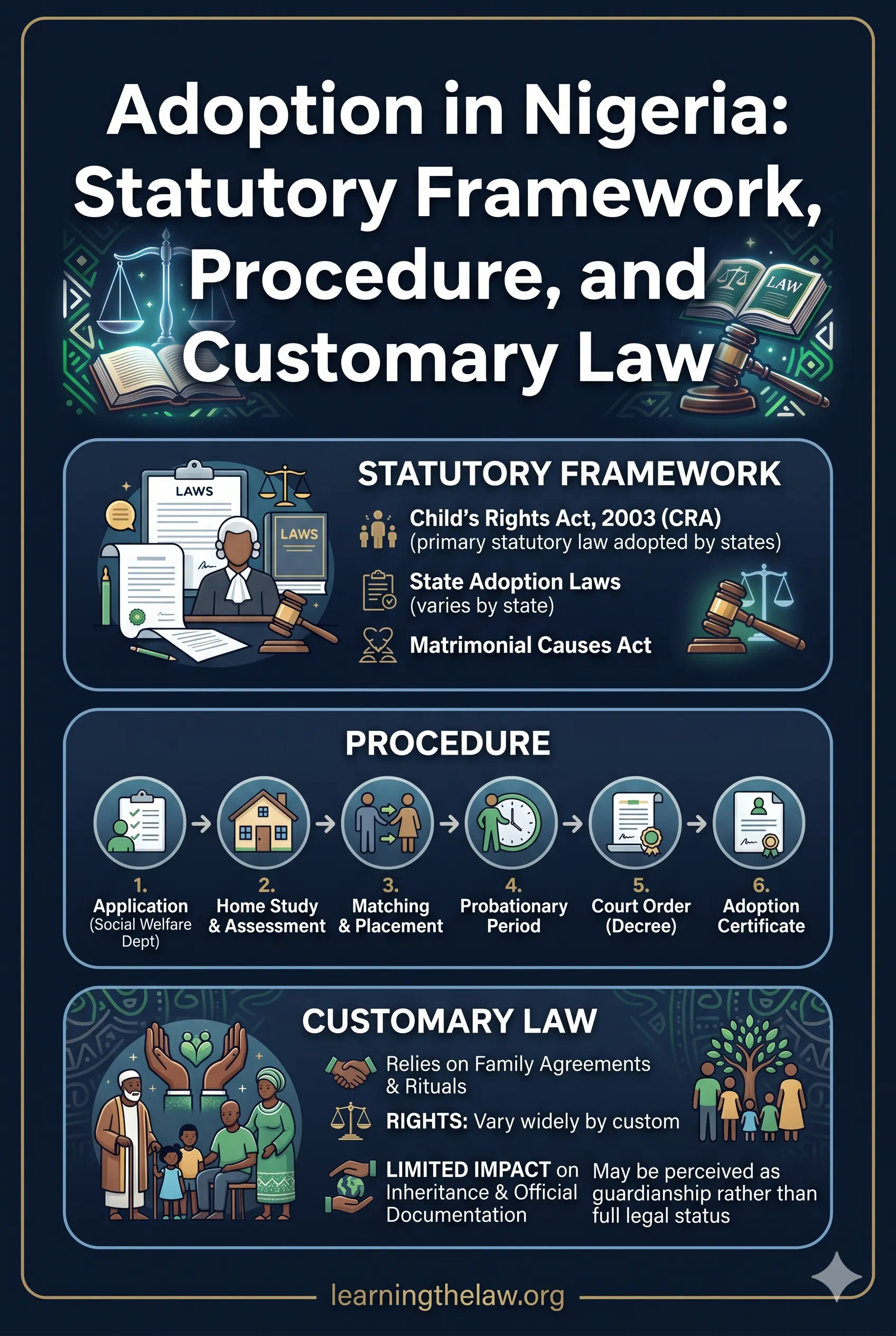
Adoption is a legal process which permanently transfers parental rights and responsibilities from a child’s biological parents to adoptive parents, thereby giving the child a new legal family. It is a way of providing new families for children who cannot be brought up by their biological parents — whether through death, abandonment, incapacity, or other circumstances.
Adoption is significant in Nigerian law for several reasons. It directly affects legal status — an adopted child loses all legal ties with their biological parents and acquires a new set of rights and obligations within the adoptive family. It affects succession and inheritance — an adopted child inherits from the adoptive parents as a biological child would. It affects marriage prohibitions — the adoption order creates a legal blood relationship between the adopted child and the adoptive family, such that the adopted child cannot marry the biological children of the adoptive parents.
Adoption in Nigeria may be effected under statutory law or under customary law. The rules, procedures, effects, and limitations differ significantly between the two, and both must be understood in the context of Nigeria’s pluralist legal system — for the broader framework of sources of law in Nigeria, including the interaction of customary law with received English law, see our dedicated note.
The relationship between adoption and the broader concepts of family status and legal capacity is also informed by the discussion in African Customary Law: Sources, Courts and Administration, particularly as it concerns the role of customary courts in determining personal law matters.
Part I: Statutory Adoption in Nigeria
Historical Development
Prior to 1965, there was no statutory adoption law in any part of Nigeria. This created significant hardship — even where couples took children into their households on the understanding they were being adopted, no legal adoption had occurred. At best, such arrangements amounted to foster parenthood or guardianship. The consequence was that the biological parents could at any time assert their rights by demanding the return of the child, leaving adoptive parents in a state of perpetual uncertainty over children they may have raised for years.
From 1958, the Federal Government sought to introduce adoption legislation, but adoption being a regional (and later state) subject, the Federal Government could not legislate for the entire country. Consultations with Regional Governments aimed at uniformity proved abortive.
The Eastern Nigeria Adoption Law 1965 was the first adoption legislation in Nigeria, coming into force on 20 May 1965. Following the creation of the twelve-state structure in 1967, Lagos State revived interest in adoption legislation, and in 1968 an adoption law was promulgated for Lagos State. Other states followed:
- Bendel State — 1979
- Cross River State — 1981
- Ogun State — 1983
- Oyo State — 1984
In the North, no state enacted adoption legislation — because Muslim law does not recognise adoption. This remains the position today in states governed primarily by Islamic personal law.
The Child Rights Act 2003
The Child Rights Act (CRA), Cap C50, LFN 2004 enacted at the federal level makes comprehensive provision for adoption and related matters — see in particular Sections 126–147 CRA. States that have domesticated the CRA through their own Child Rights Laws are governed by those state laws, which supersede earlier state adoption enactments. In states which have adoption legislation but have not yet enacted Child Rights legislation, the pre-2003 enactments remain in force.
The CRA is the primary framework discussed in this article where federal/general principles are concerned.
The Adoption Authority
The Social Welfare Office of the state where the child is located is the adoption authority. All applications for adoption originate from this office.
The Magistrate Court of the state where the child is located is the government office responsible for making adoption orders. Under the CRA, the jurisdiction to make adoption orders is vested in the Family Court at Magisterial level — see Section 126 CRA.
An application for an adoption order must be made in the prescribed form and submitted to the Registrar of a competent court.
The Role of the Guardian Ad Litem
Upon receiving an application for adoption, the court appoints a guardian ad litem for the juvenile — a child under the age of seventeen years — to represent the child’s interests in the adoption proceedings.
The person appointed as guardian ad litem is:
- The welfare officer in charge of the area where the juvenile resides; or
- A child development officer; or
- Some other person suitably qualified in the opinion of the court
The guardian ad litem represents the child’s interests until the Magistrate is able to interrogate the prospective adoptive parents and grant the adoption order. The guardian investigates the circumstances relevant to the proposed adoption and reports in writing to the court. This role is analogous to — though distinct from — the broader concept of the guardian ad litem in litigation generally, where a court appoints a representative for an incompetent or minor party in any lawsuit.
Persons Who May Be Adopted — Section 128 CRA
The rules on who may be adopted vary from state to state, but the following general principles apply:
- In Lagos State, the child must be under 17 years of age
- In Oyo State, the child must be under 18 years and must never have been married
- In Oyo State, an adoption order cannot be made in respect of a child who is not an indigene of the state
Abandoned children: In Lagos State, an adoption order may only be made in respect of a juvenile who is abandoned, or whose parents and other relatives are unknown or cannot be traced after due enquiry certified by a juvenile court. Ogun State’s law is similar, and also includes unwanted babies of unmarried mothers where putative fathers are unknown, not interested, or agreeable to adoption, and babies of insane mothers with no relatives willing to care for them and recommended for adoption by doctors.
Persons Who May Adopt — Section 129 CRA
The following general rules govern who may apply for adoption:
Joint application (married couple): A married couple may jointly apply. Each must have attained 25 years of age, and the adoption order authorises them jointly.
Married person applying alone: A married person may apply as a sole applicant if they have obtained the consent of the other spouse. This requirement is intended to preserve family harmony. The court may require such consent even where the statute does not expressly mandate it.
Single person: A single person may apply if they have attained 35 years of age, provided the child to be adopted is of the same sex as the adopter. A sole male applicant will not be permitted to adopt a female child unless there are exceptional circumstances which in the opinion of the court justify such an order — this is to guard against the danger of sexual corruption of the female child: Section 129(c) CRA.
General rule on multiple applicants: In no case other than a joint application by a husband and wife will more than one person be allowed to adopt a juvenile.
Restrictions on Making Adoption Orders — Section 131 CRA
The following restrictions apply to all adoption proceedings:
Age requirement: An adoption order will not be made unless the applicant — or in the case of joint applicants, at least one of them — is not less than 25 years of age and is at least 21 years older than the child.
Residence: Both the adoptive parents and the child to be adopted must be resident within the state where the application is made. Residence connotes some degree of permanence — it is not necessary to show that the applicant has a home in the state, but they must have a settled headquarters there.
Citizenship: The applicant must be a citizen of Nigeria. In the case of a joint application, both applicants must be citizens of Nigeria. Where one of the joint adopters is not a Nigerian citizen, an adoption order cannot be made.
Period in care: The child must have been in the care and custody of the applicant for at least three consecutive months immediately preceding the application for an adoption order — Section 131(1)(e) CRA. The purpose is to give the prospective adopter the opportunity to bond with the child and to allow the Social Welfare Officer to observe the relationship. The applicant must, within twelve months before the making of the order, have informed the social welfare officer of their intention to adopt.
No payment: The court must be satisfied that the applicant has not received or agreed to receive any payment or other reward in consideration of the adoption. Prospective adoptive parents are strongly advised to research any adoptive agency fully — some agencies use adoption as a commercial venture and engage in deception.
Good repute: The applicant must be a person of good repute and commendable character.
Welfare of juvenile: The court must be satisfied that if the adoption order is made, it will be for the maintenance, care, education, and welfare of the juvenile. Adequate consideration must be given to the wishes of the juvenile depending on their age and understanding.
The Role of the Social Welfare Officer
Once a child is placed with the prospective adoptive parents, the Social Welfare Officer undertakes a supervision role:
- Visits the home of the adoptive parents repeatedly until satisfied that the child is settled and the prospective parents are capable of caring for the child
- Reports in writing to the court with a positive recommendation after several visits
- The Magistrate thereafter meets the adoptive parents in court to confirm their suitability
The entire process — from placement to adoption order — can take from a few months to a few years, depending on the state.
Consent Requirements — Section 132 CRA
Parental Consent
Generally, no adoption order may be made unless each parent or guardian of the child agrees freely and unconditionally with full understanding of what the order involves.
Consent of a spouse: Where a husband or wife is a sole applicant, the court may require the consent of the other spouse. Where a person other than the parent or relative of the child has a right or obligation in respect of the child under a court order or customary law agreement, the court may also require that person’s consent.
Illegitimate children: In the case of an illegitimate child, the mother’s consent is required. The father of an illegitimate child does not automatically have consent rights, though the court may consider his position.
Identity of applicant: It is not necessary for the person giving consent to know the identity of the applicant for an adoption order. This protects the privacy of the adoptive parents where desired.
Consent is not transferable: A parent who has given consent to a pending adoption proceeding cannot withdraw the juvenile from the custody of the applicant without the leave of court. In determining whether to grant leave, the court will give due regard to the welfare of the child.
Dispensing with Parental Consent — Section 132(6) CRA
The court may dispense with parental consent in the following circumstances:
(a) The parent or guardian has not performed their natural or legal duties, or is incapable of giving consent, or is acting unreasonably
(b) The parent or guardian cannot be found or is incapable of giving their agreement
(c) The parent or guardian has abandoned or neglected the juvenile
(d) The child has been persistently ill-treated and rehabilitation within the household is unlikely
Exception within the first year of the Adoption Law’s commencement: A court may dispense with parental consent where an application was made within one year of commencement of the Adoption Law, if the juvenile has for a period of two years immediately preceding that date been brought up, maintained, and educated under a de facto adoption. The reasonableness of the parent’s attitude — not just the fact of withholding consent — is the fundamental question.
Interim Orders — Section 135 CRA
All adoption legislation in Nigeria provides for interim adoption orders. On application, the court may, instead of making a full adoption order, make an interim order for a probationary period not exceeding two years. The interim order may specify terms relating to:
- Maintenance
- Education
- Supervision
- Welfare of the juvenile
An interim order typically requires the juvenile to remain under the supervision of a welfare officer and not to be taken out of the state without the leave of court.
An interim order cannot be made where any of the restrictions on the making of a full adoption order exist — the interim order is subject to the same substantive conditions.
Taking the Child Out of Nigeria
After an adoption has been granted, the adoptive parents in some states must obtain the leave of court before taking the child out of the jurisdiction — whether temporarily or permanently.
In addition, a letter from the social welfare officer to the immigration officer — informing the immigration officer that the adoptive parents are now the legal parents of the juvenile — must be obtained before the adoptive parents can secure a passport to take the adopted child out of Nigeria.
Legal Effects of Adoption — Section 141 CRA
An adoption order has the following legal consequences:
(a) Vesting of parental rights in the adopter:
All rights, duties, obligations, and liabilities in relation to the future custody, maintenance, and education of the child vest in the adopter as if the child were born to the adopter in lawful marriage. Correspondingly, all such rights and duties of the biological parents — including any arising under customary law — are extinguished.
(b) Severance of biological ties:
The legal effect of an adoption order is to sever all parental rights and obligations between the child and the biological parents. The child becomes a full member of the adoptive family, usually taking the family’s name.
(c) Parent-child relationship:
The adopted child stands in relation to the adopter as a child born in lawful wedlock. This is complete and unqualified — the adopted child is not a second-class member of the adoptive family.
(d) Marriage prohibition:
An adopted child cannot marry the son or daughter of the adoptive parents — Section 147 CRA. The adoption order creates a legal blood relationship between the adopted child and the adoptive family, and the marriage prohibition follows from that legal kinship. This parallels the prohibited degrees applicable to biological families — see our note on Void and Voidable Marriages in Nigeria for the statutory prohibited degrees.
(e) Intestate succession:
On the death intestate of any person occurring after the making of the adoption order, the adopted child’s property rights devolve as if the adopted child were the lawful biological child of the adopter. Any reference in a will made after the date of the adoption order to the “child” or “children” of the adopter includes the adopted person. This extends equally to instruments inter vivos — the adopted child may also inherit under such instruments.
The Adopted Children’s Register — Section 142 CRA
Every adoption order directs the chief or principal registrar to make entries in the Adopted Children’s Register in the prescribed form, recording:
- Date of entry
- Name and sex of the adopted child
- Name, surname, addresses, and occupation of the adopters
- Date of birth of the adopted child
- Date of the adoption order
A certified copy of an entry in the Adopted Children’s Register, if stamped or sealed by the registrar’s office, constitutes proof of the adoption. Where an adoption order is revoked, the court transmits that information to the Registrar who arranges for the change to be reflected in the Register.
Part II: Adoption Under Customary Law
Islamic Law and Adoption
Muslim law does not recognise adoption. This is not a procedural gap — it is a substantive doctrinal position. Under Islamic jurisprudence, the legal parent-child relationship can only be established by blood or, in some schools, through acknowledged paternity. The concept of a legal stranger becoming a child’s parent through a formal legal process is not accommodated within the Islamic framework. For this reason, no northern state has enacted adoption legislation, and Islamic personal law applies in those states. See our note on Islamic Marriage in Nigeria for the broader framework of Islamic family law.
Customary Law Adoption: Forms
Adoption under customary law may be effected formally or informally.
Formal adoption:
A formal adoption under customary law involves a ceremony. Under some systems, a meeting of the families of the prospective adopter and the child to be adopted is held. At the meeting, a formal transfer of parental rights and obligations is carried out with the approval of both families. In other places, a meeting of the elders of the adopter’s family is convened, at which the adopter announces the intention to adopt and make the child their heir. The formal consent of the family is obtained and ceremonies are performed to initiate the child into the family.
In Re Martin: Martin v. Johnson and Henshaw, Webber CJ described the formal customary law adoption procedure as follows: “The adoption of a son under native law and custom is a ceremony to be performed to which the families are called to be witnesses in the ceremony. The adopter nominates his or her adoptee to the family and the ceremony is over.”
Informal adoption:
Informal adoption takes the form of the adopter taking into their household the child of a relative or an orphan, bringing the child up and treating them as one of their own children. If continued over a long period, this arrangement may mature into an adoption. The process is one by which foster-parentage matures in time into adoption.
In Akinwande v. Doqbo, X took the child of his deceased sister into his household and cared for the child over a long period, being responsible for the child’s upbringing and maintenance. The court held that the child was adopted by X under customary law. The court noted, however, a definitional difficulty — the same facts are capable of being regarded as evidence of either guardianship or adoption, which reflects one of the defects of customary law adoption.
Informal adoption may also arise where a widowed or divorced woman remarries and, with the consent of her new husband, brings her child from the former union into his household. The child is brought up by the step-father, whose name the child may take — and the relationship may mature into adoption with the passage of time.
Who may adopt under customary law:
Only males of full age are generally regarded as having the capacity to adopt children under customary law. The reason is that in most Nigerian customary law systems, men play the determining role in establishing family membership. A Nigerian who is married under the Marriage Act is not thereby deprived of the capacity to adopt children under customary law — the two systems are not mutually exclusive.
Under customary law, the consent of the natural parent is not mandatory — in contrast to statutory adoption, where parental consent is a core requirement. However, the consent of the person to be adopted is required — even under customary law, the adoptee’s agreement matters.
Adults may be adopted: Unlike statutory adoption, which is directed at children (juveniles under 17), customary law adoption does not universally restrict adoption to infants. In the absence of any contrary rule, it is possible to adopt an adult. The adoption of a married person is almost unknown, but the law does not in principle preclude it.
Effects of Adoption Under Customary Law
The effects of customary law adoption differ materially from statutory adoption in one critical respect — the severance of biological ties is incomplete.
(a) Name and legitimacy:
A child adopted under customary law usually takes the name of the adopter and is regarded as their legitimate child. The adopted child will succeed along with the other legitimate children of the adopter to the latter’s property.
(b) No complete severance of biological ties:
Unlike statutory adoption — where the adoption order severs all parental rights and obligations between the child and biological parents — customary law adoption does not affect a clear and permanent severance of the parental rights and obligations between the child and the natural parents.
The adopted child may succeed to property both in the family of the adopter and also in respect of the natural parents. The child retains inheritance rights in two families simultaneously. This is both an advantage and a source of legal uncertainty — the child’s membership of two families simultaneously creates questions about which family’s rules apply in any given dispute.
(c) Marriage prohibitions:
Customary law adoption creates sufficient family membership to engage the customary law prohibitions on marriage within the family. An adopted child would generally not be permitted to marry within the adoptive family in communities where such prohibitions are observed.
Comparative Overview: Statutory vs. Customary Adoption
| Feature | Statutory Adoption | Customary Law Adoption |
|---|---|---|
| Governing law | Child Rights Act / State Adoption Laws | Customary law of the relevant community |
| Court involvement | Mandatory — Magistrate Court | Not required (formal) or none (informal) |
| Parental consent | Generally mandatory (dispensable in specified cases) | Not mandatory; adoptee’s consent required |
| Age of adoptee | Under 17 (Lagos); under 18 (Oyo) | No fixed limit; adults may be adopted |
| Who may adopt | Married couple (25+); single person (35+, same sex) | Males of full age (generally) |
| Severance of biological ties | Complete — all ties severed | Incomplete — dual family membership possible |
| Intestate succession | Adopter’s estate only | Both adoptive and biological family |
| Marriage prohibition | Cannot marry adoptive family children (s.147 CRA) | Customary prohibitions apply |
| Islamic law | Not applicable (Muslim law rejects adoption) | Not applicable in Islamic law states |
| Register | Adopted Children’s Register (s.142 CRA) | None |
Guardianship Distinguished from Adoption
Adoption and guardianship are related but distinct concepts. Both involve a third party taking responsibility for a child. The key differences are:
Permanence: Adoption permanently extinguishes the biological parent-child relationship and creates a new legal one. Guardianship is a temporary or conditional arrangement — it can be terminated by the court, by the death of the ward or guardian, or by the ward attaining majority.
Legal status: An adopted child becomes the legal child of the adopter in all respects. A ward under guardianship does not acquire the legal status of the guardian’s child.
Succession: An adopted child inherits from the adoptive parents as a biological child. A ward under guardianship does not automatically inherit from the guardian.
Marriage: An adopted child cannot marry the biological children of the adoptive parents (s.147 CRA). A ward is not subject to this prohibition by reason of the guardianship alone.
For the full treatment of guardianship — including testamentary guardians, court-appointed guardians, guardians ad litem, and termination of guardianship — see our forthcoming note on Guardianship in Nigeria.
Key Cases Summary
| Case | Point |
|---|---|
| Re Martin: Martin v. Johnson and Henshaw | Formal customary adoption procedure described by Webber CJ |
| Akinwande v. Doqbo | Informal customary adoption — long-term care of deceased sister’s child |
Recommended Reading
- Nwogugu, E.I., Family Law in Nigeria (3rd ed.) HEBN Publishers, Ibadan, 2015 — Adoption: pp. 333–345
- Olomola, O., Family Law and Succession in Nigeria, Princeton Company Limited, Lagos, 2021
- Sagay, Itse, Nigerian Family Law, Malthouse Press, Lagos, 1999
- Child Rights Act, Cap C50, LFN 2004 — Sections 126–147
- Various State Adoption Laws (pre-2003, where Child Rights Act not domesticated)
This article is part of the Family Law II (LPP 306) series on learningthelaw.org. For the broader framework of Nigerian family law and the three types of marriage, see the Marriage and Divorce Law in Nigeria guide. For how customary law operates as a source of legal obligation in Nigeria, see African Customary Law: Sources, Courts and Administration and Sources of Law in Nigeria. For Islamic family law and the non-recognition of adoption under Muslim law, see Islamic Marriage in Nigeria. For the prohibited degrees of marriage — including how adoption-created kinship engages marriage prohibitions — see Void and Voidable Marriages in Nigeria. For dissolution of customary law marriage and the custody rules that often make adoption relevant, see Dissolution of Customary and Islamic Marriage.

Kolawole Adebowale is a law graduate of the University of Ibadan with a specialization in intellectual property law, digital patent enforcement, and software law. His research focuses on the intersection of technology and IP protection in Nigeria’s emerging digital economy, with comparative analysis spanning multiple jurisdictions. He is a member of the Law Students Association of Nigeria (LAWSAN) and the IP Association.