

The Tort of Nuisance in Nigerian Law: Generator Noise, Oil Spills, and Your Legal Rights
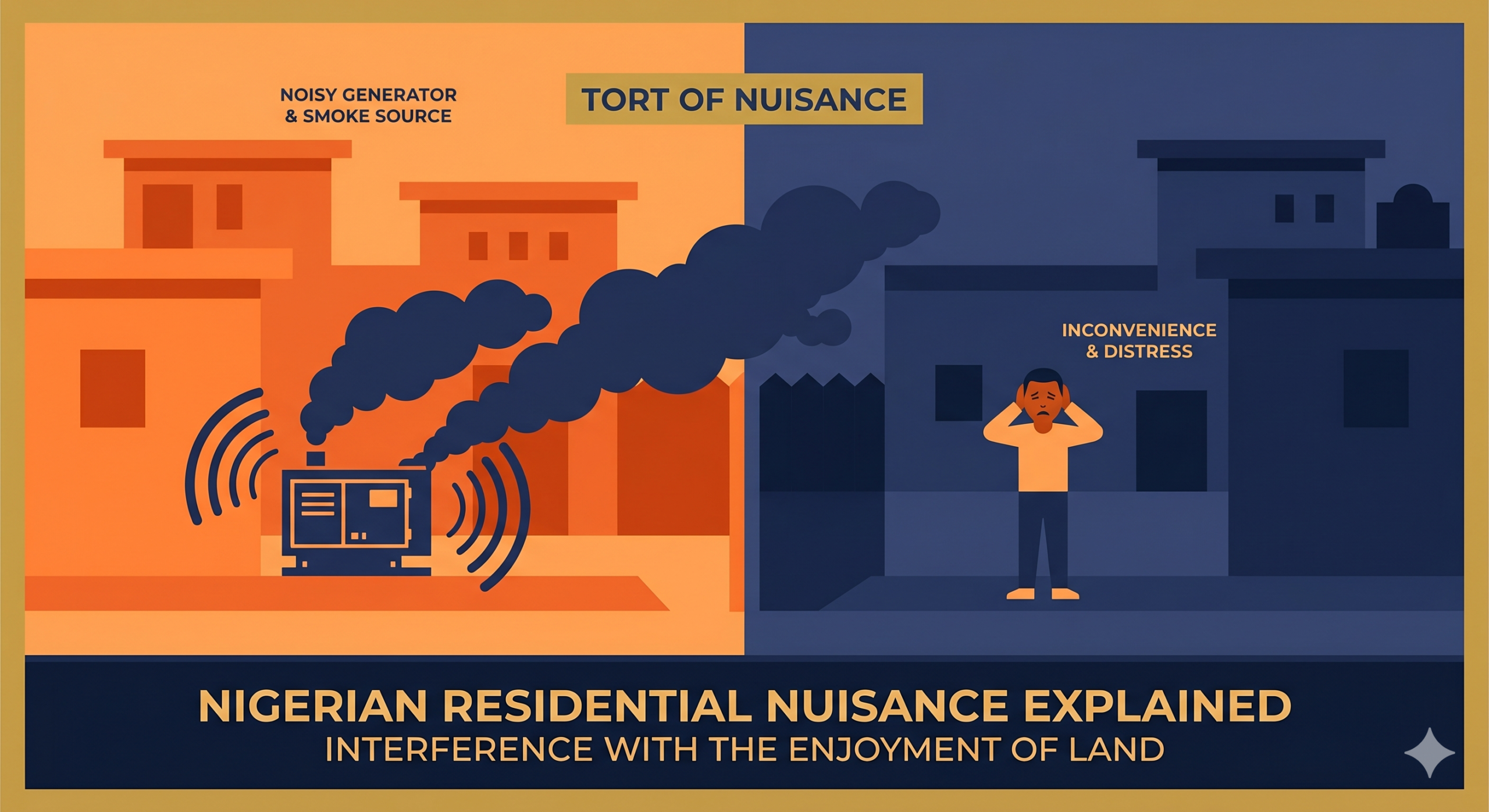
Picture this. You have just moved into a quiet residential estate in Lekki. Three weeks later, your neighbour sets up a commercial generator that runs from 6am to 11pm, six days a week. The fumes drift through your windows. Your children cannot sleep. Your concentration at work is shattered. You complain, informally. Nothing changes.
Or consider a different scenario. An oil company has been operating a pipeline through your community in Bayelsa for two decades. Over time, there have been spills. The farmland your family depends on is contaminated. Fish have disappeared from the creeks. The water is no longer safe. You have complained to the company. They promise to remediate. Nothing changes.
Both of these scenarios raise the same legal question: is this a nuisance the law can remedy?
The short answer is yes. The tort of nuisance is one of the oldest areas of Nigerian civil law, and it is directly relevant to the environmental and neighbourhood conflicts that millions of Nigerians experience in their daily lives. This article explains how it works, when you can sue, what you must prove, and what the courts can do for you.
What Is Nuisance?
The Supreme Court in Ipadeola v Oshowole (1987) NWLR (PT.59) 18 defined nuisance as an act or omission which is an interference with, disturbance of, or any annoyance to a person in the exercise or enjoyment of:
(a) a right belonging to him as a member of the public, when it is public nuisance; or (b) his ownership or occupation of land or of some easement, profit, or other right used or enjoyed in connection with land, when it is private nuisance.
Nuisance differs from trespass. Trespass is a direct physical invasion of your land, for example a neighbour who dumps refuse on your compound, or a developer whose workers walk across your plot without permission. Nuisance is indirect: it is the consequence of what the defendant does on their own land that crosses over and affects yours. The generator fumes that drift over your fence, the noise that penetrates your walls, the industrial chemical that seeps into your groundwater through soil, all of these are nuisances, not trespasses.
Types of Nuisance
Nuisance in Nigerian law falls into two main categories: public nuisance and private nuisance. There is also statutory nuisance, governed in Nigeria primarily by the National Environmental Standards and Regulations Enforcement Agency (NESREA) Act 2007, the National Environmental (Noise Standards and Control) Regulations 2009, and various state environmental laws.
Public Nuisance
A public nuisance is any act or omission that endangers or damages the life, health, property, morals, or comfort of the public, or obstructs the public in the exercise of rights common to all citizens.
Unlike private nuisance, public nuisance is also a crime, and the Attorney General may prosecute it. However, an individual may also bring a civil claim for public nuisance, provided they can show that they suffered particular damage over and above what the rest of the public suffered.
The Particular Damage Requirement
This requirement is critical and frequently misunderstood. The logic is straightforward: if everyone in a neighbourhood suffers equally from a noisy construction site on a main road, any one of them suing individually for a share of the general inconvenience would flood the courts with indistinguishable claims. The law therefore insists that your harm must be distinctly greater, or different in kind, from the harm suffered by the general public.
In Halsey v Esso Petroleum, the plaintiff’s car was physically damaged by acid smuts from the defendant’s factory. While many members of the public were generally inconvenienced by the fumes, the plaintiff’s car suffered concrete, measurable property damage. That was enough to establish particular damage.
In Savage v Akinrinmade, the defendant’s obstruction of a public street interfered specifically with the access of staff, parents, and pupils to the plaintiff’s school. While the general public was also inconvenienced, the plaintiff’s school was uniquely and substantially affected.
The Ogbia Community Case: A Lesson in What Does Not Suffice
In Amos v Shell BP (Nigeria) Ltd (1974) ECSLR 486, the defendants constructed a temporary dam across a public navigable creek in Rivers State during oil industry operations. The Ogbia Community sued, alleging that the dam caused flooding on their land and made it impossible to pass through the creek by canoe to transport goods to market.
The court dismissed the claim. The community had suffered collectively, but no individual had shown that he personally suffered damage over and above the general community harm. This remains one of the most instructive Nigerian cases on what public nuisance requires: collective suffering, even if severe, does not automatically translate to an individual legal claim.
The Constitutional Development: Adediran v Interland Transport
The landmark decision of Adediran v Interland Transport Ltd (1991) 9 NWLR (Pt. 214) 155 significantly expanded access to public nuisance claims in Nigeria. The Supreme Court held that the common law requirement that an individual can only sue in public nuisance if he has the Attorney General’s consent is inconsistent with section 6(6)(b) of the 1979 Constitution, which guarantees access to courts to every person with a justiciable cause of action. That restriction is therefore void in Nigeria.
This means that today, any Nigerian citizen can bring a public nuisance claim without first obtaining the Attorney General’s permission. They still need to show particular damage, but they no longer need to go through the government’s gatekeeping function.
Private Nuisance
Private nuisance is the more commonly litigated form of the tort. It protects your right to enjoy your land, your home, and your property from the unreasonable interference of others. In Cunard v Antifyre, private nuisance was defined as “interferences for a substantial length of time by owners or occupiers of property with the use or enjoyment of neighbouring property.”
What Makes an Act a Private Nuisance?
The court in Eholor v Idahosa explained that the conduct of a landowner only becomes a nuisance when its consequences extend beyond his own land and affect his neighbour by: (a) causing encroachment, which also becomes a trespass; (b) causing physical damage to the neighbour’s land or buildings; or (c) unduly interfering with the neighbour’s comfort and convenient enjoyment of the land.
Two conditions must be met for private nuisance liability:
- The injury or interference must be sensible (in the case of physical damage to property) or substantial (in the case of interference with enjoyment of land).
- The defendant’s conduct must be unreasonable in the circumstances.
Sensible Material Damage
Sensible material damage means damage that is not trifling or minimal and that causes a real reduction in the value or utility of the plaintiff’s property. The nature of the neighbourhood is irrelevant where there is physical damage to property. In St Helen’s Smelting v Tipping (1865) 11 HL Cas 645, the House of Lords held that even though the plaintiff lived in an industrial area, the fact that fumes from the defendant’s copper smelting works had physically damaged his trees and shrubs was enough to establish liability. The locality factor had no weight where actual physical damage was proved.
Nigerian courts applied this principle in Ige v Taylor Woodrow (Nig.) Ltd (1963) LLR 40, where pile-driving by a construction contractor in Lagos caused structural damage to a neighbouring building. The defendants were held liable despite the lawfulness of the construction activity. The key was the physical damage to the plaintiff’s property.
This principle is particularly significant in the context of oil company operations in Nigeria. Where oil spills or gas flaring causes actual physical damage to farmland, fishponds, or buildings, the locality argument (that this is an oil-producing area and such activities are normal) will not provide a defence.
Oil Spills and Nuisance: The Biggest Nigerian Cases
In June 2021, the Federal High Court in Abuja awarded N81.9 billion in damages against Mobil Producing Nigeria Unlimited and NNPC to oil-producing communities in Ibeno Local Government Area of Akwa Ibom State. Justice Taiwo Taiwo held that the defendants were negligent in the way they handled oil spills that caused environmental degradation in the communities. The judge specifically criticised NNPC for being more interested in revenue generation from oil exploration than in the welfare of the communities.
This case illustrates how nuisance and negligence frequently overlap in the context of industrial pollution, and how Nigerian courts are increasingly willing to hold major corporate actors to account for environmental harm.
Separately, in the Alame v Shell Plc litigation being heard in UK courts (which applies Nigerian law), the Bille and Ogale communities in the Niger Delta are pursuing claims in nuisance, negligence, and trespass for oil pollution. In a June 2025 preliminary judgment, the court found that the continued presence of unremediated oil on community land could constitute an ongoing breach of duty. The court held that claims in nuisance in respect of unremediated spills are viable under Nigerian law, subject to the applicable limitation periods under state statutes. This is a significant confirmation that Nigerian nuisance law applies to oil pollution cases even when heard before foreign courts.
Substantial Interference with Enjoyment of Land
The law is not intended to remedy trifles. An occasional noisy party, a dog that barks once a week, the smell of cooking from a restaurant next door, none of these will typically suffice. The interference must be substantial, measured against the standard of an ordinary, reasonable person with normal sensitivity.
Generator Noise: A Uniquely Nigerian Nuisance Problem
In no other country is the generator noise problem quite so acute as in Nigeria. With chronic electricity supply failures, diesel and petrol generators have become a normal part of Nigerian life. The law has had to grapple with when generator noise crosses the line from a reasonable response to a shared national problem into an actionable private nuisance.
The governing principle, confirmed in Nigerian courts, is that noise nuisance is assessed by the standard of the ordinary person in that particular Nigerian community. As one court memorably stated: “what is a nuisance in Bodija may not be a nuisance in Beere or Beyeruka.” A 5kVA domestic generator running for three hours in the evening in a Lagos residential estate is one thing. A 100kVA industrial generator running from dawn to dusk next to a residential building in Asokoro is quite another.
The National Environmental (Noise Standards and Control) Regulations 2009 set decibel limits for different zones in Nigeria: 45 dB(A) in quiet zones such as hospitals and schools, 55 dB(A) in residential areas during the day, and lower limits at night. Breach of these regulations can be strong evidence of actionable nuisance, even though the regulations provide their own enforcement mechanisms.
In Abiola v Ijoma (1970) 2 All NLR 268, the plaintiff and defendant were neighbours in a residential area in Surulere, Lagos. The defendant kept 400 chicken pens against the boundary wall. The court held that the excessive noise from the chickens in the early morning hours and the smells from the pens were an actionable nuisance. The judge noted: “I do not believe that the plaintiff is being fanciful in all his complaints of excessive noise and smells, and they are, in my judgement, more than a trifling inconvenience that an ordinary person living in that part of Surulere, which is a residential area, can be called upon to bear.”
In Tebite v Nigeria Marine and Trading Co (1971) 1 ULR 432, a lawyer whose office was next to a shipbuilding company’s workshop in Warri sued over excessive noise and noxious fumes. The court concluded that the defendant was “an extraordinary neighbour who produced noise which is a lot more than any noise that can be produced even in the noisiest Nigerian district.” Damages and an injunction were awarded.
In Moore v Nnado (1967) FNLR 156, excessive noise from the defendant’s palm wine bar interfered with the plaintiff’s enjoyment of his land. The court held that though the defendant’s use of his land was lawful, the plaintiff was equally entitled to quiet enjoyment of his property. The key factors considered were the time of operation, the intensity of the noise, and whether the noise was transitory or continuous.
Factors in Assessing Reasonableness
The central balancing exercise in private nuisance is reasonableness. Courts weigh the interests of the plaintiff against those of the defendant by examining:
Locality: Where the defendant’s activity takes place matters enormously. A blacksmith’s forge in a market area in Aba is different from a blacksmith’s forge in a residential estate in Maitama, Abuja. Note however that this locality factor only applies to interference with enjoyment of land, not to cases of actual physical damage to property.
Motive and Malice: Though motive is generally irrelevant in tort law, an activity that might otherwise be acceptable becomes unreasonable when done out of spite. If your neighbour in Ibadan runs his generator at maximum volume specifically to annoy you, that malicious purpose can convert what might otherwise be a tolerable noise into an actionable nuisance. See Christie v Davey (1893) 1 Ch 316 and Hollywood Silver Fox Farm v Emmett (1936) 1 All ER 825.
Abnormal Sensitivity: You cannot turn an otherwise lawful activity into a nuisance simply because your use of your own land is unusually sensitive. In Robinson v Kilvert (1889), a claim for damage to abnormally sensitive paper failed because ordinary paper would have been unaffected. In Nigeria: a recording studio that requires absolute silence has no claim against a neighbouring school’s general noise levels that would not affect an ordinary residential occupant.
Duration and Continuity: A one-off incident is generally not enough. Nuisance typically requires some degree of repetition or a continuous state of affairs. A single noisy party is unlikely to ground a nuisance claim; a recurring weekly event that disrupts sleep and work is another matter entirely.
Key Differences Between Public and Private Nuisance
| Feature | Public Nuisance | Private Nuisance |
|---|---|---|
| Nature | Usually an isolated act | Must be continuous or repetitive |
| Who can sue | Anyone with particular damage, no land interest needed | Only a person with an interest in land |
| Criminal liability | Yes, it is also a crime | No, it is only a tort |
| Personal injury recovery | Yes | No, only negligence covers personal injury |
| Examples | Blocking a public road; oil spill on a navigable creek | Generator noise; chicken farm smell; industrial fumes damaging crops |
Who Can Sue?
In Private Nuisance
You must have a legal, equitable, or statutory interest in the affected land to sue. This means owners, lessees, and holders of a statutory right of occupancy. A tenant of a flat in Port Harcourt whose sleep is disturbed by a neighbour’s generator can sue. The tenant’s visiting relative cannot.
This was confirmed in Maloney v Laskey (1907), where the wife of a tenant failed in her claim because she had no proprietary interest in the property herself. In Nigeria, this has practical implications: if you are living in a family compound without a formal legal interest in the land, your ability to sue in private nuisance may be limited, though you may still have a claim in negligence for personal harm.
In Public Nuisance
No interest in land is required. Any individual who can show particular damage over and above that suffered by the general public may sue. This is why public nuisance is the more appropriate cause of action in many environmental pollution and public infrastructure cases.
Who Can Be Sued?
The Creator of the Nuisance: Anyone who creates a nuisance may be sued, whether or not they currently occupy the premises.
The Occupier: The person in occupation of the land from which the nuisance emanates is primarily liable. An occupier who knowingly allows a nuisance to continue on their land is treated as having adopted it.
The Landlord: A landlord is liable where the nuisance was a foreseeable and probable result of the letting, or where the landlord authorised or ratified the nuisance. A landlord who rents a property in a residential area to a commercial generator rental company without restrictions, knowing the noise will affect neighbours, may face liability.
An Employer: An employer is vicariously liable for nuisances committed by employees in the course of their employment, as confirmed in Sedleigh-Denfield v O’Callaghan (1940).
Defences to Nuisance
Defences That Work
Statutory Authority: If an Act of the Nigerian National Assembly or State House of Assembly expressly or impliedly authorises the activity that constitutes the nuisance, the defendant may escape liability. However, this defence only extends to what the statute actually authorises. It does not cover activities that go beyond the statutory mandate, and it does not protect unreasonable conduct. In the Nigerian oil industry, oil companies sometimes invoke their operating licences as a form of statutory authority, but the courts have consistently held that a licence to operate does not authorise the company to cause unremediated pollution.
Act of a Stranger: If the nuisance was caused by the independent act of a third party, provided the nuisance was abated within a reasonable time.
Volenti Non Fit Injuria: If the plaintiff consented to the nuisance, the claim fails, provided the defendant was not also negligent.
Defences That Do Not Work
“I was here first”: The defendant cannot argue that the nuisance was already in existence when the plaintiff moved into the neighbourhood. In Bliss v Hall, a plaintiff who moved next to an existing factory still succeeded in nuisance. You do not lose your right to a quiet environment simply because the offending factory was there before you bought your house.
Public Benefit: The fact that a nuisance benefits the community is not a defence. In Bellew v Cement Co Ltd (1948), Ireland’s only cement factory was ordered to close despite the desperate national need for cement in the post-war reconstruction period. In Nigeria, this principle means that an oil company cannot avoid nuisance liability simply because the country needs the oil revenue.
The Defendant’s Conduct Was Lawful: An activity may be entirely lawful and still constitute a nuisance if it unreasonably interferes with the plaintiff’s enjoyment of their land. The palm wine bar in Moore v Nnado was operating lawfully. The shipbuilding company in Tebite was also acting lawfully. Lawfulness does not equal freedom from nuisance liability.
Remedies for Nuisance
Injunction: The most effective remedy. The court orders the defendant to stop, remove, or restrict the nuisance activity. Injunctions are particularly useful where the nuisance is ongoing, since damages alone would not prevent future harm. Courts will grant an injunction where damages would be an inadequate remedy, but they have discretion and will sometimes prefer damages where the nuisance is temporary or already resolved.
Damages: Compensation for past and present harm caused by the nuisance. Nuisance is not actionable per se: the plaintiff must prove actual damage. In the oil spill and industrial pollution cases, damages have run into billions of naira.
Abatement: A self-help remedy. You may physically abate a nuisance yourself, for example by cutting back a neighbour’s tree branches that overhang your compound, provided you do so without causing unnecessary damage and after giving notice where notice is practicable. Courts view self-help with caution and it is generally safer to seek judicial relief.
Frequently Asked Questions
Can I sue my neighbour for generator noise in Nigeria? Yes, if the noise is substantial, continuous, and unreasonable for an ordinary person in your neighbourhood to bear. The National Environmental (Noise Standards and Control) Regulations 2009 set specific decibel limits for residential areas. Breach of these limits is strong supporting evidence. You would need to document the noise levels, the frequency, and the impact on your daily life.
Can oil-producing communities sue oil companies for nuisance in Nigeria? Yes. Nigerian courts have awarded billions of naira in damages against oil companies for environmental degradation caused by oil spills. The Federal High Court in Abuja awarded N81.9 billion against Mobil and NNPC in 2021 for oil spill damage to Ibeno communities in Akwa Ibom. Nuisance claims are viable alongside negligence and trespass claims in such cases.
Does it matter that the nuisance existed before I moved into the neighbourhood? No. It is not a defence that you came to the nuisance. Your right to enjoy your property without unreasonable interference exists regardless of how long the nuisance has been in operation.
Can a tenant sue, or only the property owner? A tenant with a valid tenancy agreement has a sufficient interest in land to sue in private nuisance. A guest, visitor, or family member living in the property without their own legal interest cannot sue in private nuisance, though they may have other claims in negligence for personal injury.
Conclusion
The tort of nuisance is not an obscure legal doctrine. It is the legal framework that determines whether a community in the Niger Delta can hold an oil company accountable for contaminating its farmland, whether a Surulere resident can restrain a neighbour from running a poultry farm against the boundary fence, and whether a Wuse resident can stop an industrial workshop from making her home uninhabitable with noise and fumes.
Understanding nuisance means understanding the balance the law strikes between the freedom to use your land as you see fit and the responsibility not to make your neighbour’s life unreasonable in the process. That balance is not always easy to strike, and the locality factor means that what is actionable in Maitama may not be actionable in Mushin. But the principle is clear: live and let live, but do not make your neighbour’s life miserable in the process.
For further reading, see our articles on Negligence in Torts and Death as a Cause of Action. For context on environmental rights under Nigerian constitutional law, see our article on Federalism in Nigeria.
References:
- Kodilinye and Aluko, The Nigerian Law of Torts (Spectrum Books, Lagos, 1995)
- Ese Malemi, Law of Tort (Princeton Publishing Company, 2013)
- National Environmental (Noise Standards and Control) Regulations 2009
- Alame and ors v Shell Plc [2025] EWHC 1539 (KB)
- Ibeno Communities v Mobil Producing Nigeria Unlimited and NNPC, Federal High Court, Abuja (June 2021)
- Adegbite, “Torts of Nuisance in Nigeria and the Relative Standard of Proof Per Locality,” African Journal of Law and Human Rights, Vol. 6(2) 2022

Kolawole Adebowale is a law graduate of the University of Ibadan with a specialization in intellectual property law, digital patent enforcement, and software law. His research focuses on the intersection of technology and IP protection in Nigeria’s emerging digital economy, with comparative analysis spanning multiple jurisdictions. He is a member of the Law Students Association of Nigeria (LAWSAN) and the IP Association.