

Negligence in Torts: Elements, Duty of Care, and Nigerian Case Law Explained
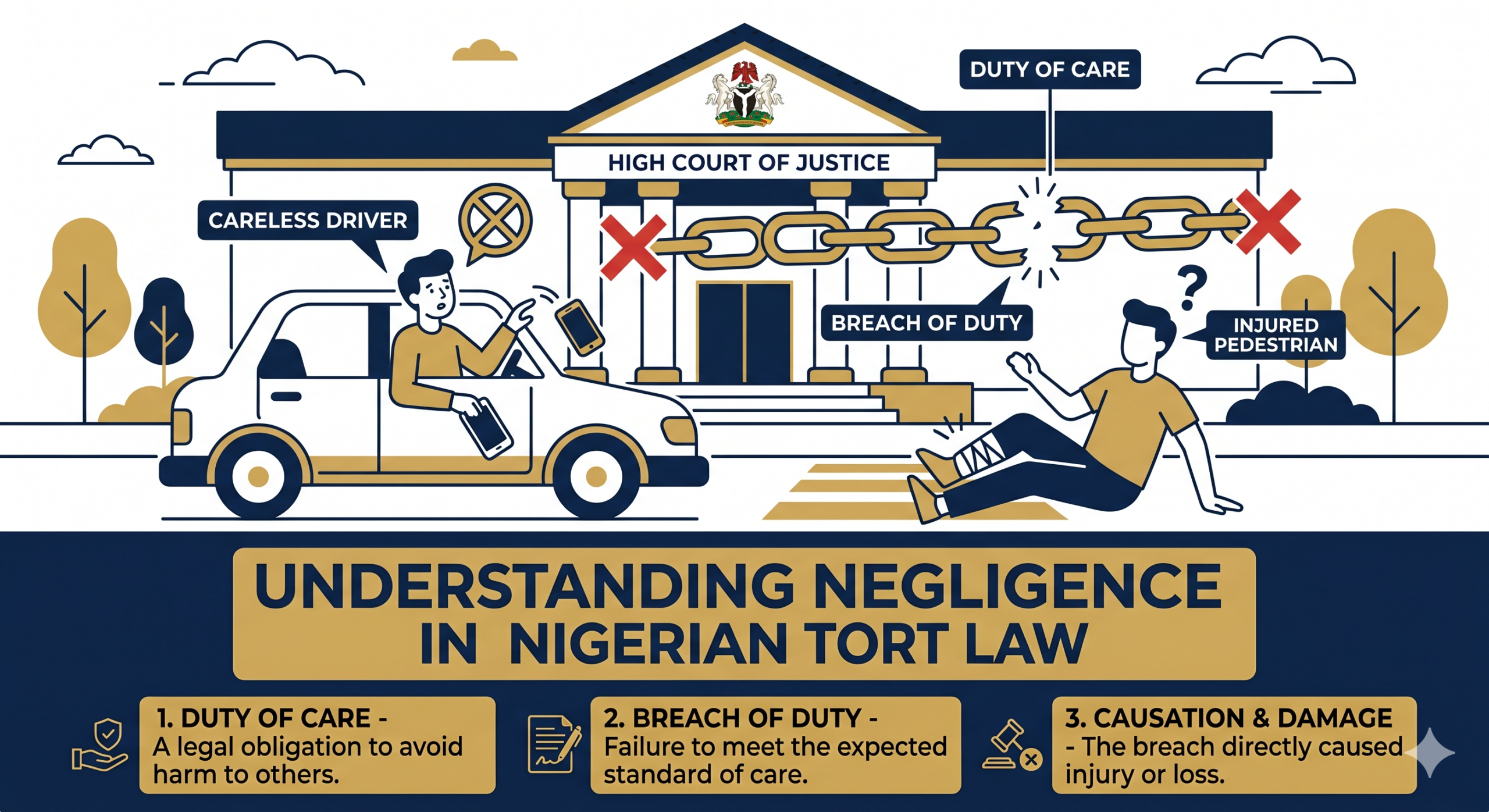
Think about the last time you were stuck behind a danfo driver swerving dangerously on the Lagos-Ibadan Expressway. Or think about the reports you have seen of patients dying after surgery at a public hospital due to what their families describe as careless treatment. Or the stories of children electrocuted by exposed NEPA cables left dangling by the roadside.
All of these situations have one thing in common: they may give rise to an action in the tort of negligence.
Negligence is the single most important tort in Nigerian law today. It provides a legal remedy for persons who suffer harm because of the careless conduct of another, whether that other person is a driver, a doctor, a building contractor, an electricity company, or even the government. Unlike torts such as trespass, which require proof of an intentional act, negligence focuses entirely on whether the defendant failed to meet a standard of care that the law required of him.
The tort of negligence as we know it today traces its roots to the landmark English decision in Donoghue v Stevenson (1932) AC 562, where Lord Atkin articulated the famous “neighbour principle” and gave birth to the modern law of negligence. Nigerian courts have adopted and built upon these principles, adapting them to the realities of Nigerian society. Decisions such as B.C. Ziks Press Ltd v Alabi (1951) 13 WACA 188 and more recently NEPA v Mallam Muhammad Auwal (2020) 1 ELR 150 confirm that these principles are alive and actively enforced in Nigerian courts.
To succeed in an action for negligence in Nigeria, a plaintiff must establish four things:
- The defendant owed him a duty of care.
- The defendant breached that duty.
- The breach caused the plaintiff’s damage.
- The damage was not too remote.
Each of these elements is discussed in detail below.
1. Duty of Care
The duty of care is the gateway to any negligence claim. If the plaintiff cannot show that the defendant owed him a legal duty of care, the case fails at the very first hurdle, no matter how badly the plaintiff was hurt or how careless the defendant’s conduct was.
The Neighbour Principle: Lord Atkin’s Test
In Donoghue v Stevenson, Lord Atkin stated the neighbour principle in terms that remain the foundation of modern negligence law:
“You must take reasonable care to avoid acts or omissions which you can reasonably foresee would be likely to injure your neighbour. Who, then, in law is my neighbour? The answer seems to be persons who are so closely and directly affected by my act that I ought reasonably to have them in contemplation as being so affected when I am directing my mind to the acts or omissions which are called in question.”
The case itself arose from a woman who became ill after drinking ginger beer from an opaque bottle that contained a decomposed snail. She could not sue in contract because she had not bought the drink herself. Lord Atkin held that the manufacturer owed her a duty of care as a consumer, because it was reasonably foreseeable that carelessness in the manufacturing process would harm the ultimate consumer of the product.
Translating this to a Nigerian setting: if a food company in Onitsha negligently packs contaminated jollof rice for sale in supermarkets and a consumer in Abuja falls ill after eating it, that consumer may have an action in negligence against the manufacturer, even though there is no contract between them. The neighbour principle bridges that gap.
Tests for Establishing a Duty of Care
Nigerian courts apply three main tests when determining whether a duty of care exists.
Reasonable Foreseeability: Would a reasonable person in the defendant’s position have foreseen that his conduct could cause harm to the plaintiff? A driver who speeds through a busy market in Kano can clearly foresee that his conduct could injure pedestrians. A road construction company that digs up a major road at night in Ibadan without placing warning signs can foresee that a motorist might fall into the trench. Foreseeability is the starting point, but it is not always enough on its own.
Proximity: There must be a sufficiently close relationship between the parties. This does not necessarily mean physical closeness. A doctor and patient have proximity. A bank and its customer have proximity. The electricity distribution company and the residents of the neighbourhood it serves have proximity.
The Caparo Three-Stage Test: From Caparo Industries Plc v Dickman (1990) 2 AC 605, the court identified three requirements: the harm must be reasonably foreseeable; there must be a relationship of proximity; and it must be fair, just, and reasonable to impose a duty. Nigerian courts have adopted this approach in complex cases, particularly those involving economic loss or professional liability.
In the Nigerian case of Okafor v Benson (1972) 1 All NLR 98, the court confirmed that a duty of care arises when there is a foreseeable risk of harm and a sufficiently close relationship between the parties.
Common Duty-of-Care Relationships in Nigeria
Understanding where a duty of care exists is practically important because these are the situations most likely to give rise to negligence claims in Nigerian courts.
Road Users and Fellow Road Users
Nigerian roads are among the most dangerous in the world, and road accidents are the most common source of negligence claims in the country. Every driver owes a duty of care to other motorists, passengers, and pedestrians. In Oyelowo v De Bank Transport Ltd (1973) 2 WSCA 35, the court confirmed this duty and applied it to a truck driver who pulled out of a roadside park without warning and caused a collision.
This is not an abstract principle. When a commercial motorcycle rider (okada) in Owerri carries a passenger and causes an accident through reckless riding, that passenger has a cause of action in negligence. When a tanker driver causes an accident on the Third Mainland Bridge, the victims or their families can sue the driver and his employer.
Electricity Companies and Members of the Public
This is perhaps the most visible category of negligence in Nigerian life, given the history of NEPA (now the various electricity distribution companies) and the harm caused by electrical infrastructure.
In N.E.P.A. v Auwal, the Supreme Court ordered NEPA to pay N10 million in damages after its servants negligently dropped uncovered electrical wires on the ground and a ten-year-old boy stepped on them and was electrocuted. The court held that NEPA owed a duty of care to members of the public who came into contact with its infrastructure.
More recently, in a widely reported case decided by the High Court in Damaturu, Yobe State, the court awarded N200 million jointly and severally against MTN Nigeria Ltd and the Nigeria Electricity Liability Management Company (NELMCO) in favour of Hamsatu Abdullahi, a girl who was electrocuted as a result of the defendants’ negligence in siting an MTN mast and 33kv power line near the plaintiff’s family home without adequate protection. The court held that both the telecommunications company and the electricity management company owed the plaintiff a duty of care and had breached it, resulting in the amputation of both her hands and one leg. This award, which included N10 million for loss of earnings, N10 million for pain and suffering, N10 million for loss of capacity for enjoyment of life, and N150 million in general damages, is one of the most significant negligence awards in recent Nigerian legal history.
To successfully establish a negligence case against an electricity distribution company in Nigeria, you must show: that the company owed you a duty of care; that it breached that duty (for example, by leaving live wires exposed without warning signs, insulating material, or fencing); and that you suffered damage as a result. See NEPA v Mallam Muhammad Auwal (2020) 1 ELR 150.
Employers and Employees
An employer owes a non-delegable duty of care to his employees. This includes the duty to provide a safe place of work, safe and serviceable equipment, a competent workforce, and a safe system of work. In the Nigerian workplace context, this duty is routinely litigated in relation to factory accidents, oil field injuries, and construction site mishaps. An employee who sustains injuries because his employer failed to provide protective equipment or maintain safe machinery has a strong negligence claim.
Doctors, Hospitals, and Patients
Medical negligence is a growing area of Nigerian tort law. A doctor and hospital owe a duty of care to every patient who comes under their care. In First Bank Nigeria Plc v Banjo, the elements of negligence were described as applying equally to the professional context: duty of care, breach, and causation.
Medical negligence in Nigeria arises from situations including failure to admit a patient whose condition requires hospitalisation, leaving a surgical instrument or swab in the body of a patient after an operation, failure to cross-match blood before transfusion, failure to diagnose a condition that a reasonably competent doctor would have detected, and using a patient for experimental purposes without consent. Despite the frequency of such incidents, Nigerian courts continue to note that medical negligence is underlitigated because of the cost of litigation, delay in the courts, and lack of awareness of legal rights. This is an important gap for law students and practitioners to understand.
Manufacturers and Consumers
Following Donoghue v Stevenson, manufacturers owe a duty to the ultimate consumer to ensure their products are free from dangerous defects. In Nigeria, this applies to food and beverage manufacturers, pharmaceutical companies, and producers of consumer goods. The consumer does not need a contract with the manufacturer to sue; the duty arises in tort.
Occupiers and Visitors
An occupier of premises owes a duty of care to persons entering their premises. A shopping mall in Victoria Island, a hotel in Abuja, or a church in Port Harcourt each owes a duty to their visitors. Where a visitor is injured by a hazard that the occupier knew about or should have known about, and failed to remedy or warn visitors of, an action in negligence may lie.
2. Breach of Duty
Once a duty of care is established, the plaintiff must prove that the defendant breached it. A breach occurs when the defendant falls below the standard of care that the law requires in the circumstances.
The Reasonable Man Test
The standard is objective: it is the standard of the “reasonable man,” meaning a hypothetical person of ordinary prudence who takes reasonable care. The question is not what the defendant personally thought was acceptable, but what a reasonable person in his position would have done.
Baron Alderson defined negligence in Blyth v Birmingham Waterworks Co (1856) 11 Exch 781 as “the omission to do something which a reasonable man, guided upon those considerations which ordinarily regulate the conduct of human affairs, would do, or doing something which a prudent and reasonable man would not do.”
In practical Nigerian terms: a “reasonable driver” does not overtake on a blind bend on the Enugu-Port Harcourt highway. A “reasonable doctor” does not discharge a patient from hospital before confirming that the wound is properly healed. A “reasonable contractor” does not leave construction materials scattered on a public path at night without any warning light or barrier.
If the defendant’s conduct falls short of this standard, he is in breach.
Factors the Court Considers in Assessing Breach
The Probability of Harm: The more likely it is that harm will result from the defendant’s conduct, the more the defendant must do to guard against it. A fuel tanker driver carries greater inherent risk than an ordinary car driver. The precautions required of him are correspondingly higher.
The Gravity of the Potential Harm: The more serious the potential injury, the greater the precautions required. In Paris v Stepney Borough Council (1951) AC 367, an employer was found negligent for failing to provide goggles to a one-eyed worker. Though the risk was small, the consequence of injury was catastrophic for someone with only one functioning eye. Nigerian employers handling explosives, chemicals, or heavy machinery are subject to this heightened standard.
The Cost and Practicability of Precautions: Where it is cheap and easy to guard against a risk, failure to do so is much more likely to constitute a breach. Electricity companies, for example, are regularly held to have breached their duty where the installation of a simple fence or warning sign around dangerous infrastructure would have prevented harm.
The Social Utility of the Activity: Courts may be slower to find a breach where the defendant’s activity serves an important social purpose, such as emergency surgery or fire fighting. However, this factor does not excuse careless conduct, it simply affects how the balance is struck.
Professional Standard of Care
Where the defendant holds himself out as having a special skill, he is judged by the standard of a reasonably competent practitioner of that skill, not by the standard of the ordinary man on the street. A doctor is judged by the standard of a reasonable doctor. An engineer is judged by the standard of a reasonable engineer.
The leading formulation comes from Bolam v Friern Hospital Management Committee (1957) 1 WLR 583, where McNair J held that a medical professional is not negligent if he acts in accordance with a practice accepted as proper by a responsible body of medical opinion, even if other doctors would have acted differently. Nigerian courts have adopted this principle in medical negligence cases.
This means that a doctor in Lagos who follows the standard treatment protocol for a condition is not negligent simply because a different protocol exists. However, if his conduct falls below any accepted standard in the profession, there is a breach.
3. Causation
Establishing duty and breach is not enough. The plaintiff must also show that the defendant’s breach caused the damage suffered. If the damage would have occurred anyway regardless of the defendant’s negligence, the claim will fail.
Factual Causation: The “But For” Test
The starting point is the “but for” test: but for the defendant’s breach, would the plaintiff have suffered this damage? If the answer is no, the breach is a cause of the damage. If the answer is yes (meaning the damage would have happened anyway), there is no causation.
This test was applied in Barnett v Chelsea and Kensington Hospital Management Committee (1969) 1 QB 428, where a doctor negligently sent away a patient complaining of stomach pains without examining him. The patient subsequently died. However, the court held that the doctor was not liable because the patient had consumed arsenic for which there was no available antidote. He would have died even if the doctor had examined him properly. The breach was established, but causation was not.
In the Nigerian context: if a hospital negligently delays treating a road accident victim for two hours, and the victim dies, the family must show that but for that delay the victim would not have died. If medical evidence establishes that the injuries were unsurvivable regardless of any treatment, the causation link is broken.
Material Contribution
Where the strict “but for” test produces an unjust result, particularly in cases involving multiple causes, the courts may find causation where the defendant’s breach materially contributed to the risk of the harm occurring. In McGhee v National Coal Board (1973) 1 WLR 1, the House of Lords accepted this approach in a case where exposure to coal dust materially increased the risk of a skin disease.
Remoteness of Damage
Even where factual causation is proved, the defendant is only liable for damage that was a reasonably foreseeable consequence of his breach. This is the rule of remoteness, established in The Wagon Mound (No. 1) (1961) AC 388. Damage of an entirely unforeseeable type is too remote to be recovered.
Nigerian courts consistently apply this principle. In Oyelowo v De Bank Transport Ltd, the court confirmed that the defendant is liable only for the foreseeable consequences of his negligent act, not for every consequence that follows in a chain from the breach.
4. Damage
Negligence is not actionable per se. The plaintiff must prove actual damage. There is no negligence claim without loss.
Types of Recoverable Damage
Personal Injury: Physical harm to the plaintiff’s body, including pain and suffering, loss of amenity, and medical expenses. This is the most commonly litigated form of damage in Nigerian negligence cases, particularly from road accidents.
Property Damage: Harm to the plaintiff’s tangible property, such as a car destroyed in an accident or equipment damaged by a contractor’s negligence.
Economic Loss: Pure economic loss (that is, financial loss unconnected to personal injury or property damage) is generally not recoverable in negligence, with important exceptions. Where a professional gives negligent advice that causes the plaintiff to suffer pure financial loss, an action may lie under the principle of Hedley Byrne and Co. Ltd v Heller and Partners Ltd (1964) AC 465. A lawyer who negligently advises a client on a property transaction, or a bank that negligently provides a false credit reference, may face liability in this category.
Psychiatric Harm: Recognised psychiatric illness caused by the defendant’s negligence may be recoverable, though the courts apply specific rules about who can claim for psychiatric harm arising from witnessing traumatic events.
Standard of Proof
The plaintiff must prove damage on the balance of probabilities. In Nigerian courts, medical evidence, police accident reports, and documentary evidence of financial loss are the typical tools for establishing this element.
Remedies for Negligence
The principal remedy is an award of damages, intended to restore the plaintiff as nearly as possible to the position he would have been in but for the tort.
General Damages are awarded for non-pecuniary losses: pain and suffering, loss of amenity, and loss of expectation of life. In the MTN/NELMCO electrocution case, for instance, N150 million was awarded as general damages to reflect the permanent disability inflicted on the young plaintiff.
Special Damages are awarded for specific, quantifiable financial losses: medical expenses already incurred, loss of earnings, and costs of care. These must be pleaded and proved with precision.
Nominal Damages are available where the plaintiff has suffered no substantial harm but a legal right has technically been infringed.
In appropriate cases, an injunction may also be available, for example to prevent an ongoing negligent activity from continuing.
Frequently Asked Questions
Can I sue NEPA or a power distribution company for electrocution in Nigeria? Yes. Where the electricity company’s negligence (such as leaving exposed wires, failing to maintain infrastructure, or siting dangerous equipment near residential areas without protective measures) caused your injury or that of your family member, you have a potential claim in negligence. You must show that the company owed you a duty of care, breached it, and that the breach caused your damage. Recent Nigerian courts have awarded substantial damages in such cases, including the N200 million award against MTN and NELMCO in Yobe State.
Can a patient sue a Nigerian hospital for medical negligence? Yes. A doctor and hospital owe a duty of care to every patient who comes under their care. If your injury or illness was caused by a failure to meet the standard of a reasonably competent medical practitioner, you may have a negligence claim. However, litigation is slow and costly in Nigeria, and expert medical evidence is usually required.
What is the difference between negligence and intentional torts? Negligence does not require proof that the defendant intended to cause harm. It only requires proof that the defendant failed to exercise reasonable care. Intentional torts such as Trespass to Chattel or Malicious Prosecution require proof of intention or a specific improper purpose.
Does the plaintiff always win if they prove all four elements? Not necessarily. A defendant may raise defences that reduce or defeat the claim entirely. The main defences are volenti non fit injuria (consent to the risk) and contributory negligence (the plaintiff’s own fault contributed to the damage). These are discussed in detail in our article on Defences to Negligence in Torts.
Conclusion
Negligence is the most practically significant tort for Nigerians. It governs what happens when a tanker driver falls asleep on the Abuja-Kaduna road and kills a passenger. It determines whether a patient’s family can recover damages when a surgeon operates on the wrong site. It holds electricity companies liable when their negligence results in a child losing her hands and leg to electrocution.
The law is clear: every person who engages in conduct that creates a reasonably foreseeable risk of harm to others owes those others a duty of care. Breach of that duty, combined with causation and actual damage, gives rise to liability. The four elements must all be proved, and the defendant may raise recognised defences in response.
For Nigerian law students, mastering negligence is not merely an academic exercise. It is training for one of the most frequently litigated areas of civil law in practice.
For further reading, see our article on Defences to Negligence in Torts and our discussion of Death as a Cause of Action, which is closely linked to negligence in fatal accident claims. You may also find it useful to review Misrepresentation in Contract Law, which shares conceptual territory with negligent misstatement.
References:
- Kodilinye and Aluko, The Nigerian Law of Torts (Spectrum Books, Lagos, 1995)
- Eni Eja Alobo, Law of Tort (Princeton Publishing Company, 2013)
- Ese Malemi, Law of Tort (Princeton Publishing Company, 2013)
- NEPA v Mallam Muhammad Auwal (2020) 1 ELR 150
- Hamsatu Abdullahi v MTN Nigeria Ltd and NELMCO, High Court, Damaturu, Yobe State

Kolawole Adebowale is a law graduate of the University of Ibadan with a specialization in intellectual property law, digital patent enforcement, and software law. His research focuses on the intersection of technology and IP protection in Nigeria’s emerging digital economy, with comparative analysis spanning multiple jurisdictions. He is a member of the Law Students Association of Nigeria (LAWSAN) and the IP Association.