
8:00 - 19:00

Our Opening Hours Mon. - Fri.

975.789.098

Always online

Facebook

Twitter

Search
 

Legal News

LearningTheLaw > Legal News

POLITICAL DEFECTION AND CONSTITUTIONAL VACUUM-IN1 NIGERIA: A CRITIQUE OF THE UNEQUAL CONSEQUENCES FOR LEGISLATORS AND EXECUTIVE OFFICE HOLDERS
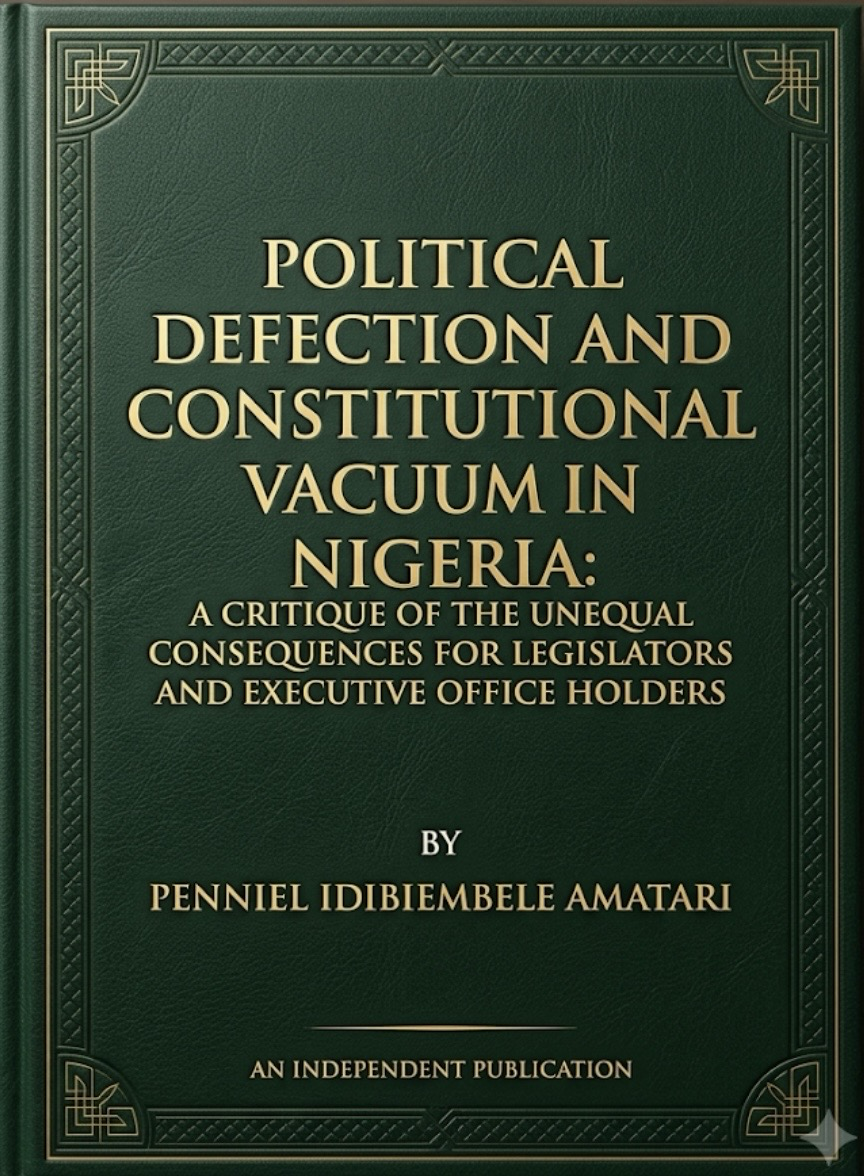
POLITICAL DEFECTION AND CONSTITUTIONAL VACUUM IN NIGERIA: A CRITIQUE OF THE UNEQUAL CONSEQUENCES FOR LEGISLATORS AND EXECUTIVE OFFICE HOLDERS ABSTRACT Political defection has become one of the most visible symptoms of institutional weakness in Nigeria's Fourth Republic. Because the Constitution of the Federal Republic of Nigeria 1999 (as amended) makes party sponsorship a precondition of contesting any elective office, and because the Supreme Court has repeatedly held that the electoral mandate belongs to the political party rather than to the individual candidate, the question of what happens when an office holder abandons the party that sponsored him ought, in principle, to be governed...

Continue reading

Conditions for Copyright Protection in Nigeria: Originality, Fixation and Qualifying Factors

A Nigerian software company discovers that a competitor has installed unlicensed copies of Microsoft Windows across its entire office network. Microsoft Corporation, a company incorporated in the United States, wants to sue for infringement in a Nigerian court. Does it have any right to do so? This is not a hypothetical concern. It is, almost word for word, the question that reached the Nigerian Court of Appeal in 2011, and the answer the court gave has shaped how foreign copyright owners approach Nigerian litigation ever since. Works Eligible for Copyright in Nigeria Under the Copyright Act 2022 established what kind of...

Continue reading

What Are the Statutory Elements to Prove Murder in Nigeria?

What Are the Statutory Elements to Prove Murder in Nigeria? To prove murder in Nigeria, the prosecution must establish four key elements beyond a reasonable doubt: that a person has died, that the accused caused the death, that the act or omission causing the death was unlawful, and that the accused acted with malice aforethought. These requirements are rooted in Nigeria's dual criminal law system, primarily defined by the Criminal Code Act in the southern states and the Penal Code Act in the northern states. The burden of proof rests entirely on the prosecution. It isn't enough to show that the accused...

Continue reading

The 3 Ingredients to Prove Armed Robbery in Nigeria

The 3 Ingredients to Prove Armed Robbery in Nigeria The case file landed with a thud. Inside were grainy photos from a roadside stop in Lekki, a victim's panicked statement, and a signed confession from a young man picked up two days later. To the police, it was an open-and-shut armed robbery case. Six months later in court, it fell apart completely. This happens more often than you think, because a confession is never enough. To successfully prove armed robbery in Nigeria, the prosecution must prove three specific ingredients beyond a reasonable doubt: that a robbery actually took place, that the perpetrators...

Continue reading

Confession Admissibility in Nigeria: The Law vs. The Reality

Confession Admissibility in Nigeria: The Law vs. The Reality The air in the interrogation room is thick and still. A single fluorescent bulb hums overhead. Across a scarred wooden table, a police officer slides a pen and a few sheets of paper towards a suspect who has been in custody for ten hours. "Just sign this," the officer says, his voice low. "Tell us what happened, and you can go home." In that moment, a statement is taken that could decide the suspect's fate for decades. But is it admissible in court? A confessional statement is only admissible in a Nigerian court...

Continue reading

Minority Shareholder Protection Under CAMA: More Power Than You Think

Minority Shareholder Protection Under CAMA: More Power Than You Think You’re a minority shareholder in a promising Lagos-based fintech company. You invested early, believing in the vision. But now, the majority owners make decisions without you, divert contracts to their own side-businesses, and refuse to declare dividends despite record profits. You feel powerless, your stake diluted in value and influence. This is the classic minority squeeze-out, and for decades in Nigeria, there was little you could do. The Companies and Allied Matters Act (CAMA) 2020 provides significant legal protections for minority shareholders against oppressive or unfair actions by the majority. It establishes...

Continue reading

Join our Newsletter

Join 1,000+ law students and professionals. Get our top-rated class notes and legal analysis delivered straight to your inbox every Tuesday and Friday.

We don’t spam! Read our privacy policy for more info.