8:00 - 19:00

Our Opening Hours Mon. - Fri.

975.789.098

Always online

Facebook

Twitter

Search
 

200 Level

LearningTheLaw > Class Notes  > 200 Level

POLITICAL DEFECTION AND CONSTITUTIONAL VACUUM-IN1 NIGERIA: A CRITIQUE OF THE UNEQUAL CONSEQUENCES FOR LEGISLATORS AND EXECUTIVE OFFICE HOLDERS
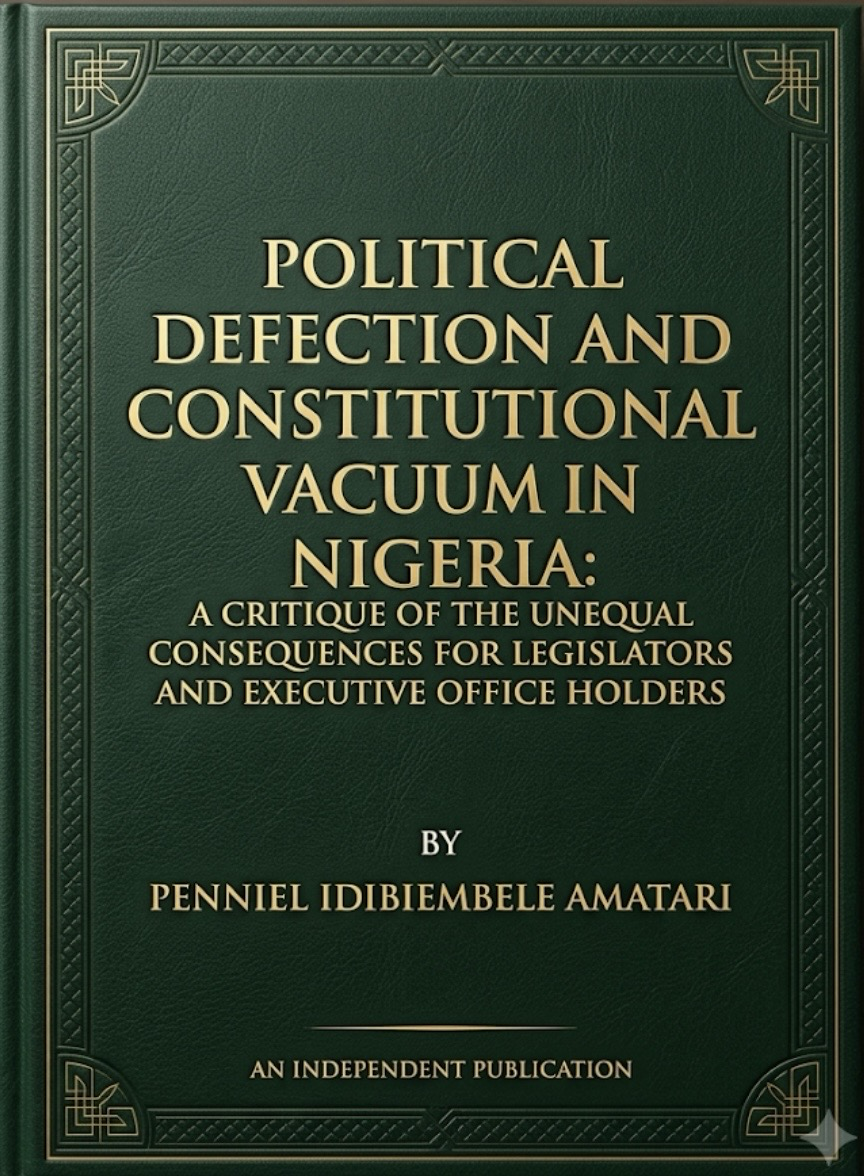
POLITICAL DEFECTION AND CONSTITUTIONAL VACUUM IN NIGERIA: A CRITIQUE OF THE UNEQUAL CONSEQUENCES FOR LEGISLATORS AND EXECUTIVE OFFICE HOLDERS ABSTRACT Political defection has become one of the most visible symptoms of institutional weakness in Nigeria's Fourth Republic. Because the Constitution of the Federal Republic of Nigeria 1999 (as amended) makes party sponsorship a precondition of contesting any elective office, and because the Supreme Court has repeatedly held that the electoral mandate belongs to the political party rather than to the individual candidate, the question of what happens when an office holder abandons the party that sponsored him ought, in principle, to be governed...

Continue reading
Hadley v Baxendale [1854]: The Rule That Rewards Silence

Hadley & Anor v Baxendale & Ors [1854] EWHC Exch J70, Court of Exchequer (England) Area of Law: Contract Law: Remoteness of Damage, Consequential Loss, Measure of Damages A note for readers new to this case: A miller's crankshaft broke. He hired a carrier to transport it to a manufacturer so a replacement could be made. The carrier delayed delivery by several days. The mill stayed shut longer than it should have. The miller sued for the lost profits. The court said no; the carrier never knew the mill's entire operation depended on that one shaft, so he could not have...

Continue reading

Keir v Leeman (1846) 9 QB 371: When an Agreement to Drop Charges Becomes Illegal

keir-v-leeman-1846-stifling-prosecution

Suppose a creditor has secured a judgment against a debtor, and in the process of enforcing it, the debtor's associates commit riot and attack a police officer. The creditor lays criminal charges. A third party then offers to pay the outstanding debt if the creditor drops the prosecution. The creditor agrees, abandons the charges, and the third party refuses to pay. Can the creditor sue to recover? That is precisely the question resolved in Keir v Leeman (1846) 9 QB 371. The answer was no. The Keir v Leeman agreement to stifle prosecution was held void as contrary to public policy,...

Continue reading

The Tort of Deceit in Nigerian Law: Fraudulent Misrepresentation and Liability

Fraud, as Nigerians understand it practically, has many faces. There is the "yahoo boy" who defrauds a foreign national through advance fee schemes. There is the land vendor in Lekki who sells the same plot of land to three different buyers. There is the developer in Osapa London who collects completion payments from fifty subscribers while knowing, from day one, that he has no building permit. And there is the more intimate kind of fraud: the man who promises marriage to a woman, receives her financial support and possibly much more, and then vanishes or reveals that he was already...

Continue reading

The Tort of Conspiracy in Nigerian Law: Elements, Defences, and Remedies

You are a successful frozen fish trader in Mushin Market. Three of your competitors, who together control the supply chain in your area, decide privately that your growing market share threatens them. They agree, informally but deliberately, to collectively refuse you supply. They have not lied to you. They have not threatened you. Each of them, individually, has done nothing unlawful. But together, their combination brings your business to its knees. This is the scenario that sits at the heart of the tort of conspiracy, and it raises one of the more intellectually interesting questions in Nigerian tort law: when does...

Continue reading

Trespass to Chattel, Conversion, and Detinue in Nigerian Law: A Complete Guide

If you have studied trespass to land, the structure of trespass to chattel will feel immediately familiar. The same architecture applies: a direct, intentional or negligent interference with something that belongs to another person, actionable without proof of damage, protecting possession rather than ownership. The difference is only in what is being protected. Trespass to land guards your right to exclusive enjoyment of a piece of ground. Trespass to chattel guards your right to exclusive enjoyment of your moveable property. One protects what you stand on; the other protects what you carry, drive, use, and own. But where trespass to land...

Continue reading

Malicious Prosecution in Nigerian Law: When False Accusations Become a Tort

Every law student who has studied procedure knows that the law is not merely a sword the plaintiff wields against the defendant. It is also a shield. But what happens when someone picks up that shield and uses it as a weapon? When the criminal justice process, built to protect society from wrongdoers, is deployed not in the service of justice but in the service of revenge, envy, or commercial rivalry? Nigeria has a problem that practitioners know intimately but that textbooks rarely confront with sufficient directness. The police system is routinely weaponised. A debtor reports his creditor to the police...

Continue reading

Defamation in Nigerian Law: Libel, Slander, Social Media, and Your Legal Rights

There is a thought experiment that tort law students encounter sooner or later. Imagine two people, both targeted by another. The first is threatened with a fist to the face. The second is told, loudly and in public, that he is a thief. Neither is physically harmed. Yet both have actionable claims. The first has an action in assault, because the law protects bodily integrity from the apprehension of force. The second has an action in defamation, because the law equally protects reputation from the apprehension of others. The parallel is not coincidental. Both torts guard something fundamental about a...

Continue reading

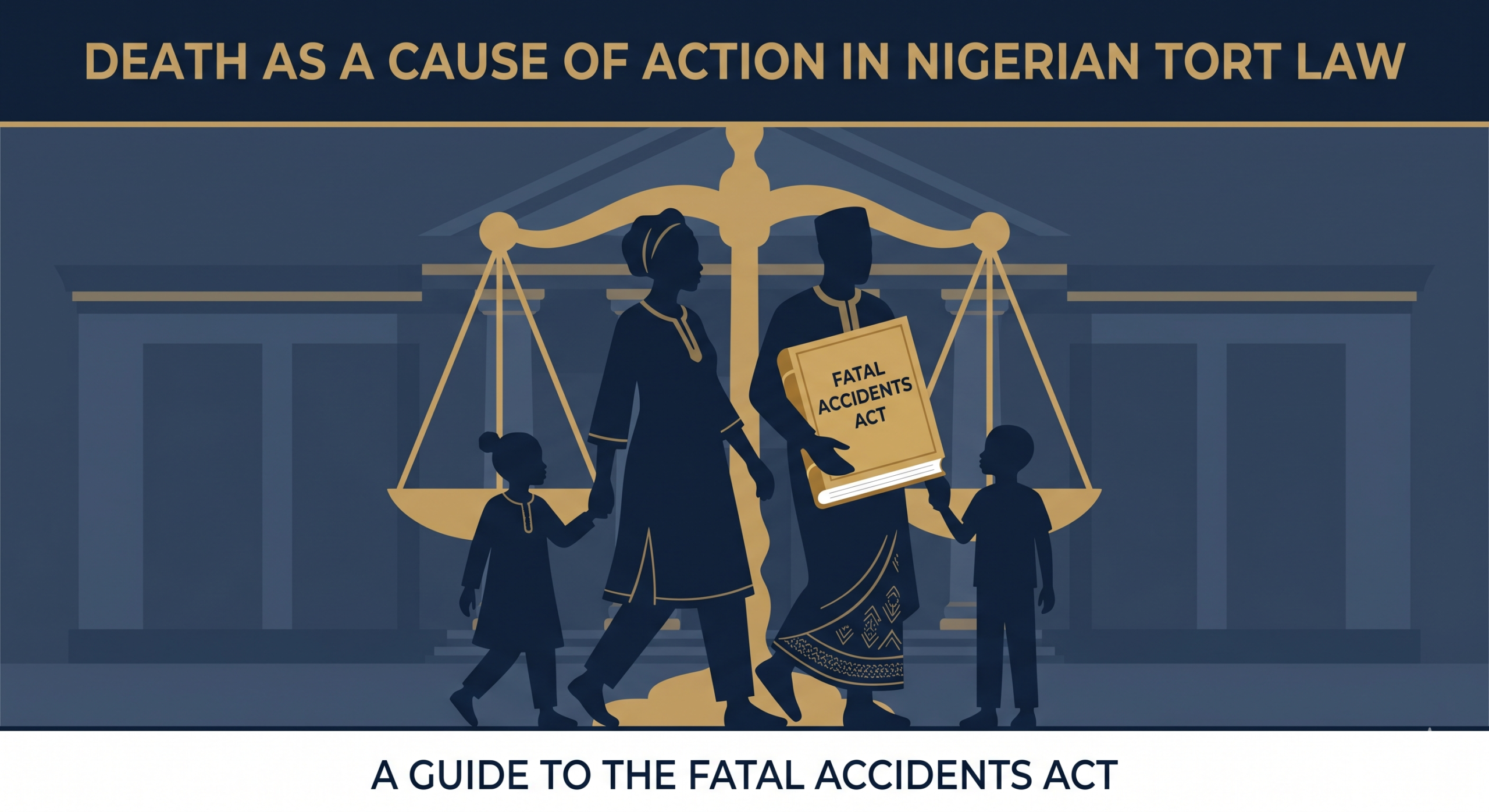
Death as a Cause of Action in Law: What Families of Accident Victims Can Claim

Death as a Cause of Action in Law

In June 2012, Dana Airlines Flight 992 crashed into a densely populated residential area at Iju-Ishaga, Lagos, killing all 153 persons on board and 10 people on the ground. Among the dead were fathers, mothers, breadwinners, and children. Their families were left not only with grief but with the immediate, crushing financial reality of lost income and lost support. The law's response to this tragedy illustrates one of the most important and underappreciated areas of Nigerian tort law: death as a cause of action. The question is not just whether someone is criminally responsible for the deaths. The question that tort...

Continue reading

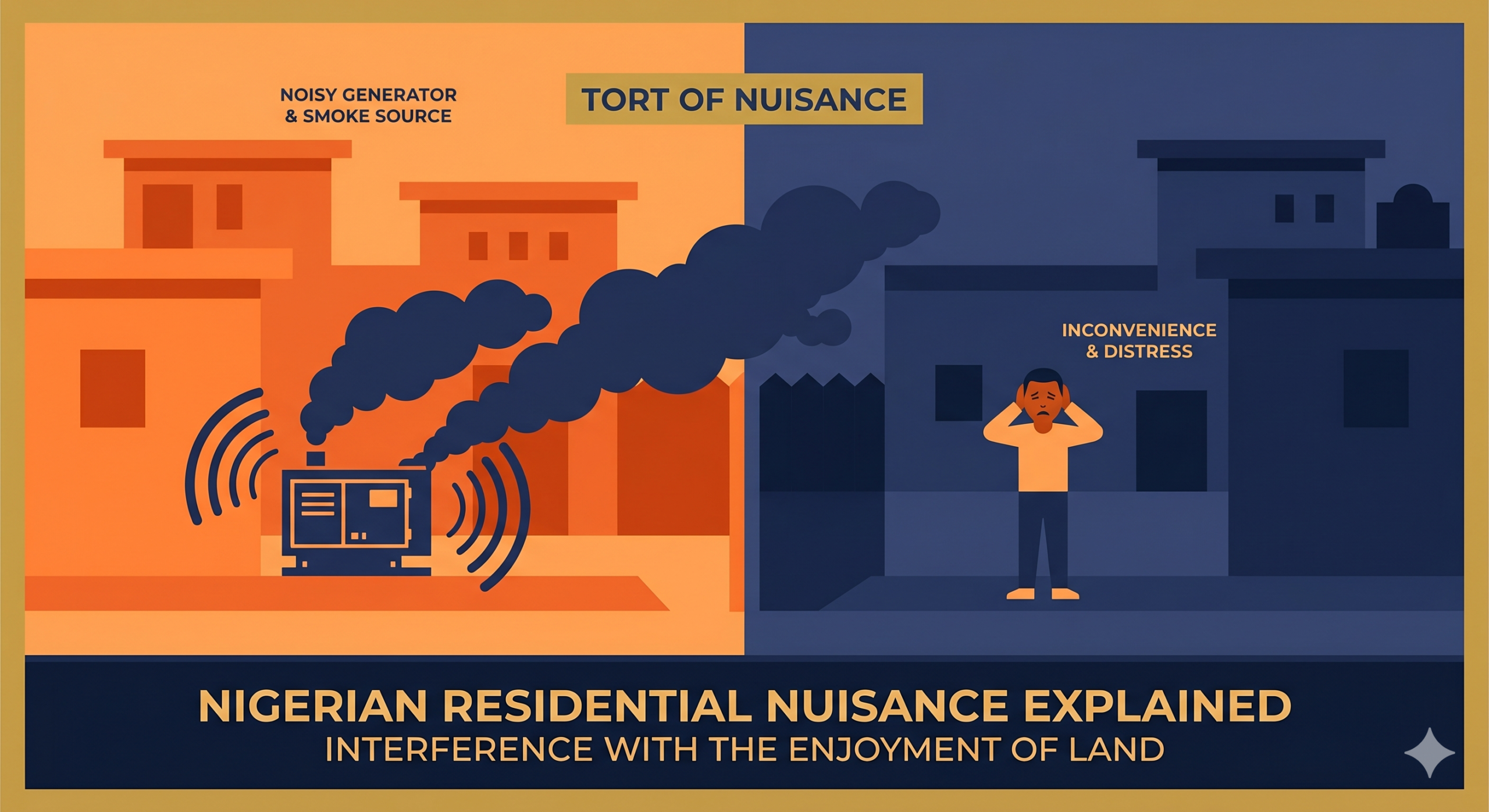
The Tort of Nuisance in Nigerian Law: Generator Noise, Oil Spills, and Your Legal Rights

tort of nuisance Nigeria

Picture this. You have just moved into a quiet residential estate in Lekki. Three weeks later, your neighbour sets up a commercial generator that runs from 6am to 11pm, six days a week. The fumes drift through your windows. Your children cannot sleep. Your concentration at work is shattered. You complain, informally. Nothing changes. Or consider a different scenario. An oil company has been operating a pipeline through your community in Bayelsa for two decades. Over time, there have been spills. The farmland your family depends on is contaminated. Fish have disappeared from the creeks. The water is no longer safe....

Continue reading

Join our Newsletter

Join 1,000+ law students and professionals. Get our top-rated class notes and legal analysis delivered straight to your inbox every Tuesday and Friday.

We don’t spam! Read our privacy policy for more info.