8:00 - 19:00

Our Opening Hours Mon. - Fri.

975.789.098

Always online

Facebook

Twitter

Search
 

Class Notes

LearningTheLaw > Class Notes (Page 9)

Islamic Marriage in Nigeria: Formation, Requirements, and Legal Framework

Islamic marriage known as Nikah, is one of the three forms of marriage recognised under Nigerian law, alongside statutory marriage and customary law marriage. See our Marriage and Divorce Law in Nigeria guide for the comparative overview of all three systems. Islamic marriage is particularly significant in the northern states of Nigeria where Sharia courts exercise jurisdiction over personal law matters for Muslims. However, its legal principles apply to Muslims across the federation regardless of state of residence. Islamic marriage is grounded in religious obligation. As prescribed by Allah, it is the lawful union of a man and a woman based on mutual...

Continue reading

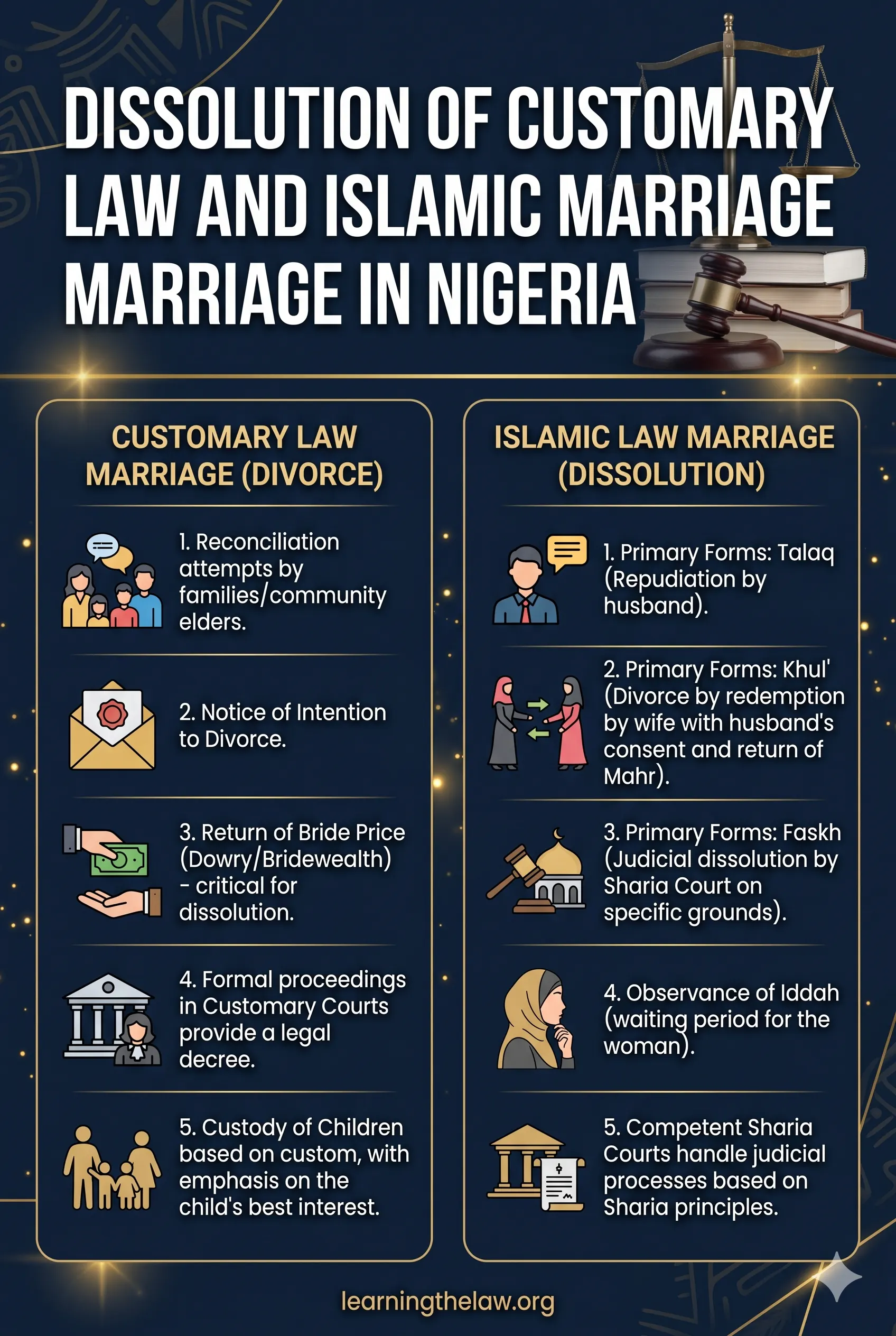
Dissolution of Customary Law and Islamic Marriage in Nigeria

Dissolution of Customary Law and Islamic Marriage in Nigeria

Nigeria operates a pluralist legal system in which customary law and Islamic law co-exist with received English law as recognised sources of legal obligation. See our note on Sources of Law in Nigeria for the broader framework. This pluralism is nowhere more visible than in family law — specifically in how marriages contracted under customary and Islamic law are dissolved. For the rules governing dissolution of statutory marriage, see our 300L note on Dissolution of Statutory Marriage. For the foundational introduction to marriage types in Nigeria, see the Marriage and Divorce Law in Nigeria guide. Part I: Dissolution of Customary Law...

Continue reading

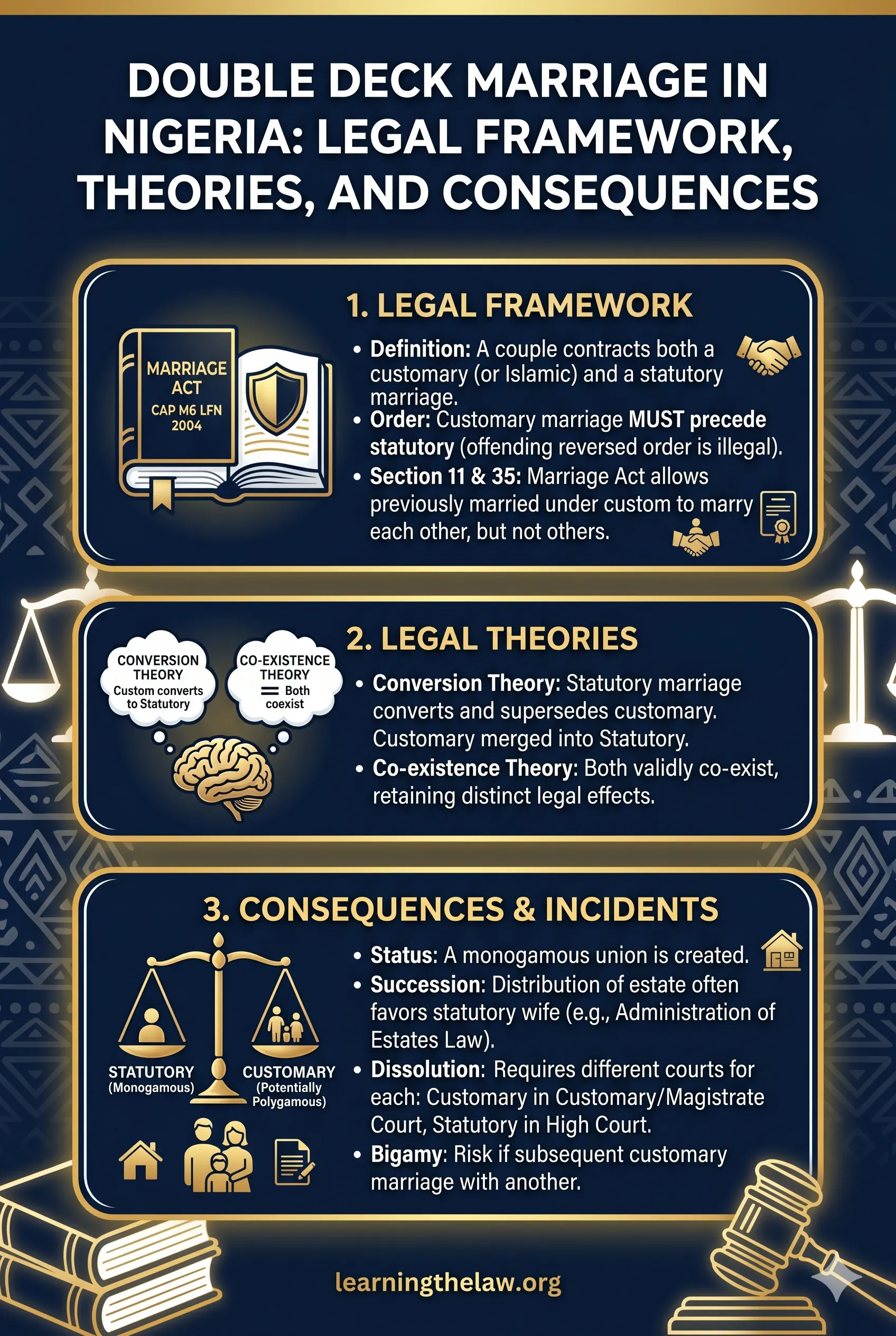
Double Deck Marriage in Nigeria: Legal Framework, Theories, and Consequences

Double Deck Marriage in Nigeria: Legal Framework, Theories, and Consequences

It has become a deeply embedded practice in Nigeria for couples who intend to contract a statutory marriage to first marry under customary law before proceeding to the registry or church. This phenomenon — commonly referred to as double deck marriage — is not a legal term found in any statute. It is a concept developed in Nigerian family law scholarship, most notably by Onokah, to describe the situation where the same couple conducts a marriage in accordance with their indigenous customary law and subsequently goes further to conduct a separate marriage under the received English law, resulting in a...

Continue reading

Void and Voidable Marriages in Nigeria: Nullity, Grounds, and Bars

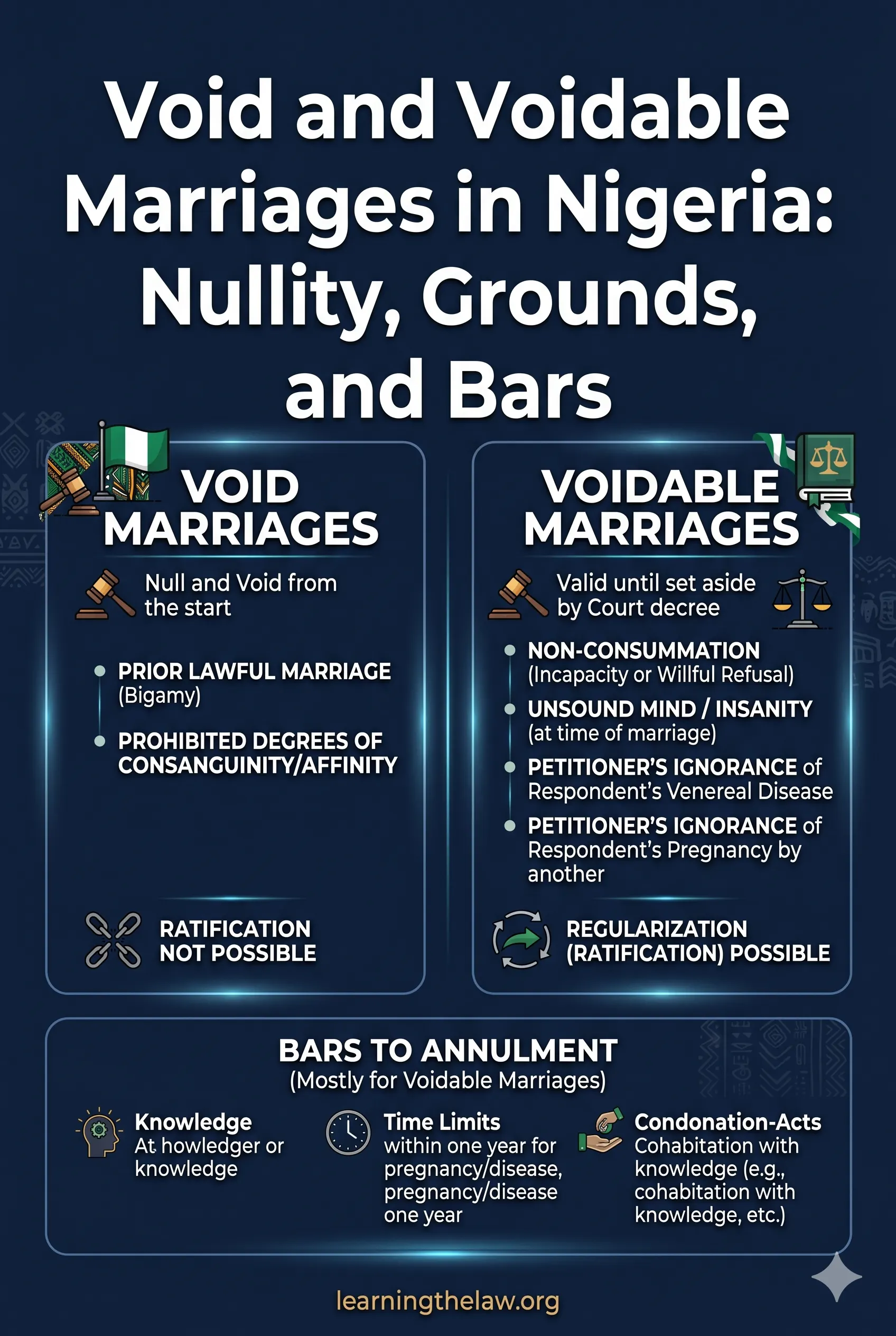
Void and Voidable Marriages in Nigeria: Nullity, Grounds, and Bars

Before reading this article, ensure you understand the three types of marriage recognised under Nigerian law. For that foundation, see our Marriage and Divorce Law in Nigeria guide. This article focuses on nullity — what it means when a marriage is legally defective from the start, and the doctrinal distinction between marriages that are void and those that are merely voidable. What is Nullity? Nullity is concerned with marriages that are legally blemished from the outset. It is conceptually distinct from divorce. Divorce terminates a valid, subsisting marriage. Nullity, by contrast, is a declaration that the marriage either never existed in law...

Continue reading

Dissolution of Statutory Marriage in Nigeria: Grounds, Case Law, and Procedure

Dissolution of Statutory Marriage in Nigeria: Grounds, Case Law, and Procedure

If you need a foundational introduction to the types of marriage in Nigeria and the general divorce process, start with our Marriage and Divorce Law in Nigeria guide. This article builds on that foundation and goes deeper — into the case law, statutory construction, and doctrinal arguments you are expected to engage with at the 300L level or 200L in some schools. What is a Matrimonial Cause? A matrimonial cause is a proceeding for a decree of dissolution of marriage, nullity of marriage, judicial separation, or restitution of conjugal rights. An appeal against a decision in a matrimonial cause is itself still...

Continue reading

Mistake of Fact and Claim of Right in Nigerian Criminal Law

Mistake of Fact and Claim of Right in Nigerian Criminal Law

People act based on what they think is real. Sometimes they're wrong. A hunter shoots at a bush thinking it's an animal, but hits a person. Someone takes money thinking it's theirs. The act was deliberate, but based on a wrong belief. Nigerian law handles these errors through Mistake of Fact (Section 25) and Bona Fide Claim of Right (Section 23). Mistake of Fact (Section 25) Section 25 provides the defense: "A person who does or omits to do an act under an honest and reasonable, but mistaken belief...

Continue reading

Intoxication as a Defence in Nigerian Criminal Law

Alcohol and crime often go together. Many violent crimes happen when people are drunk. The law faces a problem: how do we balance punishing dangerous behavior with the requirement of mens rea (guilty mind)? If someone is too drunk to know what they're doing, do they have criminal intent? Nigerian law, under Section 29 of the Criminal Code (and Section 52 of the Penal Code), generally says yes—unless narrow exceptions apply. The Basic Rule Section 29(1) is harsh: intoxication is not a defence to any criminal charge.[^1] If you voluntarily get drunk, you accept the consequences. But Section 29(2) allows two exceptions: involuntary...

Continue reading

Insanity and Criminal Responsibility in Nigerian Law

Insanity and Criminal Responsibility in Nigerian Law

In criminal law, "insanity" is a legal term, not a medical one. You can be medically ill but legally sane. Or legally insane due to conditions medicine classifies differently (like sleepwalking). The insanity defense challenges a basic requirement for criminal guilt: the ability to reason and choose. Section 28 of the Criminal Code defines this defense. It's broader and more humane than the English M'Naghten Rules it came from. Everyone Is Presumed Sane Section 27 of the Criminal Code says: "Every person is presumed to be of sound mind...

Continue reading

The Defence of Accident in Nigerian Criminal Law

The Defence of Accident in Nigerian Criminal Law

Sometimes harm happens without anyone meaning it. A hunter shoots at an animal but hits another hunter. A friendly push leads to a fatal fall. Criminal law must separate deliberate criminals from unlucky people. Section 24 of the Criminal Code provides the defence of accident. This article explains Section 24, the difference between "unwilled acts" and "accidental events," and key cases like Timbu Kolian and Iromantu. Section 24: Two Types of Protection Section 24 is crucial for understanding criminal responsibility. It says: "Subject to the express provisions of this code relating to negligent acts and omissions, a person is not criminally responsible for an...

Continue reading

Self-Defence in Nigerian Criminal Law

Self-Defence in Nigerian Criminal Law

The right to life is fundamental. But the law recognizes that when someone attacks you with deadly force, survival comes first. In Nigerian law, self-defence (also called "private defence") is a complete defense to murder. Section 33(1) of the Constitution allows taking life in self-defense,[^1] and Section 32 of the Criminal Code justifies it. This article explains Sections 286, 287, and 288 of the Criminal Code, which define when you can legally defend yourself. We'll look at the difference between unprovoked and provoked attacks, and examine key cases like Musa v The State and Nwuzoke v State. The Law: Sections 286-288 The Criminal...

Continue reading

Join our Newsletter

Join 1,000+ law students and professionals. Get our top-rated class notes and legal analysis delivered straight to your inbox every Tuesday and Friday.

We don’t spam! Read our privacy policy for more info.