8:00 - 19:00

Our Opening Hours Mon. - Fri.

975.789.098

Always online

Facebook

Twitter

Search
 

Class Notes

LearningTheLaw > Class Notes (Page 11)

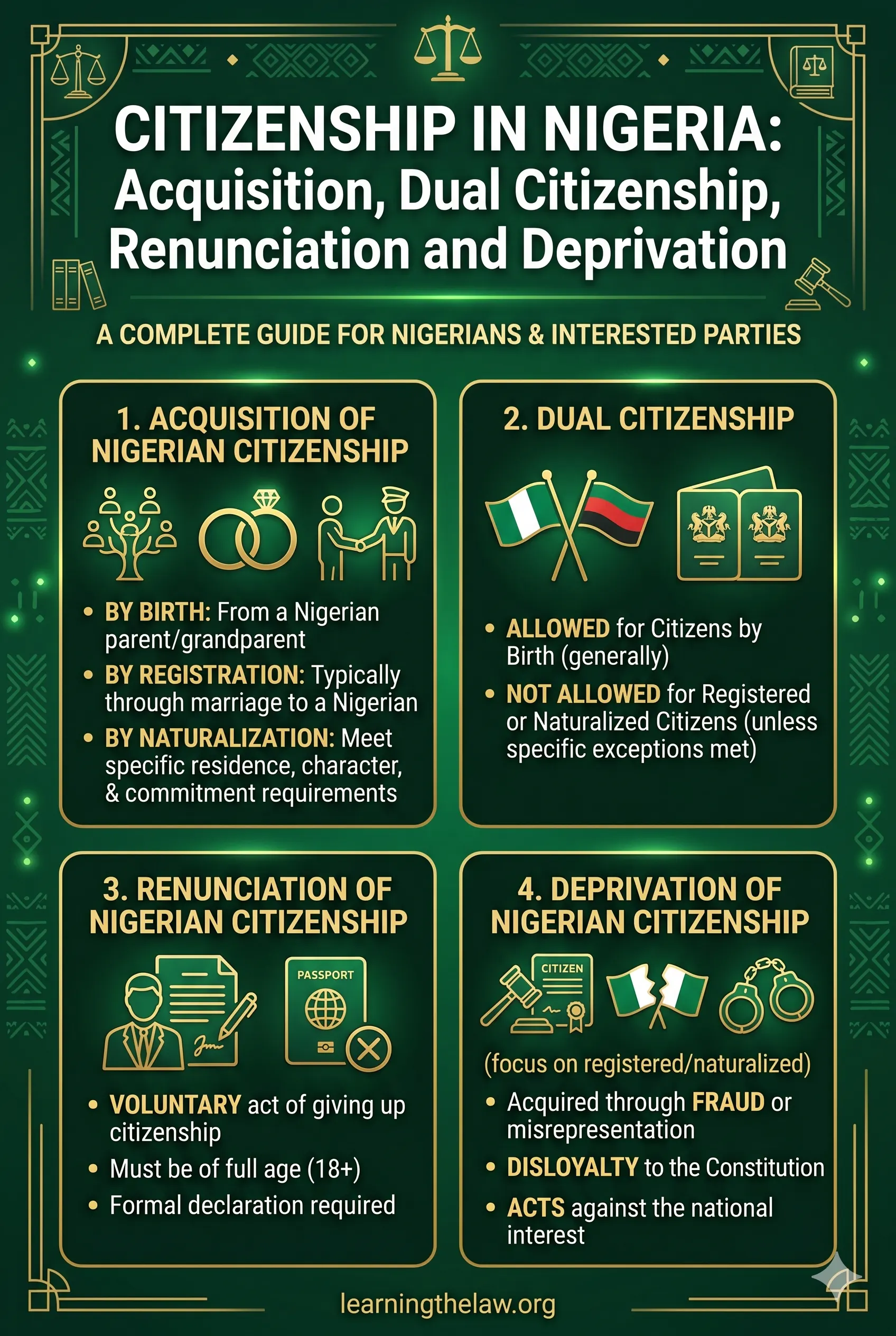
Citizenship in Nigeria: Acquisition, Dual Citizenship, Renunciation and Deprivation

Citizenship in Nigeria: Acquisition, Dual Citizenship, Renunciation and Deprivation

According to the Black's Law Dictionary, citizenship is defined as the status of being a citizen, the quality of a person's conduct as a member of a community. A citizen is a person who, by either birth or naturalization, is a member of a political community, owing allegiance to the community and being entitled to enjoy all its civil rights and protections; a member of the civil state, entitled to all its privileges.1 The word citizenship is often used interchangeably with "subject", "individual", and "nationality". It has been defined as pertaining to a person who under the constitution and the laws...

Continue reading

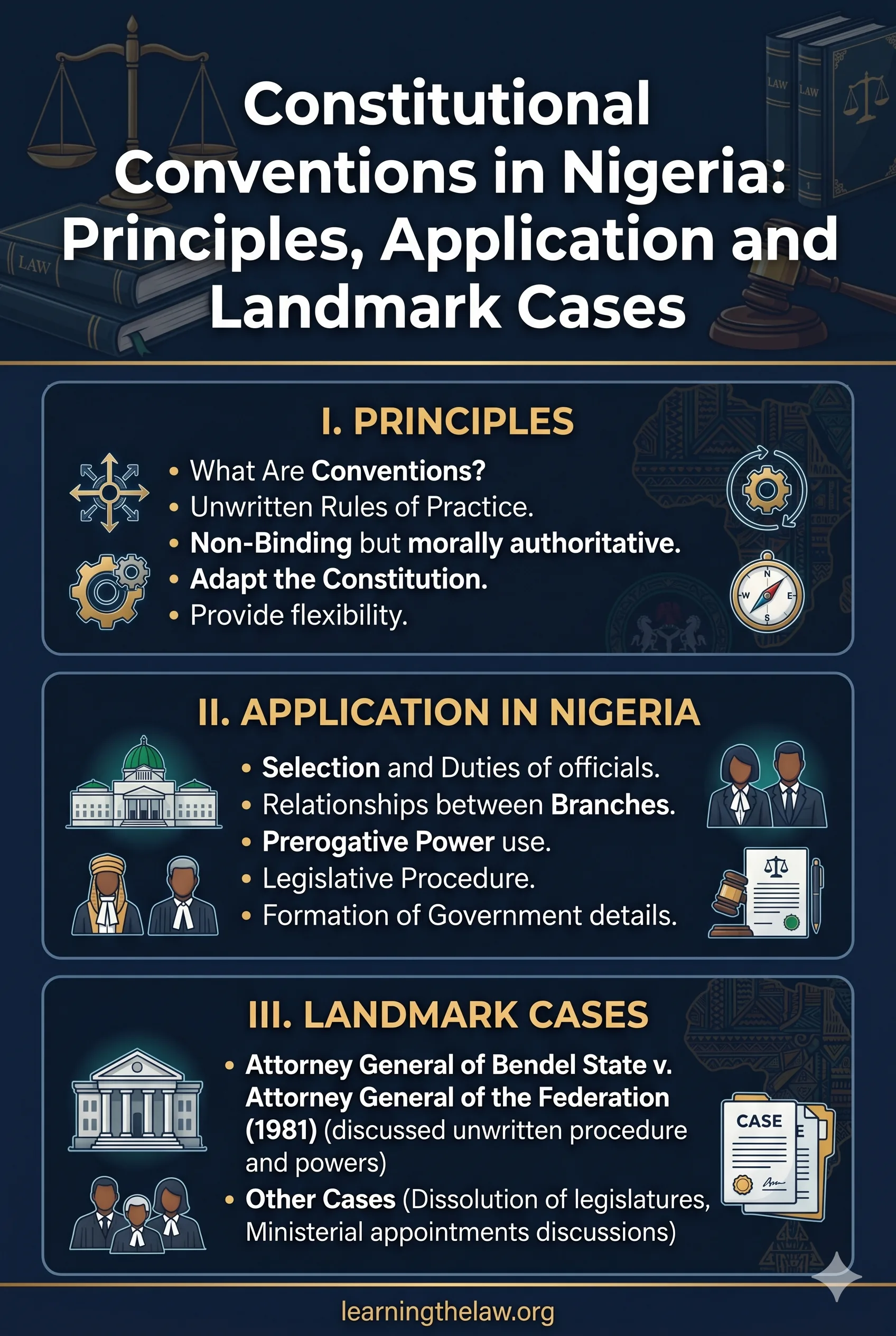
Constitutional Conventions in Nigeria: Principles, Application and Landmark Cases

Constitutional Conventions in Nigeria: Principles, Application and Landmark Cases

Britain operates an unwritten constitution and many of the operations of the government do not have formal legal documentation. Hence, there are conventional rules guiding the operations of the government and its relationship with the sovereign/crown. The Cabinet and the Prime Minister/Parliament are conventional institutions, and the formal rules of the constitution only deal with marginal aspects of these institutions.1 Constitutional conventions are the non-legal rules of governmental operations. Not only do conventions supplement the legal rules, some of them are significantly constitutional rules.2 Think of conventions as unwritten customs that everyone in government follows, even though there's no law forcing...

Continue reading

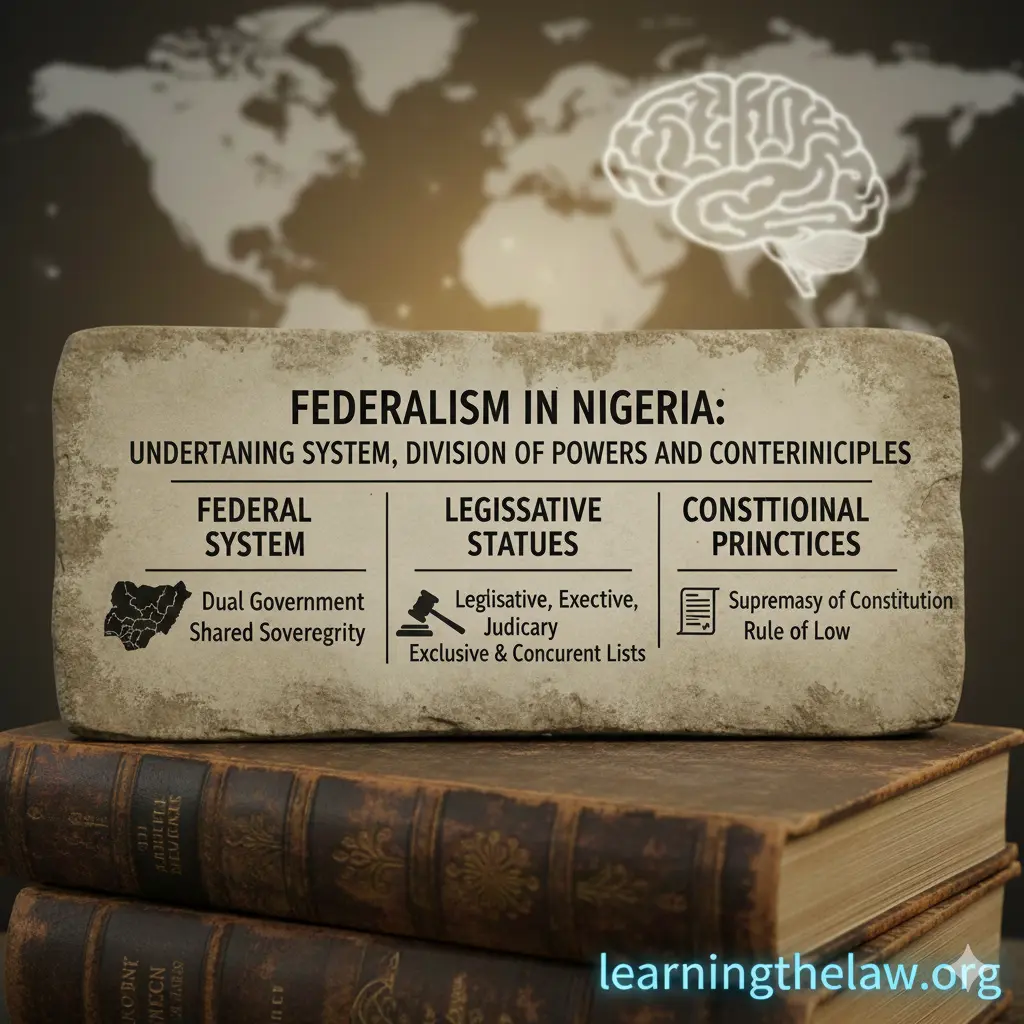
Federalism in Nigeria: Understanding Federal System, Division of Powers and Constitutional Principles

federalism in nigeria

Federalism according to Black's Law Dictionary is defined as 'a league or compact between two or more states to become united under the central government'.1 K.C. Wheare defined federalism as 'the method of dividing power so that general and regional governments are each within a sphere co-ordinate and independent'.2 In simpler terms, federalism is a system where power is shared between a central (federal) government and smaller regional governments (states), with each level having its own specific powers and operating independently within its sphere. Professor Nwabueze provides a more detailed definition: federalism is an arrangement whereby the powers of government within a...

Continue reading

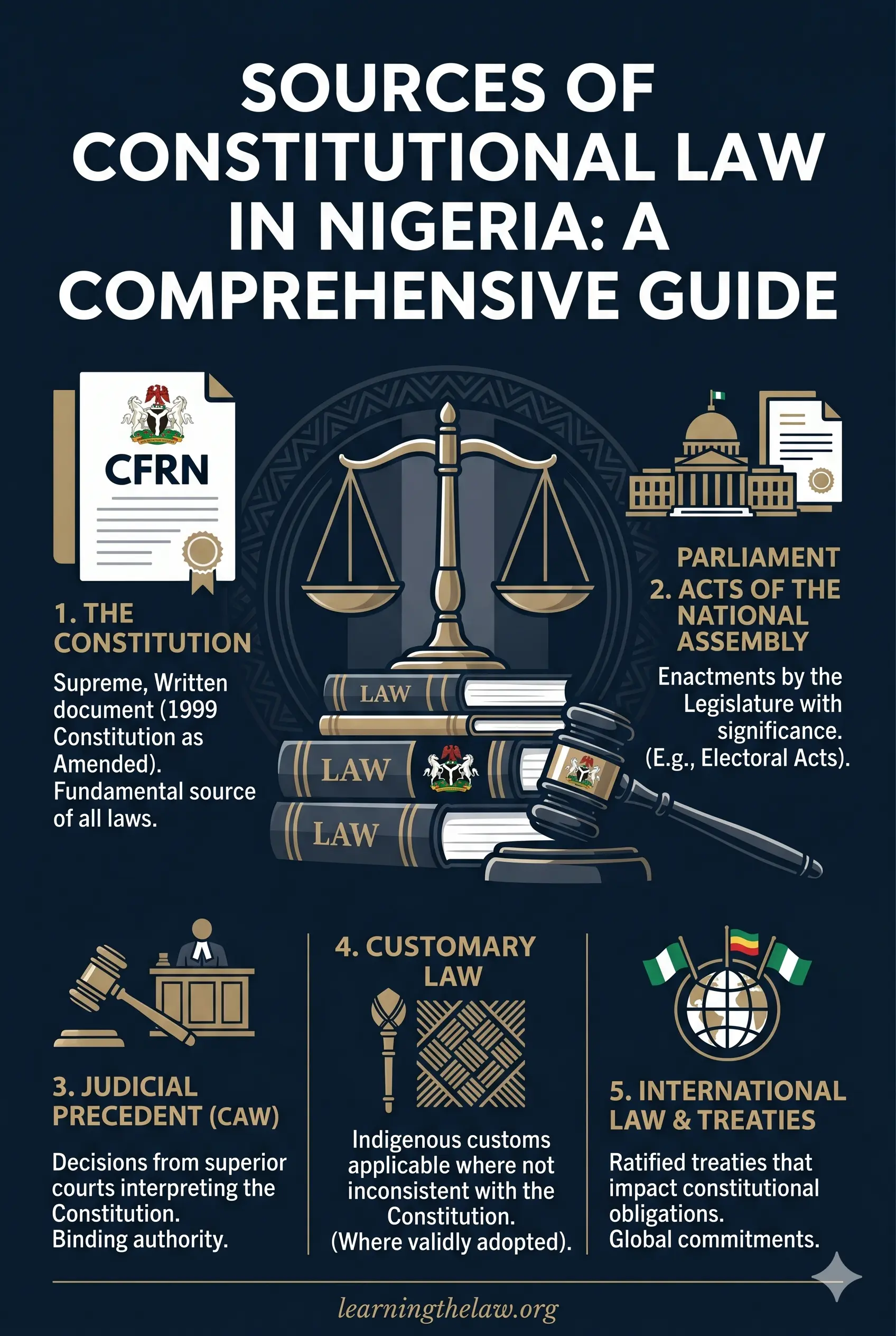
Sources of Constitutional Law in Nigeria: Written, Unwritten & Case Law

Sources of Constitutional Law In Nigeria: A Comprehensive Guide

INTRODUCTION: UNDERSTANDING SOURCES OF CONSTITUTIONAL LAW When we talk about "sources" of constitutional law, we are referring to the origins or channels from which constitutional rules are created, developed, and given authority. Think of it like asking: "Where do the rules that govern our country come from?" The answer is not simple because constitutional rules don't come from just one place – they come from multiple sources, each contributing to the overall constitutional framework of a nation. Constitutional law derives its authority from various origins or channels through which constitutional rules are framed or developed. The sources of constitutional law represent the...

Continue reading

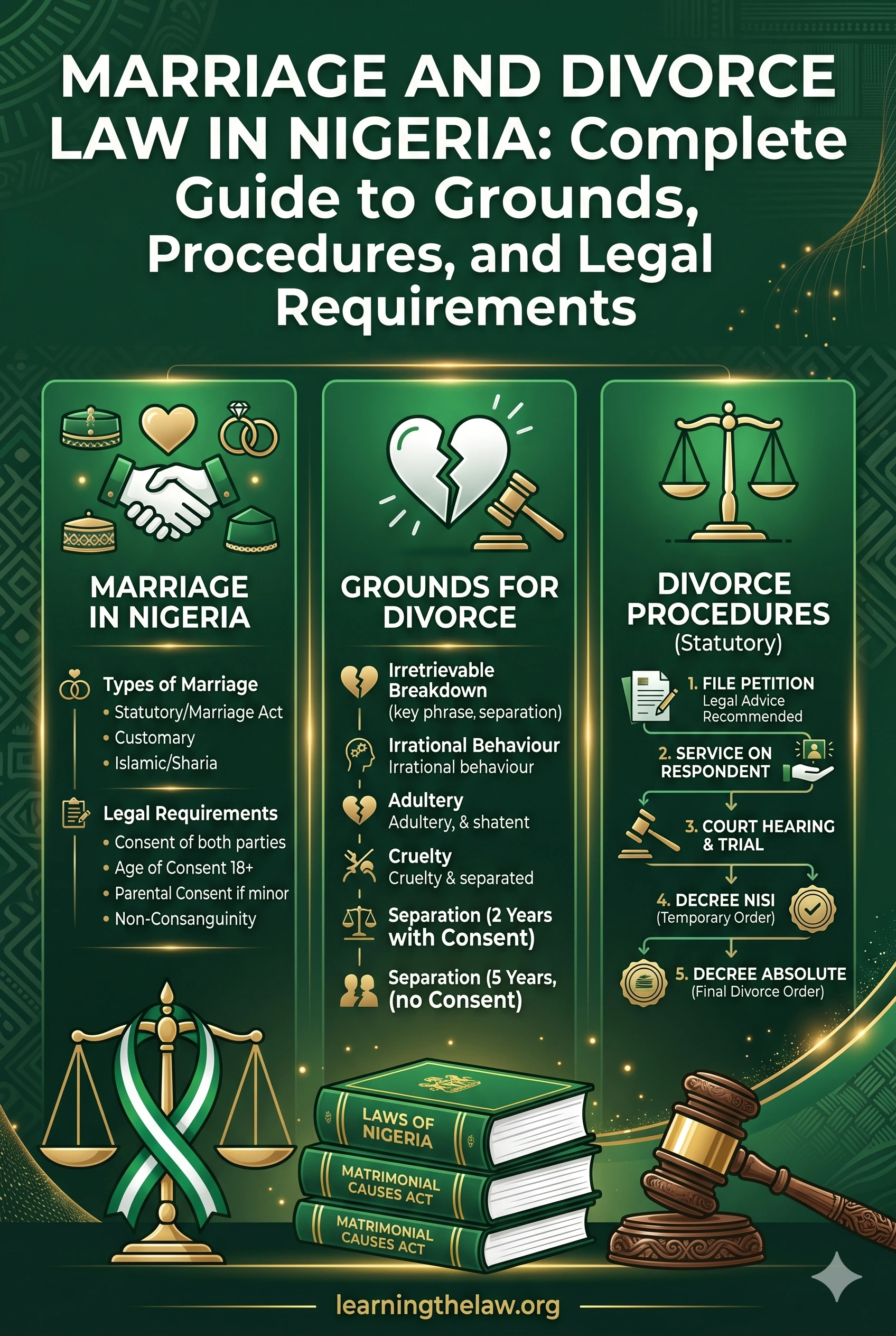
Marriage and Divorce Law in Nigeria: Complete Guide to Grounds, Procedures, and Legal Requirements

Marriage and Divorce Law in Nigeria: Complete Guide to Grounds, Procedures, and Legal Requirements

Nigerian matrimonial law provides a comprehensive framework governing how marriages begin, how they're maintained, and when necessary, how they can legally end. Whether you're planning to marry, experiencing marital difficulties, or considering divorce, understanding these laws protects your rights and helps you make informed decisions. This guide explains everything you need to know about marriage types, divorce procedures, and legal requirements in Nigeria. Understanding the Three Types of Marriage in Nigerian Law Nigeria recognizes three distinct marriage systems, each with its own legal framework, requirements, and implications. Think of these as three different "contracts" you can enter into, each governed by different...

Continue reading

Privity of Contract in Nigerian Law: Meaning, Exceptions, and Examples

Privity of Contract in Nigerian Law

What is Privity of Contract? Privity of contract is a fundamental common law principle establishing that only parties directly involved in a contract possess rights and obligations under that agreement. The doctrine ensures contractual relationships remain exclusive to signatories, preventing third parties from enforcing or being bound by contractual terms. The Nigerian Supreme Court affirmed this principle in Chuba Ikpeazu v. African Continental Bank (1965) NMLR 374, stating that generally, a contract cannot be enforced by a person who is not party to it, even if made for their benefit. Core Principles of Privity The doctrine operates on three essential foundations: 1. Binding Obligations: Only...

Continue reading

Illegality & Public Policy in Contract Law: Keir v Leeman Cases Explained

Illegality and Public Policy in Contract Law

Not all agreements, even if validly formed, will be enforced by the courts. The law recognises certain categories of contracts that, despite satisfying the basic requirements of offer, acceptance, consideration, and intention to create legal relations, are nonetheless unenforceable because they are either illegal or contrary to public policy. This principle reflects the fundamental truth that contract law exists not merely to facilitate private arrangements, but to serve the broader interests of society. As the Supreme Court of Nigeria declared in Nnadozie v Mbagwu,1 "a contract is illegal if the consideration or the promise involves doing something illegal or contrary to...

Continue reading

Mistake in Contract Law: A Comprehensive Guide for Nigerian Law Students

Mistake in Contract Law: A Comprehensive Guide for Nigerian Law Students

Mistake is one of the most intricate vitiating factors in contract law, raising fundamental questions about when parties should be bound by their apparent agreements. If one or both parties enter into a contract under some misunderstanding or misapprehension about a fundamental fact, in what circumstances will the law permit them to escape from their obligations? This question lies at the heart of the doctrine of mistake. The importance of mistake in Nigerian contract law cannot be overstated. In our commercial environment, parties frequently make assumptions about the subject matter of their contracts, the identity of those with whom they are...

Continue reading

Misrepresentation in Contract Law

Misrepresentation in Contract Law

In the formation of contracts, parties often make various statements to induce others to enter into contractual relationships. While some of these statements become terms of the contract, others remain mere representations. When these representations turn out to be false, the law must determine what remedies, if any, should be available to the party who has been misled. This is the domain of misrepresentation—a crucial vitiating factor in contract law that can render an otherwise valid contract voidable. Misrepresentation occupies a unique position in contract law because it bridges the gap between the formation of valid contracts and their enforceability. Understanding...

Continue reading

Capacity to Contract: Understanding Legal Competence in Nigerian Contract Law

Capacity to Contract: Understanding Legal Competence in Nigerian Contract Law

The freedom to contract is a fundamental principle of commercial law. However, not everyone possesses the legal capacity to enter into binding contracts. The law recognizes that certain categories of persons—by reason of age, mental condition, intoxication, illiteracy, or legal status—require protection from their own contractual undertakings or from exploitation by others. Consider these scenarios: A 15-year-old purchases a luxury car on credit. An illiterate farmer thumbprints a complex loan agreement he cannot read. A severely intoxicated person signs away property rights. A company director purports to bind the corporation to a contract outside its constitutional objects. Which of these contracts...

Continue reading

Join our Newsletter

Join 1,000+ law students and professionals. Get our top-rated class notes and legal analysis delivered straight to your inbox every Tuesday and Friday.

We don’t spam! Read our privacy policy for more info.