

Double Deck Marriage in Nigeria: Legal Framework, Theories, and Consequences
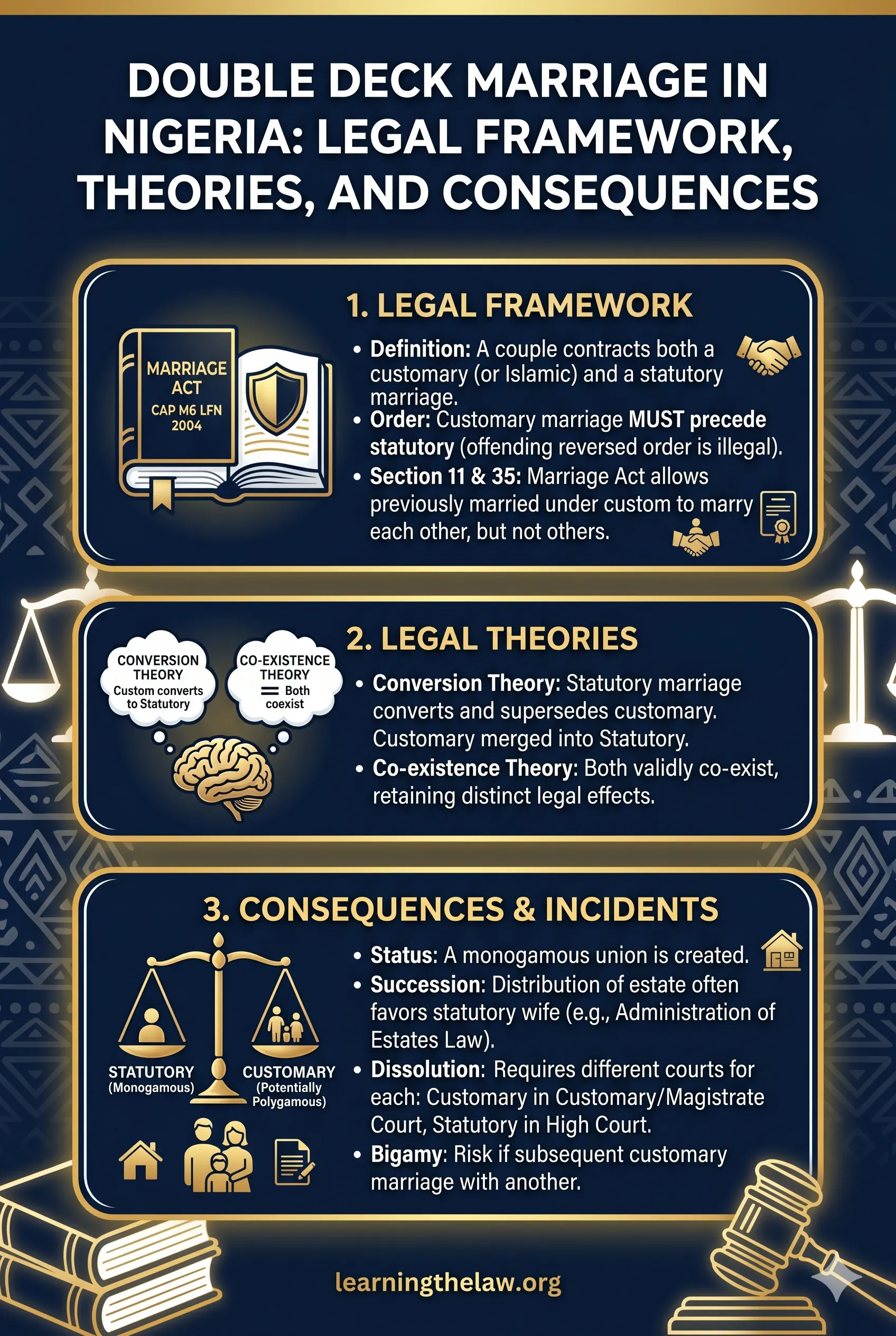
It has become a deeply embedded practice in Nigeria for couples who intend to contract a statutory marriage to first marry under customary law before proceeding to the registry or church. This phenomenon — commonly referred to as double deck marriage — is not a legal term found in any statute. It is a concept developed in Nigerian family law scholarship, most notably by Onokah, to describe the situation where the same couple conducts a marriage in accordance with their indigenous customary law and subsequently goes further to conduct a separate marriage under the received English law, resulting in a marriage governed simultaneously, or at different times, by two distinct legal regimes.
Understanding double deck marriage is essential because it generates significant legal complications around dissolution, property, custody, and succession. It is also an examinable topic precisely because Nigerian law has not definitively resolved every dimension of the problem by legislation — the courts have been left to navigate it through competing theories.
For the foundational introduction to the three types of marriage recognised in Nigerian law, see our Marriage and Divorce Law in Nigeria guide. For the rules governing dissolution of a statutory marriage, see our 300L note on Dissolution of Statutory Marriage.
Why Do Couples Contract Double Deck Marriages?
The persistence of double deck marriages despite the legal complications they generate requires explanation. Several converging reasons account for the practice.
Cultural Imperative
Many Nigerians — even the most educated and westernised — regard themselves as bound by the customary law of their place of origin. A statutory marriage contracted without the performance of customary rites is regarded by many communities as socially incomplete. The couple may be seen as mere cohabitees in the eyes of their community. A woman who has not been formally handed over through the appropriate customary ceremonies is often described in her community as a “lover” or “concubine” rather than a wife, regardless of what the registry certificate says. The traditional marriage fulfils the community’s conditions for social recognition of the union.
Parental and Family Blessing
Many Nigerian women do not consider themselves properly married until they have performed the customary rites with the consent of their parents and to the community. A study by Onokah reveals this as a significant factor — the customary rites carry the parents’ blessing and the goodwill of both families in a way that a registry ceremony alone does not. This explains why the customary marriage typically precedes the statutory one: families must first give their blessing before the parties formalise the union at the registry.
Extended Family Rights
The customary marriage serves the families’ interest in asserting customary rights over the children of the union and over questions of inheritance and succession. Families that participated in and witnessed the customary marriage regard themselves as having a stake in the marriage and its outcomes that a purely statutory union would not give them.
Advantages of Statutory Marriage
Despite the cultural pull toward customary marriage, the statutory marriage offers concrete legal advantages that many couples find indispensable:
Legal enforceability: Statutory marriage is legally enforceable with respect to cohabitation and conjugal rights, maintenance, and property settlement in the event of divorce in ways that customary marriage, relying largely on social and family sanction, is not.
Monogamy and its benefits: Statutory marriage defeats the potentially polygamous nature of the customary law marriage. Where a couple wishes to be in a monogamous union with the full protections that entails, the statutory marriage achieves this.
Official documentation: The statutory marriage produces a marriage certificate — a document of official standing used for passports, bank accounts, visas, property transactions, insurance policies, and immigration matters.
Succession rights: Under statutory marriage, the wife inherits her husband’s estate on intestacy. Under customary law, the woman generally does not inherit her husband’s property — though her children do. The statutory marriage secures the wife’s inheritance rights directly.
Custody of children: Under customary law, children belong to the father on divorce or separation — see our note on Dissolution of Customary and Islamic Marriage for the patrilineal custody rule. Under statutory marriage, custody is determined by the welfare of the child, giving both parents equal standing before the court.
The Legal Question: What Happens When Both Marriages Co-Exist?
The Nigerian Marriage Act has given validity to the practice of double deck marriage by enabling parties married under customary law to marry each other under the statute. However, the Act does not expressly address what happens to the customary law marriage once the statutory marriage is contracted. This gap has generated two competing theories.
The Two Theories of Double Deck Marriage
Theory 1: The Conversion Theory
The conversion theory holds that when parties to a valid customary law marriage subsequently contract a statutory marriage, the customary marriage is converted and superseded by the subsequent statutory marriage. The customary marriage loses its independent legal existence. The couple become exclusively subject to the provisions of the Marriage Act and the Matrimonial Causes Act.
The logic of the conversion theory rests on the fundamental incompatibility between the two types of marriage:
- Customary law marriage is potentially polygamous — the husband may take additional wives
- Statutory marriage is strictly monogamous — additional marriages during its subsistence constitute the criminal offence of bigamy under Section 47 of the Marriage Act
These two regimes cannot easily accommodate each other. Conversion theory resolves the tension by treating the statutory marriage as upgrading and absorbing the customary one.
Practical consequences of the conversion theory:
- The couple is regulated exclusively by statutory law from the date of the statutory marriage
- The husband cannot take additional customary law wives — doing so would be bigamy
- The husband cannot claim a refund of bride price if the marriage breaks down — the customary marriage no longer exists as an independent legal instrument
- To dissolve the marriage, the parties must go through the High Court under the MCA
- Property division, maintenance, and custody all follow statutory law rules
- Dissolution of the statutory marriage is sufficient — the customary marriage does not survive it and does not need to be separately dissolved
The leading authority:
In Teriba v. Teriba and Rickett, it was held: “the true position is that the customary marriage is converted by the Act marriage which in effect supersedes it. Therefore, if the Act marriage is subsequently dissolved, the customary marriage cannot revive.”
This statement is the most frequently cited judicial position on double deck marriages in Nigeria and represents the majority or dominant view.
Theory 2: The Co-Existence Theory
The co-existence theory holds that both the customary law marriage and the subsequent statutory marriage are separate and independent contracts, neither of which can be devalued or superseded by the other. On this theory:
- Both marriages continue to exist simultaneously
- Dissolution of the customary marriage does not constitute dissolution of the statutory marriage
- Dissolution of the statutory marriage does not constitute dissolution of the customary marriage
- Each marriage must be separately dissolved through its appropriate mechanism
Arguments in favour of co-existence:
Proponents argue that since both marriages are valid and independently contracted, neither can extinguish the other without express legislative authority. The Marriage Act does not expressly provide for conversion — only the court-created conversion theory does, without a clear statutory basis.
Practical problems with co-existence:
The co-existence theory generates serious difficulties that undermine its utility:
- Bigamy risk: If the two marriages co-exist, the customary marriage remains potentially polygamous while the statutory marriage is monogamous. Any subsequent customary law wife taken after the statutory marriage would expose the husband to bigamy liability — the statutory marriage is still in force and prohibits additional marriages.
- Conflicting dissolution rules: If both marriages must be independently dissolved, the wife faces the burden of dissolving two separate marriages before she is fully free to remarry. She would need a decree of dissolution from the High Court (for the statutory marriage) and a separate customary dissolution with bride price refund (for the customary marriage).
- Conflicting property and succession rules: The two marriages confer different succession and property rights. Running them simultaneously creates irreconcilable conflicts about which regime governs in any given dispute.
- Custody conflicts: Customary law gives custody to the father by patrilineal default; statutory law gives custody based on the welfare of the child. Co-existence provides no principled basis for choosing between them.
Because of these difficulties, the co-existence theory has not found favour with the courts, and the conversion theory remains dominant.
The Conversion Theory: Further Analysis
Does the Customary Marriage Revive After Dissolution of the Statutory Marriage?
One of the most examined questions in double deck marriage jurisprudence is whether the customary marriage revives after the statutory marriage is dissolved. The conversion theory answers this firmly in the negative — Teriba v. Teriba and Rickett expressly holds that “the customary marriage cannot revive” once the statutory marriage is dissolved.
This matters practically:
- A woman whose statutory marriage is dissolved cannot thereafter claim bride price rights under the pre-existing customary marriage — that marriage was converted and cannot be resurrected
- The husband cannot, after statutory dissolution, revert to claiming customary law rights over children on the basis that the original customary marriage still subsists
- Both parties are simply divorced — governed by the MCA — and the customary marriage plays no further role
Effect on Polygamy
Once the statutory marriage is contracted, the husband loses his capacity to take additional customary law wives. Under the conversion theory, he is a statutory monogamist from that point. Any purported subsequent customary law marriage to another woman during the subsistence of the statutory marriage is not merely socially problematic — it is a criminal offence.
This is a significant practical point often missed: many men who have contracted a double deck marriage with their first wife wrongly believe they retain the capacity to marry additional wives under customary law. They do not — the statutory marriage has converted the arrangement into a monogamous one.
Effect on Bride Price
Under the conversion theory, the bride price paid in respect of the customary marriage loses its pivotal legal role once the statutory marriage is contracted. Since the customary marriage has been converted and superseded, the refund of bride price is no longer the operative mechanism of dissolution. The marriage ends by decree of the High Court — not by bride price refund.
This creates a difficulty for the husband’s family, who may have paid substantial bride price in reliance on the customary marriage framework. The conversion theory offers no recovery mechanism for this. It is one of the strongest practical arguments against the conversion theory and in favour of co-existence.
Dissolution of a Double Deck Marriage
Since the conversion theory is the dominant judicial position, dissolution of a double deck marriage is governed by the Matrimonial Causes Act. The High Court has jurisdiction. The sole ground is irretrievable breakdown of marriage demonstrated through one or more of the facts under Section 15(2) MCA.
For the full treatment of the grounds, bars, procedure, and ancillary relief in statutory dissolution, see our 300L note on Dissolution of Statutory Marriage.
One additional point specific to double deck marriages: where a petitioner attempts to dissolve only the customary component of a double deck marriage (by refunding bride price before or after filing for statutory divorce), the courts applying the conversion theory will treat the statutory marriage as the operative marriage requiring High Court dissolution. The bride price refund, standing alone, does not dissolve the statutory marriage.
Property and Succession in Double Deck Marriages
The customary and statutory law regimes differ significantly on the property rights of a wife:
- Under customary law, the wife generally does not inherit her husband’s property on intestacy — though her children do
- Under statutory law (and the Administration of Estates Law in most states), the wife is an heir entitled to her husband’s estate
The conversion theory settles this conflict in favour of the statutory regime. A woman in a double deck marriage is entitled to statutory succession rights because the customary marriage has been converted. She is a statutory wife.
Where there are multiple wives — a first wife under a double deck arrangement and subsequent wives married under customary law — the question of succession and inheritance becomes complex. The statutory wife’s superior legal status is a matter Nigerian courts have grappled with but not fully resolved in all its dimensions.
Summary of Key Principles
| Issue | Conversion Theory (Dominant) | Co-Existence Theory |
|---|---|---|
| Status of customary marriage after statutory marriage | Converted and superseded | Remains independently valid |
| Additional customary wives permissible? | No — bigamy | Unclear / contested |
| Bride price refund mechanism | Lost on conversion | Still operative |
| Dissolution mechanism | MCA only (High Court) | Both must be separately dissolved |
| Revival of customary marriage after statutory dissolution | No — Teriba v Teriba | Possible |
| Succession rights of wife | Statutory regime applies | Both regimes potentially applicable |
Recommended Cases
| Case | Point |
|---|---|
| Teriba v. Teriba and Rickett | Conversion theory: customary marriage superseded; cannot revive after statutory dissolution |
Recommended Reading
- Nwogugu, E.I., Family Law in Nigeria (3rd ed.) HEBN Publishers, Ibadan, 2015
- Sagay, Itse, Nigerian Family Law, Malthouse Press, Lagos, 1999
- Onokah, M.C., Family Law, Spectrum Books, 2003
- Marriage Act, Cap M6, LFN 2004
- Matrimonial Causes Act, Cap M7, LFN 2004
This article is part of the Family Law series on learningthelaw.org. For the foundational overview of Nigerian marriage law, see the Marriage and Divorce Law in Nigeria guide. For dissolution of statutory marriage, see Dissolution of Statutory Marriage in Nigeria. For dissolution of customary law marriage including the bride price rules, see Dissolution of Customary and Islamic Marriage. For void and voidable marriages, see Void and Voidable Marriages in Nigeria.

Kolawole Adebowale is a law graduate of the University of Ibadan with a specialization in intellectual property law, digital patent enforcement, and software law. His research focuses on the intersection of technology and IP protection in Nigeria’s emerging digital economy, with comparative analysis spanning multiple jurisdictions. He is a member of the Law Students Association of Nigeria (LAWSAN) and the IP Association.