

Dissolution of Statutory Marriage in Nigeria: Grounds, Case Law, and Procedure
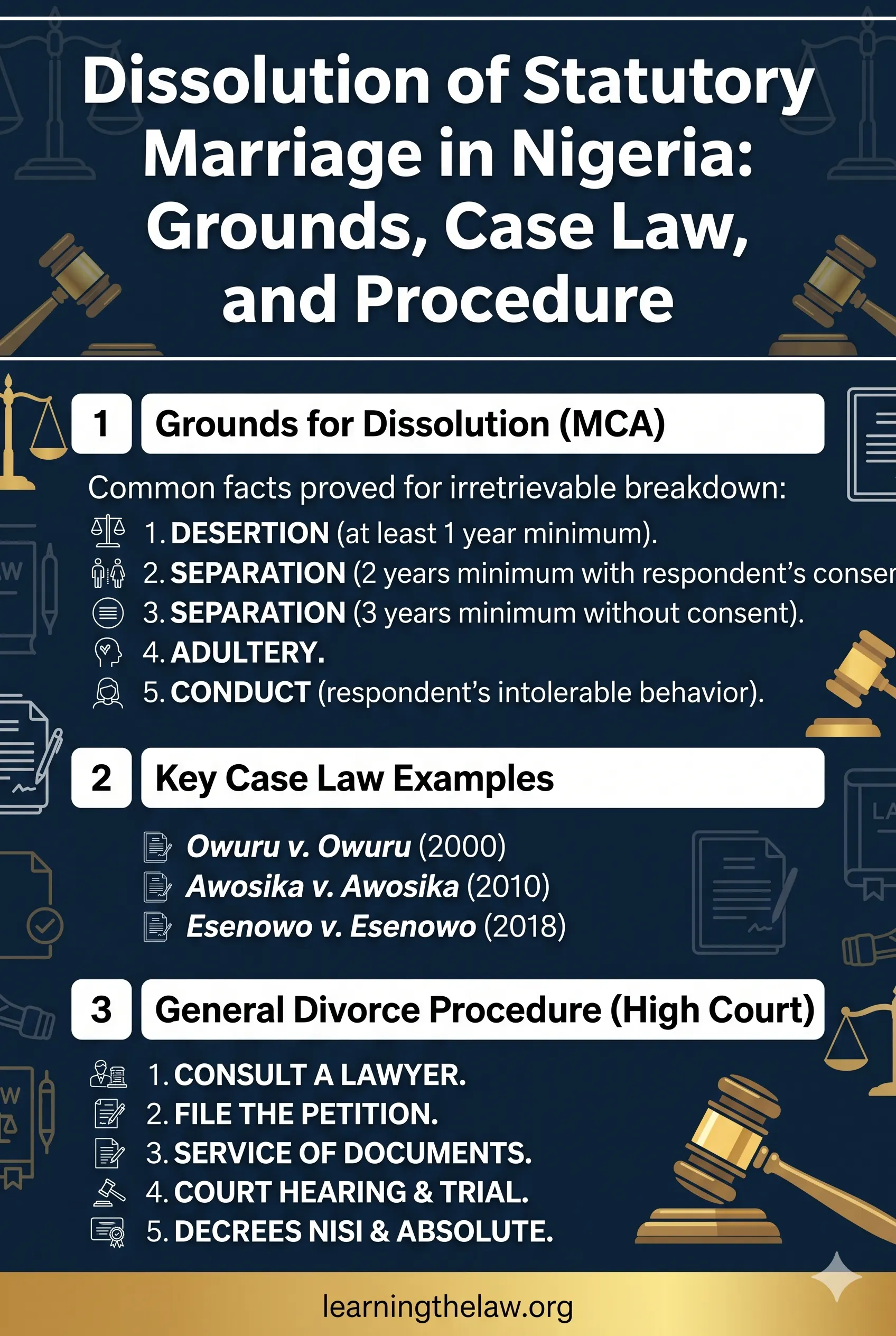
If you need a foundational introduction to the types of marriage in Nigeria and the general divorce process, start with our Marriage and Divorce Law in Nigeria guide. This article builds on that foundation and goes deeper — into the case law, statutory construction, and doctrinal arguments you are expected to engage with at the 300L level or 200L in some schools.
What is a Matrimonial Cause?
A matrimonial cause is a proceeding for a decree of dissolution of marriage, nullity of marriage, judicial separation, or restitution of conjugal rights. An appeal against a decision in a matrimonial cause is itself still a matrimonial cause. See Section 114 MCA; Harriman v. Harriman (1989) 5 NWLR pt 119 at 6.
Dissolution of statutory marriage in Nigeria is governed primarily by the Matrimonial Causes Act, Cap M7, Laws of the Federation of Nigeria 2004 (originally the Matrimonial Causes Act 1970). The Act borrowed significantly, with modifications, from the Australian Matrimonial Causes Act 1959 and the English Divorce Reform Act 1969.
The critical shift in modern Nigerian divorce law is the abolition of the “matrimonial offence” model. Under the old law, divorce required proving a specific wrong by one spouse. Today, the sole inquiry is: has the marriage broken down irretrievably? Per Section 15(1) MCA. If so, one of the facts under Section 15(2) must be proved. The court will then dissolve the marriage irrespective of who is to blame. See Sowande v. Sowande (1969) 1 ALL NLR 482.
The Two Hurdles: A Structural Overview
Before a decree of dissolution is granted, a petitioner must clear two distinct hurdles:
Hurdle One — The Two-Year Rule (Section 30 MCA): Has the marriage subsisted for at least two years? Proceedings for dissolution cannot be instituted within two years of marriage, except by leave of court.
Hurdle Two — Irretrievable Breakdown (Section 15 MCA): Has the marriage broken down irretrievably, demonstrated by at least one of the eight facts under Section 15(2)?
Both hurdles are mandatory. Satisfying one without the other is fatal to the petition.
Hurdle One: The Two-Year Rule (Section 30 MCA)
The Rule
Section 30(1) MCA provides that proceedings for dissolution shall not be instituted within two years after the date of the marriage, except by leave of court. The rationale is to deter impulsive divorces and compel parties to make a genuine effort to sustain the marriage through early difficulties.
Exceptions: Leave of Court
Leave may be granted before the expiry of two years only where the petitioner establishes either:
(a) Exceptional Hardship — suffering of a kind beyond the ordinary discomforts of a troubled marriage.
In Fletcher v. Titt (1979) 10 FLR 151, the wife applied for leave within the first year, alleging her husband had beaten her and twice attempted to strangle her while drunk, and that their cohabitation in the same police station was affecting her work performance. Leave was granted. The hardship was both physical and professional — demonstrably exceptional.
In Cooper v. Cooper (1981) 4 Cam LJ 52, the husband had concealed his sterility from the wife before marriage. The court held that deliberately withholding such information constituted exceptional hardship on the wife who had married with a reasonable expectation of children. Leave was granted.
See also Woolf v. Woolf (1978) 9 FLR 216.
(b) Exceptional Depravity — conduct by the respondent that is shockingly immoral or grossly degrading.
Note that the two grounds are not mutually exclusive. A petitioner may rely on both in the same application.
Important Exclusions from the Two-Year Rule
Notwithstanding Section 30, the following facts permit a petition to be filed at any time without leave, including within two years:
- Wilful and persistent refusal to consummate — Section 15(2)(a)
- Adultery — Section 15(2)(b)
- Rape, sodomy, or bestiality
This reflects the legislature’s recognition that waiting two years is unreasonable where such conduct is alleged from the outset.
Hurdle Two: Irretrievable Breakdown — Section 15 MCA
The Sole Ground
Section 15(1) establishes irretrievable breakdown as the only ground for divorce. In Harriman v. Harriman (supra), the Supreme Court confirmed that the eight facts under Section 15(2)(a–h) are not separate independent grounds. They are “various aspects of the breakdown” — factual circumstances through which a court may conclude that irretrievable breakdown has occurred.
This means: a petitioner who proves one or more of the facts under Section 15(2) is entitled to a finding that the marriage has broken down irretrievably, and consequently to a decree of dissolution.
The Eight Facts Under Section 15(2)
(a) Wilful and Persistent Refusal to Consummate — Section 15(2)(a)
The petitioner must show that the respondent has wilfully and persistently refused to consummate the marriage, and that as of the commencement of the hearing, the marriage remains unconsummated.
What is “consummation”?
In D-E v. D-A (1845) 1 Robinson Report 279 at 288, Lord Lushington stated that consummation “must be ordinary and complete and not partial and imperfect.” This definition has been repeatedly applied in Nigerian courts.
In K v. W, the wife petitioned for nullity on the ground of the husband’s incapacity or, in the alternative, his wilful refusal to consummate. Brandon J. granted the decree, holding that the question of consummation is primarily a question of fact. Evidence showed the husband’s penetration during intercourse was brief and without emission inside or outside the wife.
In R v. R (1952) 1 ALL ER 1194, it was held that a marriage is not consummated where the husband, though capable of penetration, cannot sustain an erection for more than a short period. Contrast: sterility is irrelevant to consummation — if penetration occurs, the marriage is consummated regardless of the ability to procreate. See S v. S (No 2) (1962) 13 ALL ER 55.
See also Owobiyi v. Owobiyi and Kuti v. Kuti (HC Oyo State) Suit No I/153/1982.
What is “wilful”?
Wilful means deliberate, conscious, and continuous refusal after repeated opportunities and requests by the petitioner. Mere neglect or reluctance does not qualify. The refusal must be intentional, not the result of medical incapacity (which is a ground for nullity, not divorce).
Historical note: Wilful refusal to consummate was previously a ground for nullity under earlier law. Under the MCA 1970, it was reclassified as a circumstantial fact establishing irretrievable breakdown. In Dorcas Fajemisin v. Emmanuel Fajemisin, the wife alleged both the husband’s impotence (nullity ground) and his wilful refusal to consummate. The court annulled the marriage on the ground of impotence, but the case illustrates how the two may be pleaded in the alternative.
Section 21 MCA — the three-year limitation: Where three years have elapsed since the marriage and the parties have lived together for part of that time, the court may refuse to grant a decree based solely on non-consummation. This reflects the legislature’s reasoning that three years of cohabitation is inconsistent with non-consummation being the real cause of breakdown.
(b) Adultery and Intolerability — Section 15(2)(b)
Section 15(2)(b) requires the court to be satisfied that since the marriage, the respondent has committed adultery and the petitioner finds it intolerable to live with the respondent.
This is a two-element test. Both must be proven independently.
Defining Adultery
Adultery is “consensual sexual intercourse between a married person and a person of the opposite sex not being the other spouse, during the subsistence of the marriage.” This definition, drawn from Raiden on Divorce (12th ed., p.189), has been adopted in numerous Nigerian decisions including Atiogbe v. Atiogbe.
Key doctrinal points:
- At least partial penetration is required — an attempt without penetration is insufficient: Dennis v. Dennis; Tobi v. Uba.
- Because adultery is a voluntary act, intercourse while drunk or under duress does not amount to adultery.
- Artificial insemination is not adultery: Maclennen v. Maclennen (1958) Scots Law Times Report 12; Redpath v. Redpath (1950) 1 ALL ER 600.
- At least one party must be married at the time of the act: Chorton v. Chorton (1952) 1 ALL ER 611; Abson v. Abson (1952) Probate 55.
Proof of Adultery
The burden of proof lies on the petitioner alleging adultery: Williams v. Williams; Kofi v. Kofi. The standard of proof is the civil standard — preponderance of probability (balance of probabilities). Where adultery is also a crime in the relevant jurisdiction, a higher standard applies.
Adultery is typically proved by circumstantial evidence. Direct evidence (eyewitness testimony of the sexual act) is rare and not required. The court draws inferences from:
- Indecent familiarity and excessive attention between a spouse and a third party
- Unexplained pregnancies — where a husband and wife are separated and the wife becomes pregnant, adultery may be inferred
- Confessions by either party or the co-respondent (though the court will scrutinize these carefully)
- Opportunity and inclination (cohabitation with a third party, hotel records, messages)
Intolerability — the Subjective Test
The intolerability limb is assessed subjectively: does this petitioner find it intolerable to live with this respondent? The court does not ask whether a reasonable person would find it intolerable. See Goodrich v. Goodrich (1971) 7 ALL ER 1340; Ogunleye v. Ogunleye Vol 1 Fed. Rep. of Nig. L.R. p.22; Fajembola v. Fajembola (1974) 12 CCHCJ.
Critically, the intolerability need not be caused by the adultery. The two limbs are independent. In Cleary v. Cleary (1974) 1 ALL ER 498, the wife committed adultery, the husband took her back, but she continued corresponding with the other man and eventually left. The husband found it intolerable to live with her — not because of the adultery per se, but because of her subsequent conduct. The court granted the decree. The same principle applies under the Nigerian MCA, whose Section 15(2)(b) is virtually identical to the English provision considered in Cleary.
Joinder of Co-Respondent
Under Section 32 MCA, where adultery is alleged, the petitioner must join the third party (co-respondent) unless the co-respondent is not named or the court dispenses with joinder. This allows the co-respondent an opportunity to contest the allegation and protects them from reputational damage without hearing.
(c) Unreasonable Behaviour — Section 15(2)(c)
The court must be satisfied that the respondent has behaved in such a way that the petitioner cannot reasonably be expected to live with the respondent.
The Test
Unlike adultery (subjective intolerability), the test for unreasonable behaviour is objective-subjective: would a reasonable person with the petitioner’s characteristics — background, health, temperament — find it unreasonable to continue living with the respondent given the respondent’s conduct? The court considers both the nature of the behaviour and the petitioner’s capacity to bear it.
Categories of Unreasonable Behaviour
There is no closed list. The following categories have consistently been recognised:
- Physical violence: Assault, domestic battery, threats to life. Even isolated incidents of grave violence may suffice.
- Verbal and psychological abuse: Persistent humiliation, insults, threatening conduct, coercive control.
- Financial misconduct: Deliberate financial ruin, gambling of family funds, refusal to maintain despite capacity.
- Habitual intoxication or drug addiction affecting family welfare.
- Sexual misconduct beyond adultery: coerced acts, exposure to disease, perversion.
- Neglect of conjugal and parental duties: Persistent abandonment of family responsibilities.
- Criminal conduct bringing disgrace or danger to the family.
The cumulative effect of lesser conduct may collectively satisfy the test even if no single act would independently do so. Courts adopt a holistic view of the marriage.
(d) Desertion for One Year — Section 15(2)(d)
The petitioner must prove that the respondent has deserted the petitioner for a continuous period of at least one year immediately before the presentation of the petition.
Elements of Desertion
Four elements are required:
- Factum of separation — the respondent has ceased to cohabit with the petitioner.
- Animus deserendi — the respondent intends the separation to be permanent.
- Without the petitioner’s consent — consensual separation is not desertion.
- Without just cause — the respondent has no reasonable justification for the separation.
The period of one year must be continuous and must immediately precede the petition. A brief reconciliation interrupts the period and resets the clock.
Constructive Desertion — Section 18 MCA
Where the petitioner’s own conduct has driven the respondent out of the matrimonial home, the petitioner is treated as the deserting party, even though they remained in the home. The physical departure is the respondent’s; the legal desertion is the petitioner’s.
In Willy Olujide v. Modupe (1959) B Customary Court, Ilesa, the husband petitioned on grounds of cruelty and desertion — the wife had stayed in another man’s house without the husband’s consent for a number of days. The court granted the divorce, treating the wife’s conduct as both cruel and desertion.
Animus must persist throughout the period. A respondent who is willing to return but is refused by the petitioner is not in desertion — the animus has been abandoned.
(e) Two Years’ Separation with Consent — Section 15(2)(e)
The petitioner must show that the parties have lived apart for a continuous period of at least two years immediately before the petition, and that the respondent consents to a decree being granted.
“Living Apart”
Parties live apart when they do not live in the same household. Continued residence under the same roof may still constitute living apart if they maintain entirely separate domestic arrangements. Courts examine the quality of the relationship, not merely the physical address.
Consent
Consent must be genuine, informed, and subsisting at the time the decree is sought. A respondent may withdraw consent at any time before the decree nisi is made absolute if circumstances change (e.g., if they discover they were misled about terms).
(f) Three Years’ Separation Without Consent — Section 15(2)(f)
Where the parties have lived apart for three continuous years immediately before the petition, the court may grant a decree regardless of whether the respondent consents.
The respondent may oppose the petition on factual grounds (contesting the duration or continuity of separation) but cannot defeat it merely by withholding consent. Three years’ separation is treated as conclusive evidence of irretrievable breakdown.
(g) Failure to Comply with Restitution of Conjugal Rights — Section 15(2)(g)
Where a decree of restitution of conjugal rights was previously granted against the respondent and the respondent has failed to comply with it for one year immediately before the petition, this constitutes a fact establishing irretrievable breakdown.
Restitution of conjugal rights is an order compelling a deserting spouse to resume cohabitation. Its practical relevance is limited today, but it remains a valid statutory remedy. Defiance of such an order for a full year is cogent evidence the marriage cannot be revived.
(h) Presumption of Death — Section 15(2)(h)
The court may grant a decree where the respondent has been absent for such time and in such circumstances that the petitioner has reasonable grounds to presume the respondent dead.
Under the Evidence Act, a person absent for seven continuous years without contact or information about their whereabouts is presumed dead. The petitioner must demonstrate:
- The date and circumstances of the respondent’s disappearance
- Genuine and reasonable efforts made to locate the respondent (police reports, inquiries through family, social media)
- Seven years of continuous absence with no reliable information that the respondent is alive
The Bars to Divorce
Even where a petitioner proves one or more facts under Section 15(2), the court may be precluded from granting a decree by operation of the bars under Section 26 MCA (absolute bars) and Section 28 MCA (discretionary bars).
Absolute Bars — Section 26 MCA
The following bars are absolute. Once established, the court has no discretion — it cannot grant the decree.
1. Condonation
Condonation occurs where the petitioner, with knowledge of the respondent’s matrimonial offence, forgave the respondent and reinstated them to their previous marital position. The condoned offence cannot thereafter be relied upon as a ground for divorce.
Elements of condonation:
- Knowledge of the specific offence
- Forgiveness — express or implied
- Reinstatement — treating the respondent as though the offence had not occurred; most clearly evidenced by resumption of sexual intercourse with knowledge of the offence
- Intention to remit the wrong completely
The strongest evidence of reinstatement is the resumption of sexual relations following knowledge of the adultery or other offence. A single act of intercourse after discovery of adultery may constitute condonation.
What does NOT constitute condonation:
- Continuing to cohabit under duress or financial necessity without forgiveness
- Remaining together temporarily for children’s welfare
- Mere toleration without genuine forgiveness
- Absence of knowledge of the full extent of the offence
Revival of condoned offences:
A condoned offence is “revived” by a subsequent matrimonial offence by the respondent. Forgiveness was conditional on improved behaviour. A fresh offence destroys the condition and restores the petitioner’s right to rely on the previously condoned conduct. This doctrine is essential to understand — a student who fails to address it in an exam question on condonation will lose significant marks.
Condonation does not bar nullity proceedings. In Etebu v. Etebu, the Court of Appeal held that condonation prevents reliance on a condoned act in divorce but does not prevent nullity proceedings. A void marriage does not acquire validity through the parties’ subsequent conduct or forgiveness.
2. Connivance
Connivance is the petitioner’s active or passive participation in, or consent to, the respondent’s matrimonial offence, particularly adultery. A petitioner who helped bring about the very wrong they now complain of cannot use that wrong as a ground for divorce.
Active connivance: Directly arranging or encouraging the respondent to commit adultery; introducing the respondent to a paramour; providing resources for the affair.
Passive connivance: Deliberately ignoring unmistakable evidence of adultery with the intent to let it occur; turning a blind eye when intervention was possible. Note: passive connivance requires more than mere knowledge after the fact — it requires deliberate inaction with the purpose of allowing the offence.
Connivance is rarely successfully pleaded. The respondent bears the burden of proving it.
3. Collusion
Collusion is an agreement between the parties to deceive the court into granting a divorce, either by fabricating or suppressing evidence, manufacturing grounds, or pre-arranging the proceedings.
Examples of collusion:
- Staging a fictitious adultery to create grounds
- Pre-arranging property settlements and then misrepresenting them to court
- Agreeing not to defend known false allegations
- Suppressing evidence of reconciliation or condonation
Where collusion is established, the court dismisses the petition. Consequences may extend to contempt of court proceedings and, where affidavits were sworn on false facts, criminal prosecution for perjury.
Distinction from consent: A petitioner and respondent who genuinely agree the marriage has broken down and cooperate in presenting honest evidence are not colluding. Collusion requires the element of deception of the court.
Discretionary Bars — Section 28 MCA
The court may (not must) refuse to grant a decree where:
- The petitioner has committed adultery which the respondent has not condoned
- The petitioner has wilfully deserted the respondent before the matters relied upon occurred
- The petitioner has engaged in other conduct making it unjust to grant the decree
These are not absolute. The court exercises genuine discretion, weighing all circumstances. A petitioner’s own adultery does not automatically bar their petition — it is a factor among many. Context matters: adultery committed in response to the respondent’s prior cruelty carries different weight from adultery committed as a first cause.
Procedure: From Petition to Decree Absolute
Section 11 MCA — Certificate of Reconciliation
Before filing, the petitioner’s legal practitioner must certify that they have discussed with the petitioner the possibility of reconciliation and that, in the practitioner’s view, reconciliation is not practicable in the circumstances. Without this certificate, the court will not accept the petition. This is a mandatory, not a formality.
The Petition
The petition must state:
- The parties’ details and date/place of marriage
- The fact(s) relied upon under Section 15(2)
- Specific particulars of conduct — dates, events, witnesses
- Ancillary relief sought (custody, maintenance, property)
It is accompanied by a verifying affidavit sworn by the petitioner.
Jurisdiction lies in the State High Court of the petitioner’s domicile or last place of cohabitation. Domicile is a prerequisite to jurisdiction — see Osibamowo v. Osibamowo (1991) 3 NWLR pt.177 at 85. On the rules of domicile and spousal domicile under the MCA, see our introductory guide.
Service and Response
The respondent must be served personally. Upon service, the respondent has 28 days to file an Answer. Options include: admitting the petition (undefended proceedings), filing a defence, or cross-petitioning on separate facts. Non-response permits the petitioner to proceed on an undefended basis.
Trial
Defended petitions proceed to trial. The petitioner bears the burden of proof on the balance of probabilities. The standard is civil — not criminal. Evidence is presented through sworn testimony and documentary exhibits. Witnesses are subject to cross-examination.
The court will not grant a decree merely because both parties desire one. In undefended proceedings, the court still examines the evidence to be satisfied grounds genuinely exist.
Decree Nisi
If satisfied, the court grants a decree nisi — a conditional order for dissolution. Section 58 MCA requires a three-month waiting period before the decree can be made absolute.
The three-month period allows for:
- Reconciliation (if parties change their minds)
- Appeals from either party
- Intervention by interested third parties
Section 68 MCA — Children’s Welfare and Decree Absolute
Where there are children under 16 years of age, the court must be satisfied that proper arrangements have been made for their welfare before making the decree absolute. This is a jurisdictional requirement, not a discretion. The court will not make a decree absolute in defiance of it.
If the court is satisfied with arrangements for children, the waiting period may be reduced to 28 days.
Either party may apply for decree absolute after the waiting period has elapsed. The registrar, upon confirming compliance with all requirements, issues the decree absolute — the final, irrevocable order dissolving the marriage.
Ancillary Relief
The MCA empowers the court to make orders beyond mere dissolution. These are called “ancillary relief” — relief ancillary to the main petition.
Custody and Access — Section 68 MCA
The court may make orders as to the custody and access of children of the marriage. The paramount consideration is the welfare of the children, not the preference of either parent. Both parents’ conduct, financial capacity, and emotional fitness are relevant.
Unlike customary law (where the father has default custodial rights), statutory marriage places the child’s welfare at the centre. See our forthcoming note on custody jurisprudence under customary law for the contrast.
Maintenance — Section 70 MCA
The court may order either spouse to pay maintenance to the other. Relevant considerations include:
- The financial means and earning capacity of each party
- The standard of living enjoyed during the marriage
- Age, health, and any disability affecting earning capacity
- Contributions to the marriage (financial and domestic)
- The length of the marriage
Maintenance may be periodic (monthly payments) or a lump sum. It may also be varied or discharged by subsequent order if circumstances change significantly.
Property Settlement — Section 72 MCA
The court has jurisdiction to make orders for the settlement or transfer of property. Nigerian law does not adopt a community property regime. The court examines:
- Direct contributions to property acquisition
- Indirect contributions (homemaking, child-rearing, enabling the other spouse to earn)
- The parties’ future needs
- The welfare of any children
A spouse who did not contribute financially but who sustained the household and raised children has made indirect contributions that the court will recognise.
Dissolution of Double-Deck Marriages
A recurring 300L examination issue concerns the effect of dissolution on a double-deck marriage — where parties contracted both a customary law and a statutory marriage. On the conversion theory (the dominant judicial approach), the customary marriage is converted and superseded by the subsequent statutory marriage. Consequently:
- Dissolution of the statutory marriage is sufficient to end the marriage entirely
- The customary marriage does not revive after the statutory marriage is dissolved
- There is no need to separately dissolve a customary marriage that has been converted
See Teriba v. Teriba and Rickett: “the true position is that the customary marriage is converted by the Act marriage which in effect supersedes it. Therefore, if the Act marriage is subsequently dissolved, the customary marriage cannot revive.”
For a detailed treatment of the conversion versus co-existence theories, see our forthcoming article on Double Deck Marriage.
Recommended Cases Summary
| Case | Point |
|---|---|
| Harriman v. Harriman (1989) 5 NWLR pt 119 | s.15(2) facts are not separate grounds; irretrievable breakdown is the sole ground |
| Sowande v. Sowande (1969) 1 ALL NLR 482 | Animus deserendi; decree nisi ordered |
| Cleary v. Cleary (1974) 1 ALL ER 498 | Intolerability need not be caused by the adultery |
| Goodrich v. Goodrich (1971) 7 ALL ER 1340 | Intolerability test is subjective |
| D-E v. D-A (1845) 1 Robinson Report 279 | Consummation must be “ordinary and complete” |
| Maclennen v. Maclennen (1958) | Artificial insemination is not adultery |
| Fletcher v. Titt (1979) 10 FLR 151 | Exceptional hardship: leave granted within 2 years |
| Cooper v. Cooper (1981) 4 Cam LJ 52 | Concealment of sterility = exceptional hardship |
| Etebu v. Etebu | Condonation bars divorce; does not bar nullity |
| Teriba v. Teriba and Rickett | Conversion theory: statutory marriage supersedes customary |
| Osibamowo v. Osibamowo (1991) 3 NWLR pt 177 | Domicile is a jurisdictional prerequisite |
Recommended Reading
- Nwogugu, E.I., Family Law in Nigeria (3rd ed.) HEBN Publishers, Ibadan, 2015
- Sagay, Itse, Nigerian Family Law, Malthouse Press, Lagos, 1999
- Adesanya, S.A., Laws of Matrimonial Causes, Ibadan University Press, 1997
- Matrimonial Causes Act, Cap M7, LFN 2004
This article is part of the Family Law II (LPP 306) series on learningthelaw.org. For the introductory treatment of marriage types and general divorce procedure, see Marriage and Divorce Law in Nigeria. For dissolution of customary law marriage and Islamic marriage, see the forthcoming 300L notes in this series.

Kolawole Adebowale is a law graduate of the University of Ibadan with a specialization in intellectual property law, digital patent enforcement, and software law. His research focuses on the intersection of technology and IP protection in Nigeria’s emerging digital economy, with comparative analysis spanning multiple jurisdictions. He is a member of the Law Students Association of Nigeria (LAWSAN) and the IP Association.