8:00 - 19:00

Our Opening Hours Mon. - Fri.

975.789.098

Always online

Facebook

Twitter

Search
 

Class Notes

LearningTheLaw > Class Notes (Page 10)

Foundations of Criminal Liability: The Historical Evolution and Dual Legal Codes of Nigeria

Understanding Nigerian criminal law requires understanding its history. Nigeria's criminal law system is split into two: the Criminal Code governs the Southern States, while the Penal Code governs the Northern States. This division comes from British colonial rule and the different legal systems that existed before colonization.[^1] Before the British Came Before the British arrived, Nigeria wasn't lawless. Different communities had their own ways of handling crime and maintaining order. In the South, criminal law was unwritten.[^2] Villages and families handled disputes based on customs passed down orally. These systems focused on making things right between people, not on locking people up. Punishments...

Continue reading

Conspiracy in Nigerian Criminal Law: When Agreement Becomes a Crime

Understanding the Inchoate Offence That Makes Planning a Crime Even Before Action What if three people sit in a room and agree to rob a bank—but never actually rob it? Can they be prosecuted? What if they're arrested while planning, before anyone picks up a weapon? The answer is yes, through the offence of conspiracy. Nigerian law recognizes that when multiple people agree to commit a crime, they become more dangerous than individuals acting alone. The law doesn't wait for them to execute their plan—the agreement itself is a crime. This comprehensive guide explains conspiracy under Nigerian law—how it's defined under both the...

Continue reading

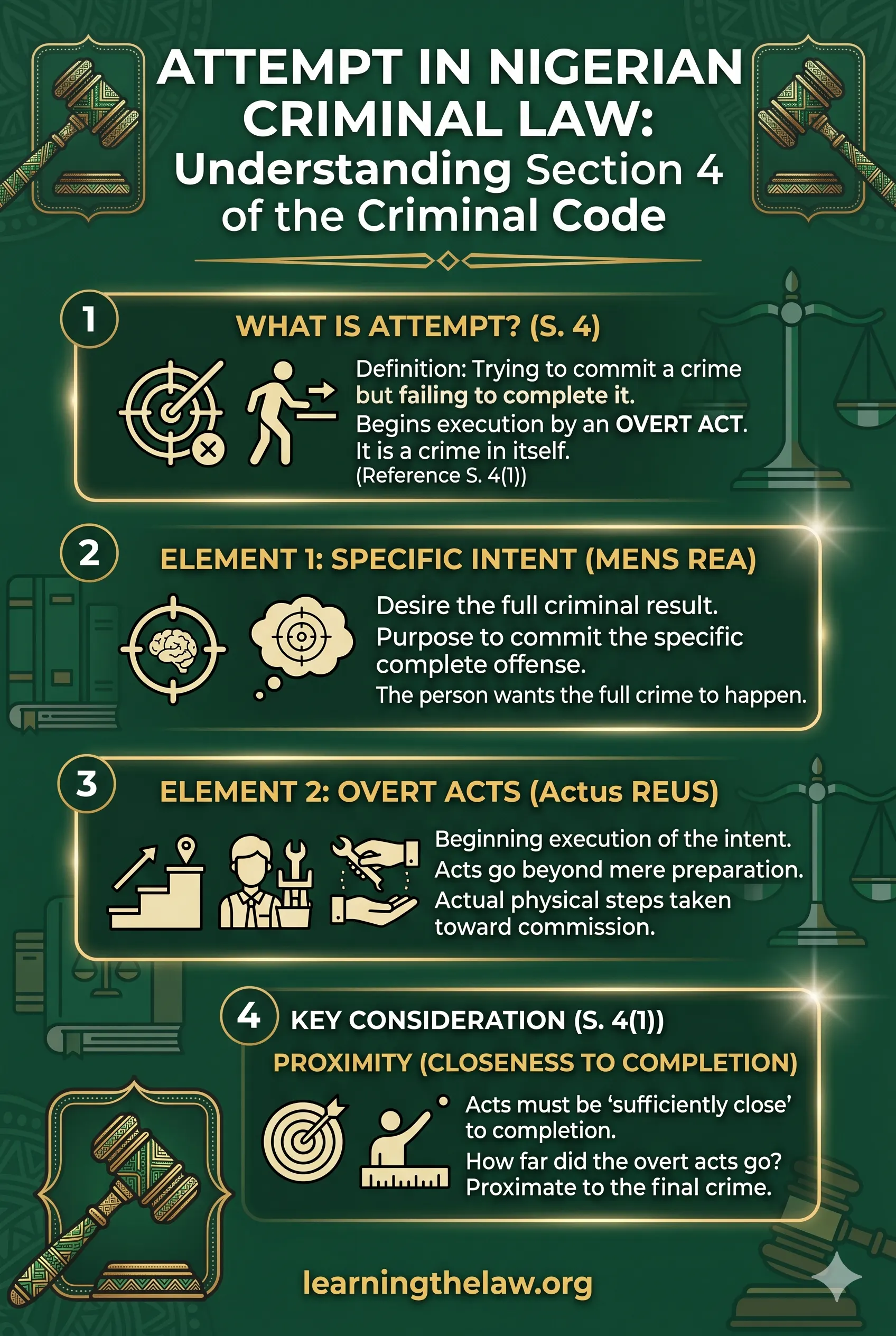
Attempt in Nigerian Criminal Law: Understanding Section 4 of the Criminal Code

Attempt in Nigerian Criminal Law: Understanding Section 4 of the Criminal Code

When Does Trying to Commit a Crime Become a Crime Itself? What if someone tries to kill you but the gun jams? What if a thief breaks into your house but runs away before taking anything? What if someone plans to rob a bank but gets arrested while loading their getaway car? In each case, the full crime wasn't completed. But should the law wait until harm actually occurs before intervening? Nigerian criminal law says no. Through the offence of Attempt, the law punishes those who try to commit crimes, even if they fail. This guide explains everything about attempt under Section 4...

Continue reading

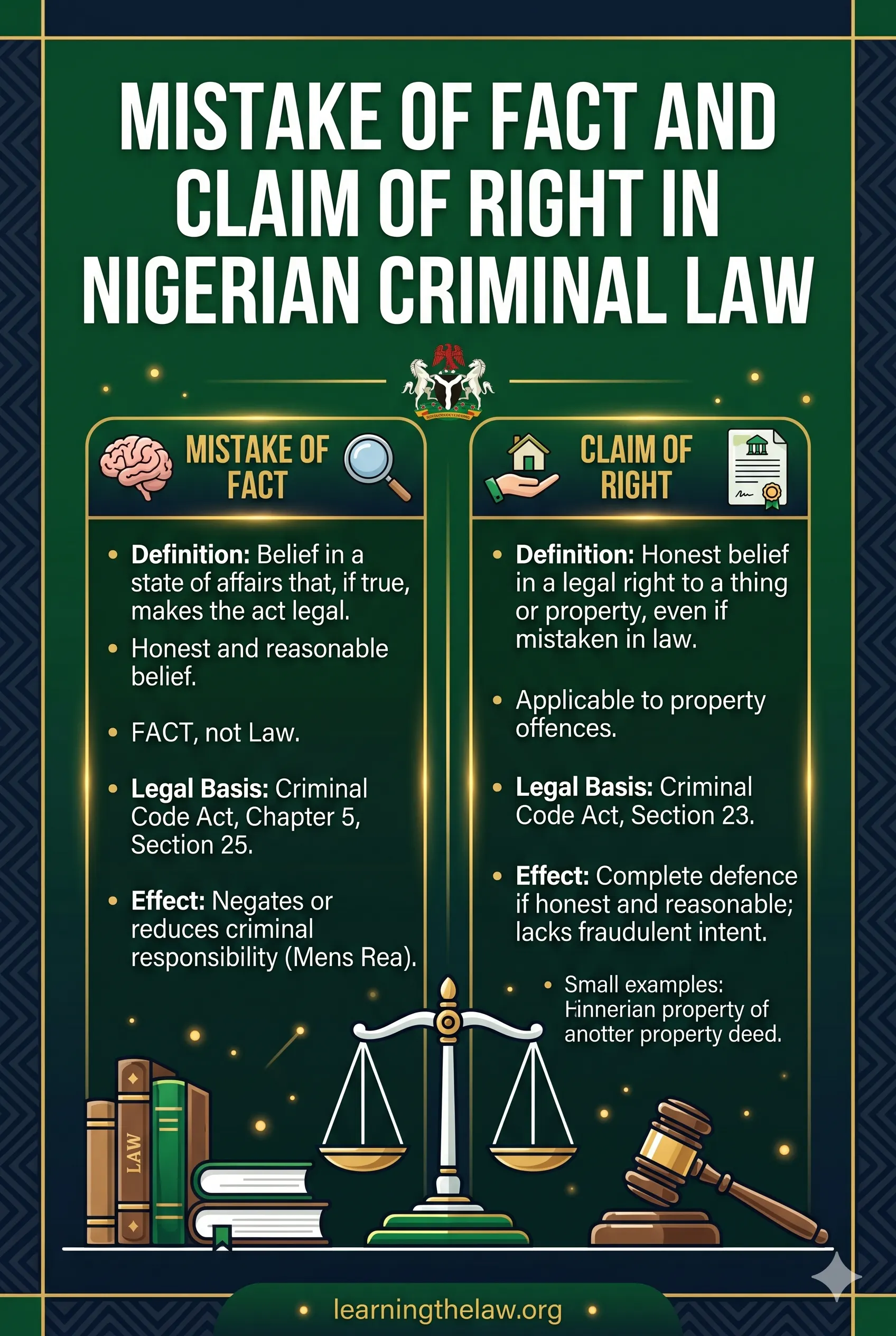
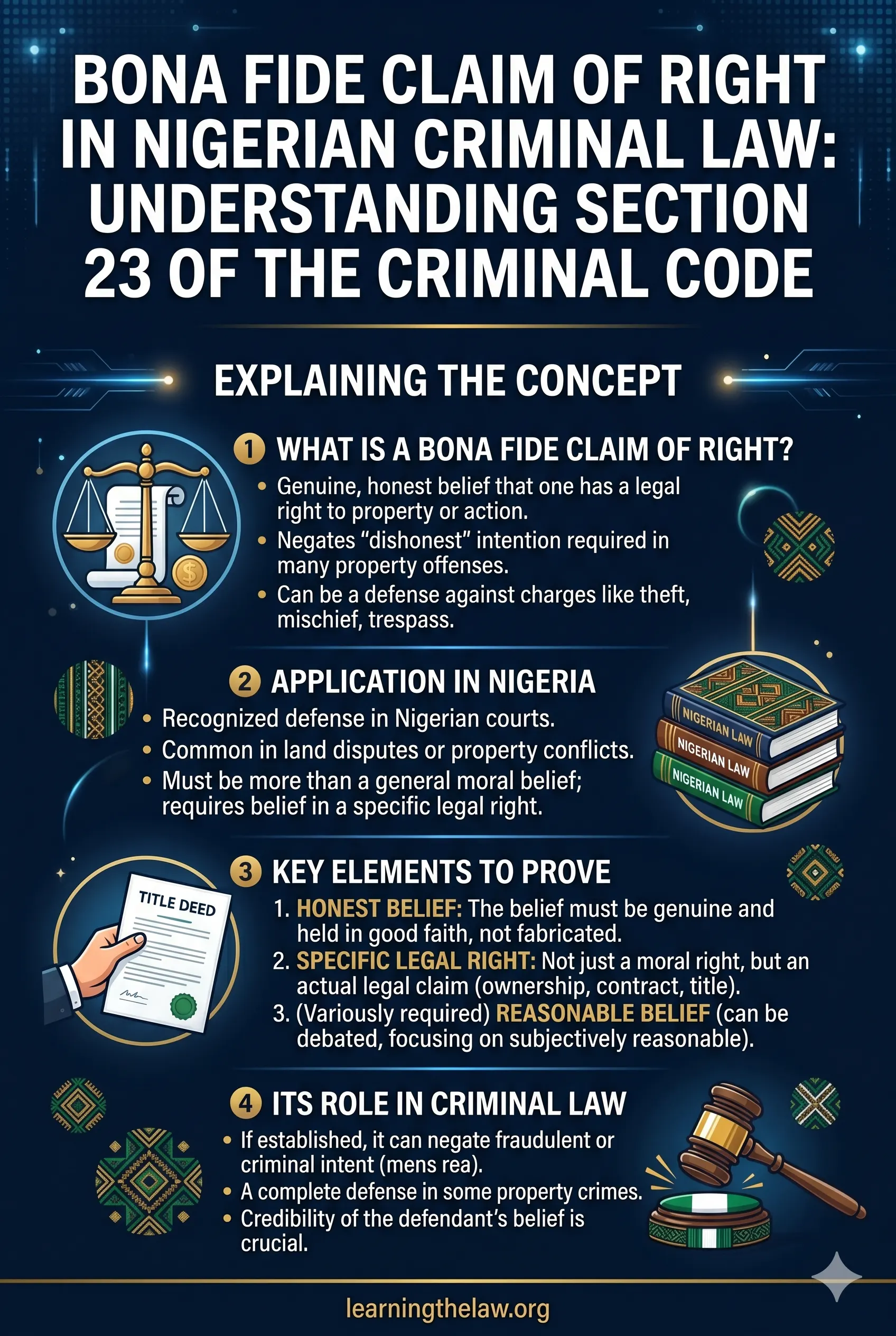
Bona Fide Claim of Right in Nigerian Criminal Law: Understanding Section 23 of the Criminal Code

Bona Fide Claim of Right in Nigerian Criminal Law: Understanding Section 23 of the Criminal Code

When Does an Honest Belief in Ownership Prevent Criminal Liability for Property Offences? Imagine you take your neighbor's generator because you genuinely believe it's yours—perhaps you lent one to them years ago, and this looks identical. You're arrested for theft. Can you be convicted if you honestly thought the generator belonged to you? This is where the Bona Fide Claim of Right defence comes in. It's a legal recognition that property disputes are often messy, confusing, and honest people can genuinely disagree about who owns what. Nigerian law won't criminalize you for taking property you honestly believe is yours—but only if your...

Continue reading

Alibi in Nigerian Criminal Law: The Defence of Being Elsewhere

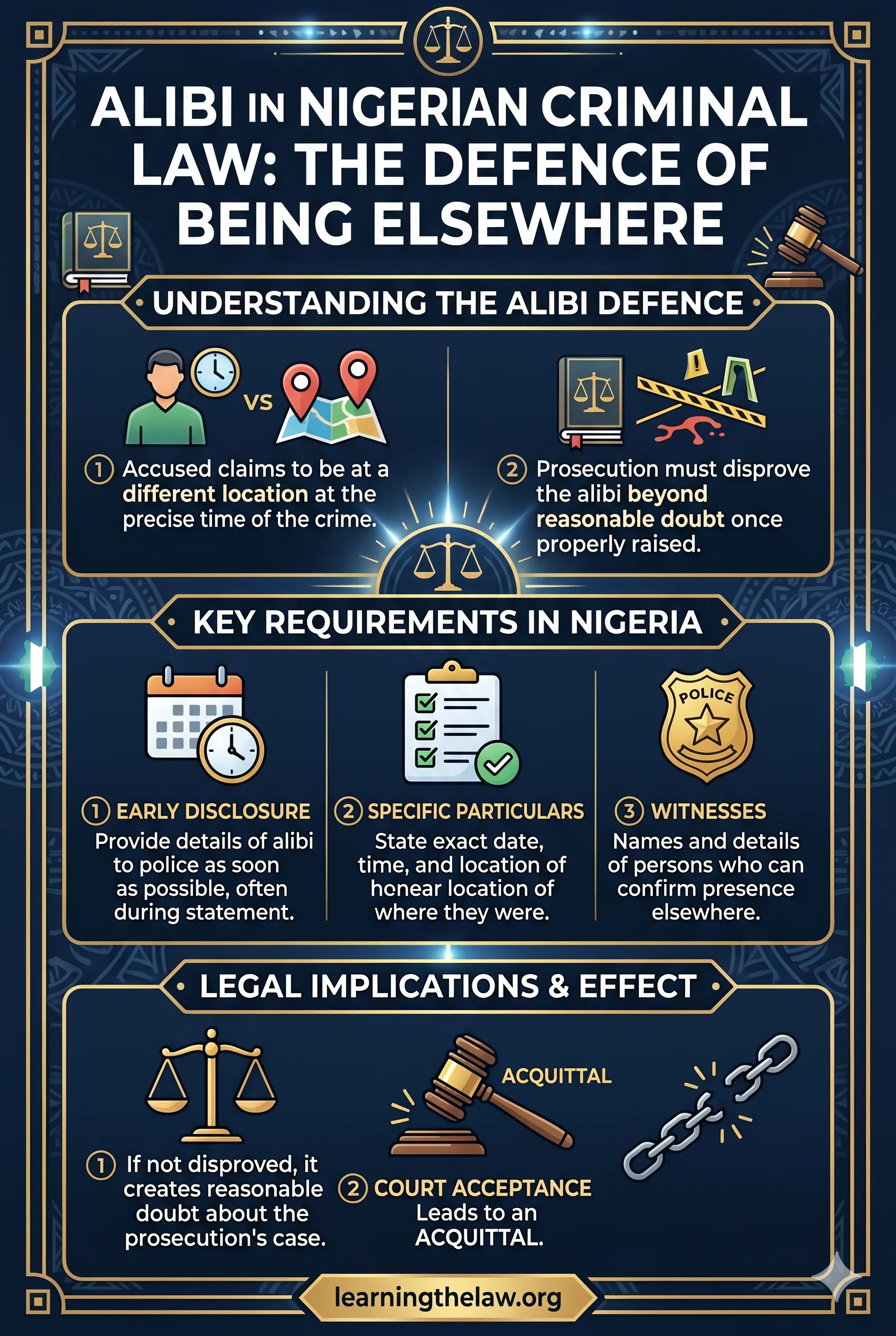
Alibi in Nigerian Criminal Law: The Defence of Being Elsewhere

Understanding the Radical Defence That Can Destroy the Prosecution's Case Completely Have you ever watched a crime thriller where someone accused of murder proves they were at a restaurant across town when the crime happened? That's alibi in action. But in real Nigerian courtrooms, claiming "I wasn't there" isn't as simple as it sounds. The law demands precision, corroboration, and timely disclosure. Get it right, and you walk free. Get it wrong, and your alibi "collapses like a pack of cards." This guide explains everything you need to know about the defence of alibi under Nigerian criminal law—what it is, how it...

Continue reading

Non Est Factum in Nigerian Law: When Can You Escape a Signed Contract?

Non Est Factum in Nigerian Law: When Can You Escape a Signed Contract?

Have you ever signed a document without fully understanding what it was? Perhaps you were told it was one thing, but it turned out to be something completely different? In Nigerian contract law, there's a legal defense called "non est factum" that can protect you in such situations—but only under very specific circumstances. This guide explains what non est factum means, when you can use it, and how Nigerian courts decide whether someone can escape a contract they signed by mistake. What Does Non Est Factum Mean? Non est factum is a Latin phrase that literally means "it is not my deed." It's...

Continue reading

Mutual Mistake and Common Mistake in Nigerian Contract Law

Imagine you agree to buy a car from someone, and both of you believe the car exists in the seller's garage. Unknown to either of you, the car was stolen the night before. Can this agreement be enforced? This scenario illustrates one of the most important defenses in contract law: mistake. In Nigerian contract law, mistake occurs when one or both parties enter into a contract based on a false belief about important facts. Not every mistake will allow you to escape a contract, but certain types of mistakes are serious enough to make the contract either void (invalid from the...

Continue reading

FUNDAMENTAL OBJECTIVES AND DIRECTIVE PRINCIPLES OF STATE POLICY IN NIGERIA: AN ANALYSIS OF CHAPTER II OF THE 1999 CONSTITUTION

FUNDAMENTAL OBJECTIVES AND DIRECTIVE PRINCIPLES OF STATE POLICY IN NIGERIA: AN ANALYSIS OF CHAPTER II OF THE 1999 CONSTITUTION

One of the most significant innovations in Nigeria's constitutional development is the inclusion of Chapter II on Fundamental Objectives and Directive Principles of State Policy. This chapter, spanning sections 13 to 24 of the Constitution of the Federal Republic of Nigeria 1999 (as amended), represents a bold attempt at constitutionalizing socio-economic rights and setting out the guiding principles for governance in Nigeria.1 The chapter contains provisions on political, economic, social, educational, environmental, cultural objectives. Understanding these provisions requires familiarity with the broader sources of constitutional law in Nigeria, national ethics, and the duties of citizens. It essentially defines the relationship between...

Continue reading

Ministerial Responsibility in Nigeria: Doctrine, Application and Constitutional Framework

Ministerial Responsibility in Nigeria: Doctrine, Application and Constitutional Framework

Ministerial responsibility is a fundamental constitutional doctrine that governs the conduct and accountability of ministers in democratic systems. Every act of government is usually done through ministers and their ministries, departments, offices and agencies under the ministry. This doctrine ensures that government officials remain accountable for their actions and policies, both individually and collectively.1 WHO IS A MINISTER? A minister is:2 A person at the head of a ministry or department of State Usually a member of Cabinet and holds the highest office in the ministry A political appointee with his or her tenure in office at the pleasure of the appointor,...

Continue reading

Constitutional Development in Nigeria: From Colonial Rule to Independence (1849-1960)

Constitutional Development in Nigeria: From Colonial Rule to Independence (1849-1960)

Nigeria's constitutional development is a fascinating journey through colonial administration to eventual independence. Understanding this evolution is crucial because many features of Nigeria's current constitutional framework can be traced back to these formative years. The path to independence was not direct or smooth – it involved multiple constitutional experiments, each building upon or reacting to the previous one. THE EARLY PERIOD: PRE-1914 Before 1914, there was no unified Nigeria. What existed were separate colonial territories administered by Britain. The territory that would become Nigeria consisted of: The Colony of Lagos (established 1862) The Protectorate of Southern Nigeria The Protectorate of Northern Nigeria Each...

Continue reading

Join our Newsletter

Join 1,000+ law students and professionals. Get our top-rated class notes and legal analysis delivered straight to your inbox every Tuesday and Friday.

We don’t spam! Read our privacy policy for more info.