

The Concept of the Family and Family Law
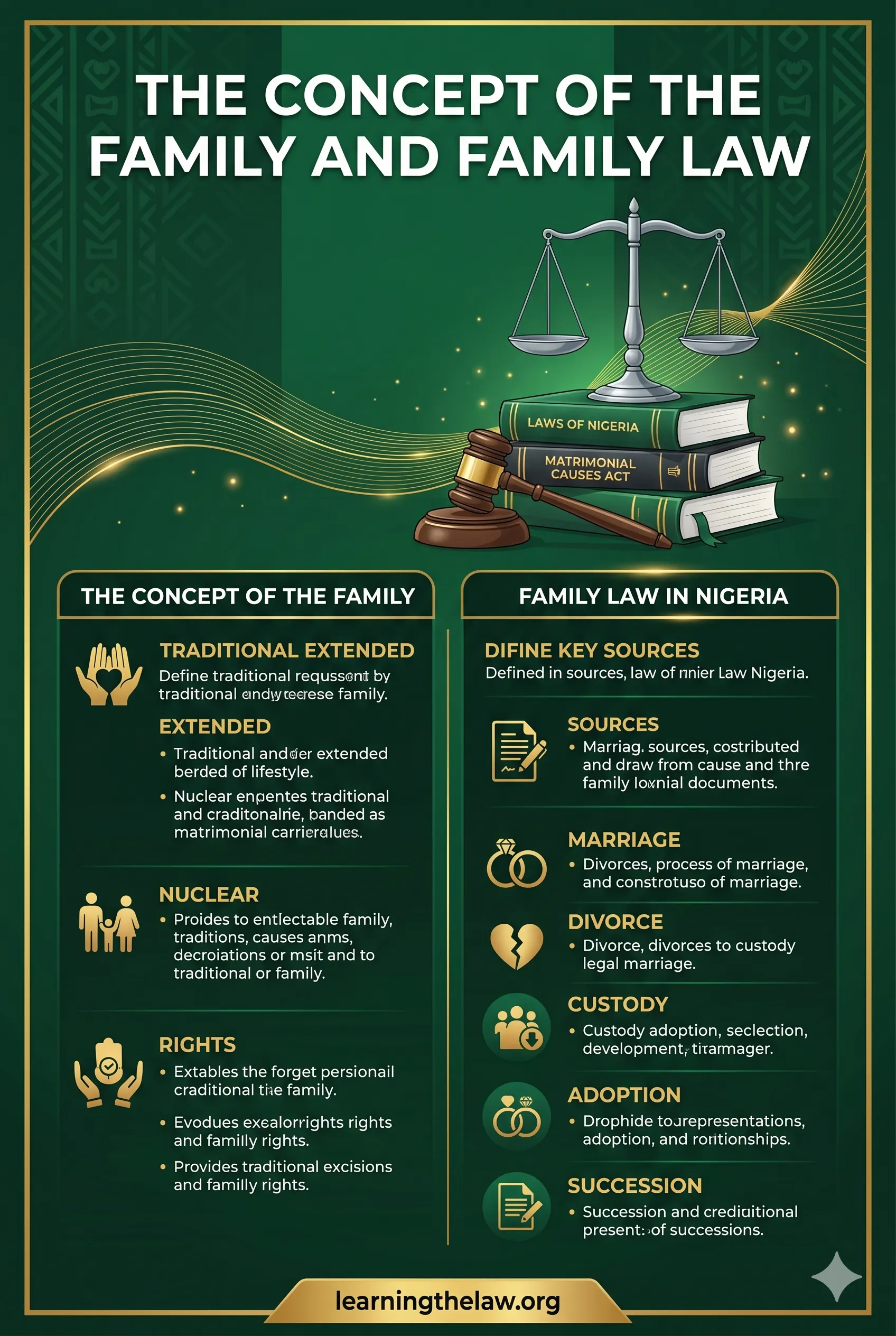
Family law is one of the most practically significant areas of legal study, touching the most intimate and consequential relationships in human life. Yet it begins with a deceptively simple question: what is a family? The difficulty of answering that question with precision shapes the entire discipline.
The concept of the family is, at once, very easy and very difficult to define. It is easy in the sense that most people can identify those they personally regard as family. It is difficult because one person’s definition is not necessarily another’s, and both may differ from the legal definition. A legal system cannot operate on purely subjective definitions. Law requires workable, coherent categories. Family law’s task, therefore, is to translate a deeply personal and culturally variable concept into a legally operative framework.
This article examines what a family is, what family law covers, and the key developments shaping the field in Nigeria and beyond. It serves as the conceptual foundation for the more specific topics covered in this series, including marriage formation, dissolution, and the legal status of children. For the overview of marriage types in Nigeria and how the law regulates them, see the Marriage and Divorce Law in Nigeria guide.
Defining the Family
Approaches to Definition
“Family” status can be determined by reference to several different criteria, and different legal systems weight these criteria differently:
Formal status: A family may be defined by reference to legally recognised relationships, chiefly marriage and parenthood. On this approach, a family consists of persons who are married to each other and the children born of or legally adopted into that marriage. The legal formalities, not the lived reality, determine membership.
Blood ties (consanguinity): Family membership may be determined by biological relationship. On this approach, the legal parent-child relationship follows from genetics, and extended family members share membership by descent from a common ancestor.
Self-determination: An alternative approach allows persons to define their own family relationships based on commitment, mutual support, and shared life, regardless of formal legal status or biological connection. This approach is more flexible but harder for legal systems to administer.
Combination approaches: Most legal systems use some combination of the above, giving weight to formal status while allowing blood ties and, increasingly, functional relationships to qualify or extend the definition.
In Fitzpatrick v. Sterling Housing Association Ltd [1998] 1 FLR 6 at 41, the court grappled with defining family membership in the context of a same-sex partner seeking to succeed to a tenancy. The court’s willingness to recognise a non-traditional household as a “family” for that purpose illustrates how courts adapt legal definitions to changing social realities.
The Nigerian Context
Nigeria’s pluralist legal framework complicates the definition further. Nigerian law recognises three distinct marriage systems, each with its own understanding of what constitutes a family:
Statutory law: Recognises the nuclear family formed by a monogamous statutory marriage and children born of or adopted into that marriage. Succession, maintenance, and custody rights all flow from this formal legal status. See Dissolution of Statutory Marriage in Nigeria for how statutory law treats the family unit upon breakdown.
Customary law: Recognises a broader, more communal conception of family. The customary law family is not merely the nuclear unit but the extended family, with the compound, the lineage, and the community all playing roles in defining membership, settling disputes, and transmitting property. Customary law marriage is bilateral, contracting not just the couple but their families. See African Customary Law: Sources, Courts and Administration for how customary law operates as part of Nigerian legal pluralism.
Islamic law: Recognises a polygamous family unit governed by the Quran and the Maliki school of Islamic jurisprudence. Family membership, succession, maintenance, and custody are all regulated by Islamic personal law for adherents. See Islamic Marriage in Nigeria for the Islamic framework.
The coexistence of these three conceptions within a single legal system means that Nigerian family law must navigate not just one definition of family but at least three, each with its own internal logic and its own institutional support structures.
What is Family Law?
The Scope of the Subject
Family law is the body of law directly regulating relationships between husband and wife, between parent and child, and between children and the adults responsible for their care. Its core concerns are:
- Laws defining formal family status, through marriage, parenthood, and adoption
- Laws protecting individuals from harm caused by other family members
- Laws adjusting rights and obligations in the wake of family breakdown
- Laws supporting and sustaining family life
This covers a wide range of topics: the formation and dissolution of marriage, void and voidable marriages, separation, adoption, guardianship, custody, maintenance, and property rights on breakdown. Each of these is addressed in detail in the notes in this series.
It is important to note what family law does not primarily concern itself with: it is not principally a law of obligations, of property, or of crime, though it intersects with all three. Family law has its own distinctive logic, shaped by the nature of the relationships it governs and the goals it pursues.
The Scope of Regulation
Family law is concerned with state regulation of the family. The state intervenes in family life to protect individuals from harm, to correct imbalances of power within domestic relationships, and to provide a framework within which family life can be organised and family breakdown managed fairly.
Historically, family law gave husbands extensive power over their wives and their property. Wives had limited legal standing, could not own property in their own name in some systems, and had no independent right of action in many matters. These rules have been progressively dismantled. Today:
- Courts have the power to exclude a violent partner from the family home
- Property is reallocated on divorce based on contribution and need
- Parental authority over children is subject to the overriding welfare principle
- Both spouses are treated as equal legal persons before the law
The law addresses both how family members should behave towards each other and what obligations family members owe to each other. These obligations cover maintenance, property, and the care of children.
The Limits of Law
Recognition of the limits of law is itself an important conceptual point in family law. Not every family dispute is amenable to legal resolution, and not every family problem is best addressed by litigation. The adversarial court process can exacerbate conflict, damage ongoing relationships, and produce outcomes that do not reflect the full complexity of a family situation.
This recognition has produced a shift towards alternative forms of governance within family law:
- Explicit guidance and codes of practice
- Mediation and alternative dispute resolution as preferred methods for financial and property disputes on divorce and disputes about children on family breakdown
- Family courts with specialist judges and integrated support services
Court proceedings are expensive, time-consuming, unpredictable, and can increase hostility between parties, with adverse effects on any children involved. For these reasons, mediation and other non-adversarial approaches are increasingly promoted. See the Marriage and Divorce Law in Nigeria guide for the treatment of alternative dispute resolution in the Nigerian context.
Key Developments in Family Law
The Handling of Family Disputes
It is now generally recognised that court proceedings are not always the best way of dealing with family disputes, particularly in relation to finance and property on divorce and arrangements for children on family breakdown. Going to court can be expensive, time-consuming, and unpredictable, and it can increase hostility between parties and adversely affect any children involved. For this reason, mediation has been increasingly promoted as an alternative and is gaining ground both internationally and in Nigeria.
Openness and Transparency
There is an increasing recognition of the need for openness and transparency in family proceedings, so that the public can see what is happening and understand how family judges reach their decisions. Open and public debate has been increasingly seen as an essential element of the family justice system, especially in matters involving children and vulnerable parties.
This development intersects with questions about the role of precedent and judicial reasoning in family law, discussed in our note on Case Law and Precedent: How Courts Make Law. Family law decisions, particularly on children’s welfare, are heavily fact-specific and do not always produce clear general rules, making transparency in reasoning especially important.
The International Dimension
Family law has an increasingly international dimension. Courts are now required to deal with the recognition of foreign marriages and divorces, applications for financial relief after a foreign divorce, international child abduction, inter-country adoption, and the protection of minors across jurisdictions. Nigeria’s engagement with these international dimensions is shaped by its treaty obligations and by the provisions of the Child Rights Act 2004.
Demographic and Social Changes
Important demographic and social changes have affected family law everywhere, including Nigeria:
- More people cohabit without formalising their relationship in marriage
- Divorce is more common, producing blended and reconstituted families
- Increasing numbers of children are born outside marriage
- There are more lone-parent families
- The extended family, while still central in many Nigerian communities, is under pressure from urbanisation and economic migration
These changes challenge legal frameworks built around the nuclear statutory marriage family and require legislatures and courts to be responsive. The Child Rights Act 2004 represents Nigeria’s most significant statutory response to some of these pressures, providing a comprehensive framework for the rights and protection of children regardless of the circumstances of their birth or the marital status of their parents.
Family Law and Related Legal Concepts
Family Law and Contract Law
Marriage in all three Nigerian systems has contractual dimensions. Nikah under Islamic law is explicitly a contract. Customary law marriage is a bilateral contract between families. Statutory marriage is governed by a statutory framework but initiated by the parties’ voluntary agreement. However, family law governs these relationships differently from ordinary contract law. The state has a far greater interest in the terms, formation, and dissolution of marriage than in ordinary commercial contracts. Parties cannot freely agree to exit a statutory marriage as they might dissolve a business relationship. The MCA imposes substantive and procedural requirements that reflect this public dimension.
For the foundational principles of contract formation and the conditions of valid consent that appear both in contract law and, in modified form, in the law of marriage, see our notes on Formation of Contract and Mistake in Contract Law. The parallels between mistake vitiating contractual consent and mistake vitiating marital consent under Section 3(1)(d)(i) MCA are instructive. See Void and Voidable Marriages in Nigeria for the marriage law treatment.
Family Law and Criminal Law
Family law intersects with criminal law at several points. Bigamy is a criminal offence under Section 47 of the Marriage Act. Domestic violence constitutes criminal assault. Child abuse and child neglect are criminal matters as well as grounds for intervention by family courts. Collusion in divorce proceedings may amount to perjury. For the foundations of criminal liability in Nigerian law, see our note on Foundations of Criminal Liability.
Family Law and Jurisprudence
The question of how law defines and regulates the family is ultimately a jurisprudential question about the proper relationship between law, morality, and society. Does the law enforce a particular moral vision of the family, or does it simply provide a framework within which diverse family arrangements can be recognised? The tension between legal formalism and social reality is acute in family law, where the law must respond to constantly evolving social norms. See our notes on Law and Morals and The Meaning of Legislation for the broader theoretical framework within which these questions sit.
Summary: The Three Questions of Family Law
Family law as a discipline may be organised around three foundational questions:
1. What is the scope of the subject? Family law regulates the legal status and obligations arising from marriage, parenthood, and adoption. It covers formation and dissolution of marriage, nullity, custody, maintenance, adoption, and guardianship.
2. What is the scope of regulation? The state regulates the family to protect individuals, correct power imbalances, and provide a fair framework for breakdown. The courts can exclude violent partners, reallocate property, determine custody, and enforce maintenance.
3. What are the limits of law? Law cannot resolve all family problems. Many disputes are better addressed through mediation, family conferences, or alternative dispute resolution. The adversarial system can increase conflict and harm children. Recognition of these limits has driven the move toward non-court dispute resolution in family law.
Recommended Reading
- Nwogugu, E.I., Family Law in Nigeria (3rd ed.) HEBN Publishers, Ibadan, 2015
- Sagay, Itse, Nigerian Family Law, Malthouse Press, Lagos, 1999
- Adesanya, S.A., Laws of Matrimonial Causes, Ibadan University Press, 1997
- Olomola, O., Family Law and Succession in Nigeria, Princeton Company Limited, Lagos, 2021
- Marriage Act, Cap M6, LFN 2004
- Matrimonial Causes Act, Cap M7, LFN 2004
- Child Rights Act, Cap C50, LFN 2004
This article introduces the conceptual foundation for the Family Law series on learningthelaw.org. The specific topics covered in this series are: Marriage and Divorce Law in Nigeria, Dissolution of Statutory Marriage, Void and Voidable Marriages, Dissolution of Customary and Islamic Marriage, Double Deck Marriage, Islamic Marriage in Nigeria, Adoption in Nigeria, and Guardianship in Nigeria.

Kolawole Adebowale is a law graduate of the University of Ibadan with a specialization in intellectual property law, digital patent enforcement, and software law. His research focuses on the intersection of technology and IP protection in Nigeria’s emerging digital economy, with comparative analysis spanning multiple jurisdictions. He is a member of the Law Students Association of Nigeria (LAWSAN) and the IP Association.