8:00 - 19:00

Our Opening Hours Mon. - Fri.

975.789.098

Always online

Facebook

Twitter

Search
 

Exam Preparation

LearningTheLaw > Study Resources  > Exam Preparation (Page 2)

The Development of Company Law in Nigeria: Ordinances, Acts, and the Road to CAMA

Before tracing its development, it helps to be clear about what company law actually governs. At its core, company law is the body of rules that determines how groups of persons may organise themselves for business purposes, how such organisations acquire legal personality, how they are governed and managed, how their members' interests are protected, and how they come to an end.¹ In the Nigerian context, the subject is inseparable from the broader question of how the economy is organised. Every registered company, from a small private firm with two shareholders to a publicly listed conglomerate traded on the Nigerian Exchange...

Continue reading

History of Company Law in Nigeria: From Trade by Barter to CAMA 2020

Long before a single ordinance was drafted, before any company was registered, before the term "corporate personality" entered the Nigerian legal vocabulary, commerce existed. The Yoruba marketplace, the trans-Saharan trade routes of the Hausa-Fulani north, the Igbo long-distance trading networks: these were sophisticated systems of exchange, credit, and commercial trust operating entirely outside any written legal framework. Trade was by barter. Obligation was enforced by custom, community, and reputation. There was no concept of a company. There was no need for one. That world was not inferior. It was simply different. And it was this world that colonial contact transformed, first...

Continue reading

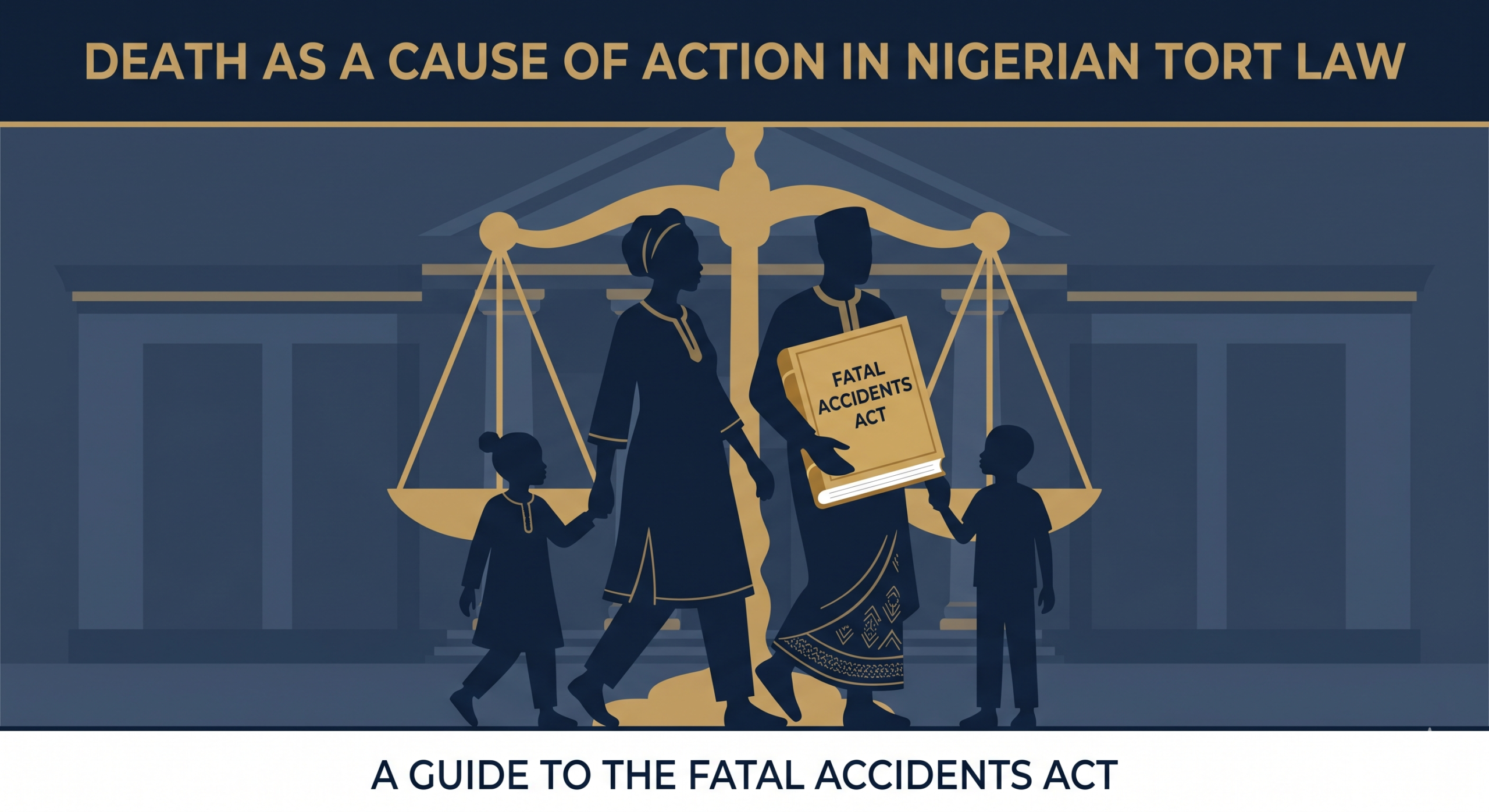
Death as a Cause of Action in Law: What Families of Accident Victims Can Claim

Death as a Cause of Action in Law

In June 2012, Dana Airlines Flight 992 crashed into a densely populated residential area at Iju-Ishaga, Lagos, killing all 153 persons on board and 10 people on the ground. Among the dead were fathers, mothers, breadwinners, and children. Their families were left not only with grief but with the immediate, crushing financial reality of lost income and lost support. The law's response to this tragedy illustrates one of the most important and underappreciated areas of Nigerian tort law: death as a cause of action. The question is not just whether someone is criminally responsible for the deaths. The question that tort...

Continue reading

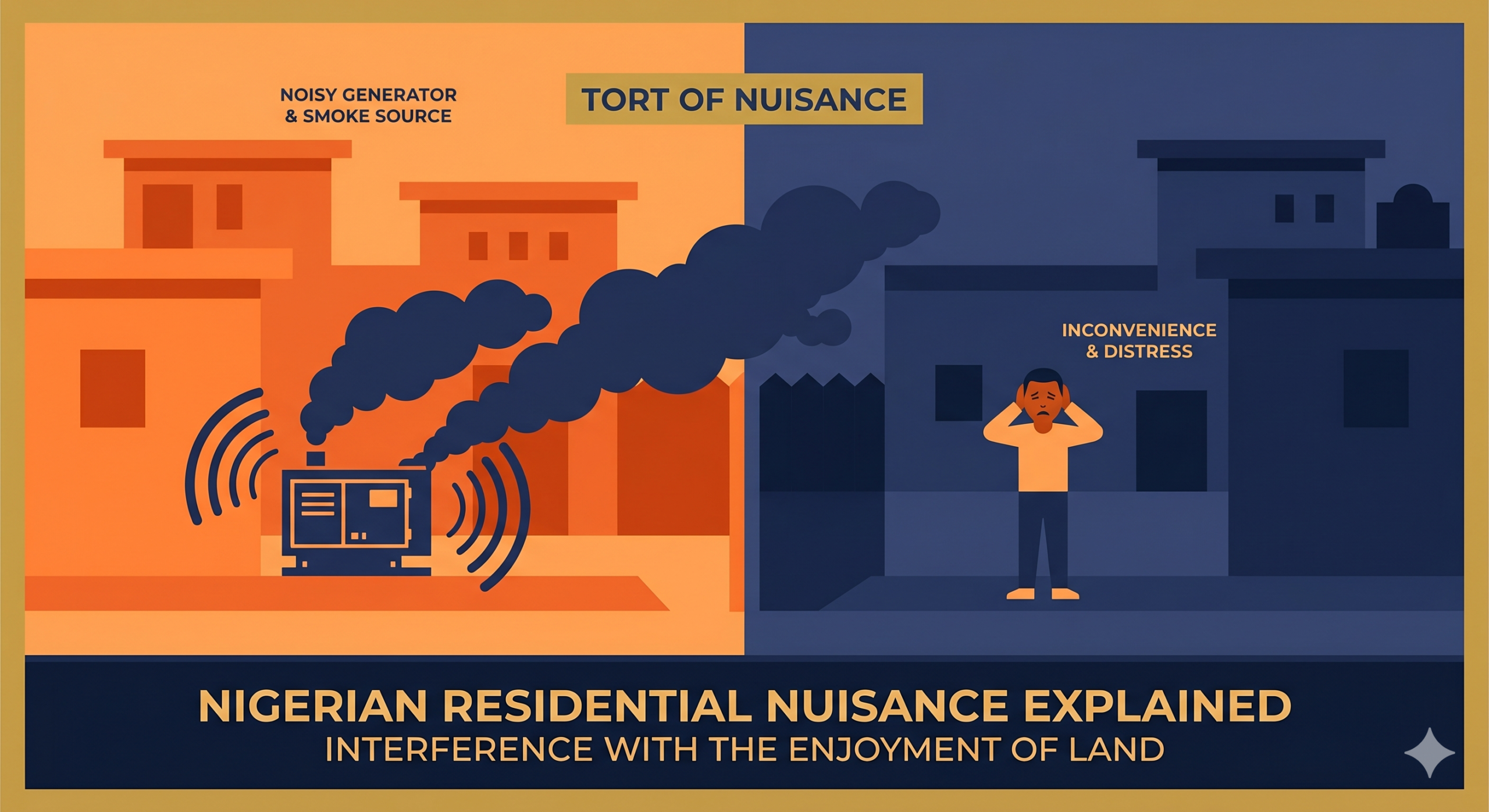
The Tort of Nuisance in Nigerian Law: Generator Noise, Oil Spills, and Your Legal Rights

tort of nuisance Nigeria

Picture this. You have just moved into a quiet residential estate in Lekki. Three weeks later, your neighbour sets up a commercial generator that runs from 6am to 11pm, six days a week. The fumes drift through your windows. Your children cannot sleep. Your concentration at work is shattered. You complain, informally. Nothing changes. Or consider a different scenario. An oil company has been operating a pipeline through your community in Bayelsa for two decades. Over time, there have been spills. The farmland your family depends on is contaminated. Fish have disappeared from the creeks. The water is no longer safe....

Continue reading

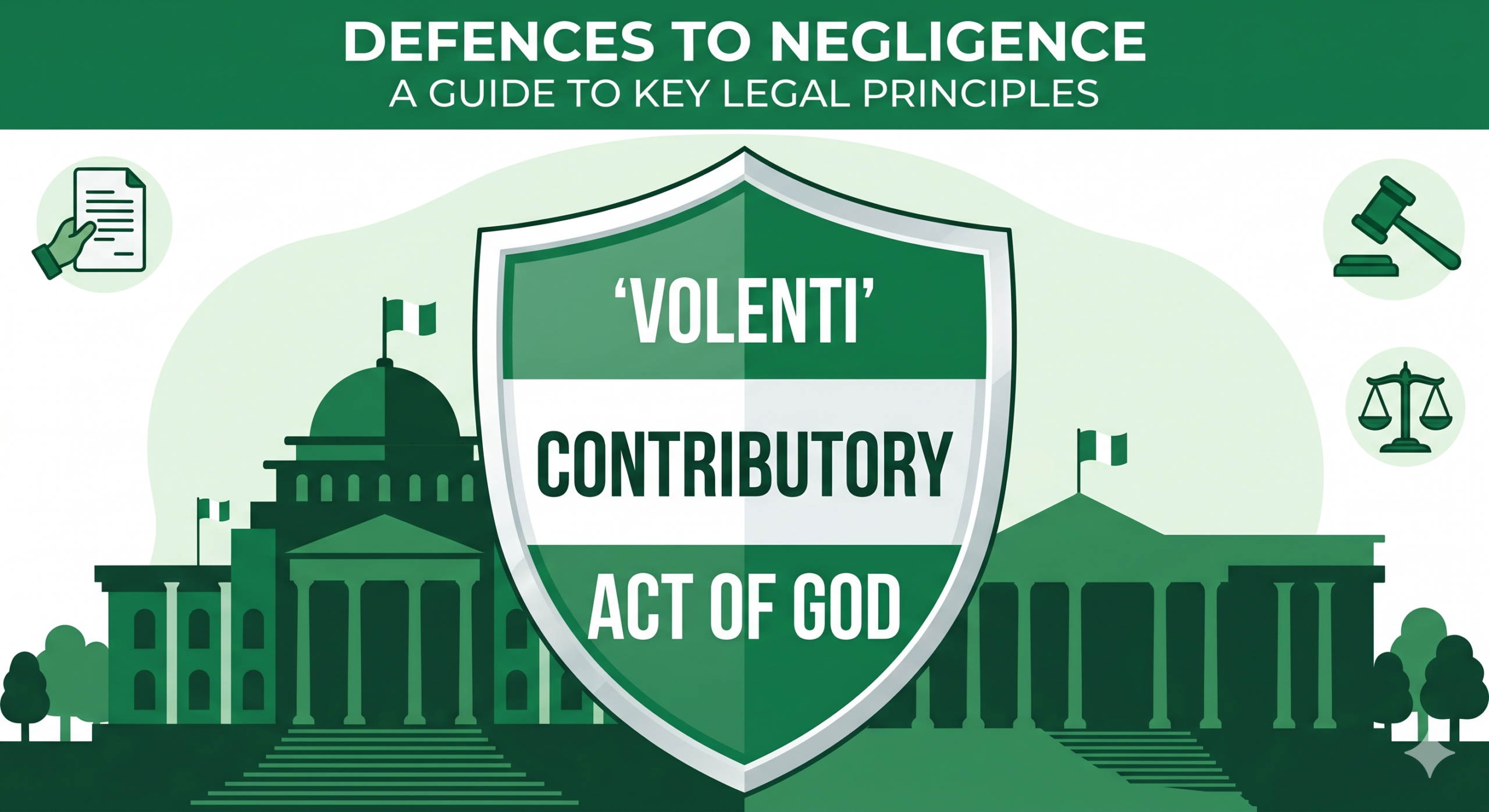
Defences to Negligence in Tort Law: Volenti, Contributory Negligence and More

defences to negligence Nigeria

Imagine you are knocked down by a danfo bus on Ikorodu Road, Lagos. You have a broken leg, medical bills, and two weeks of lost income. You instruct a lawyer, who confirms that the bus driver was clearly negligent. You file your claim, confident in the outcome. Then the defendant's lawyer stands up and says: "Yes, our client was negligent. But the plaintiff was crossing at the wrong point on the road, wearing dark clothing at night, without looking left or right." Suddenly, your apparently straightforward case has a complication. This is what defences to negligence do. They either completely defeat a...

Continue reading

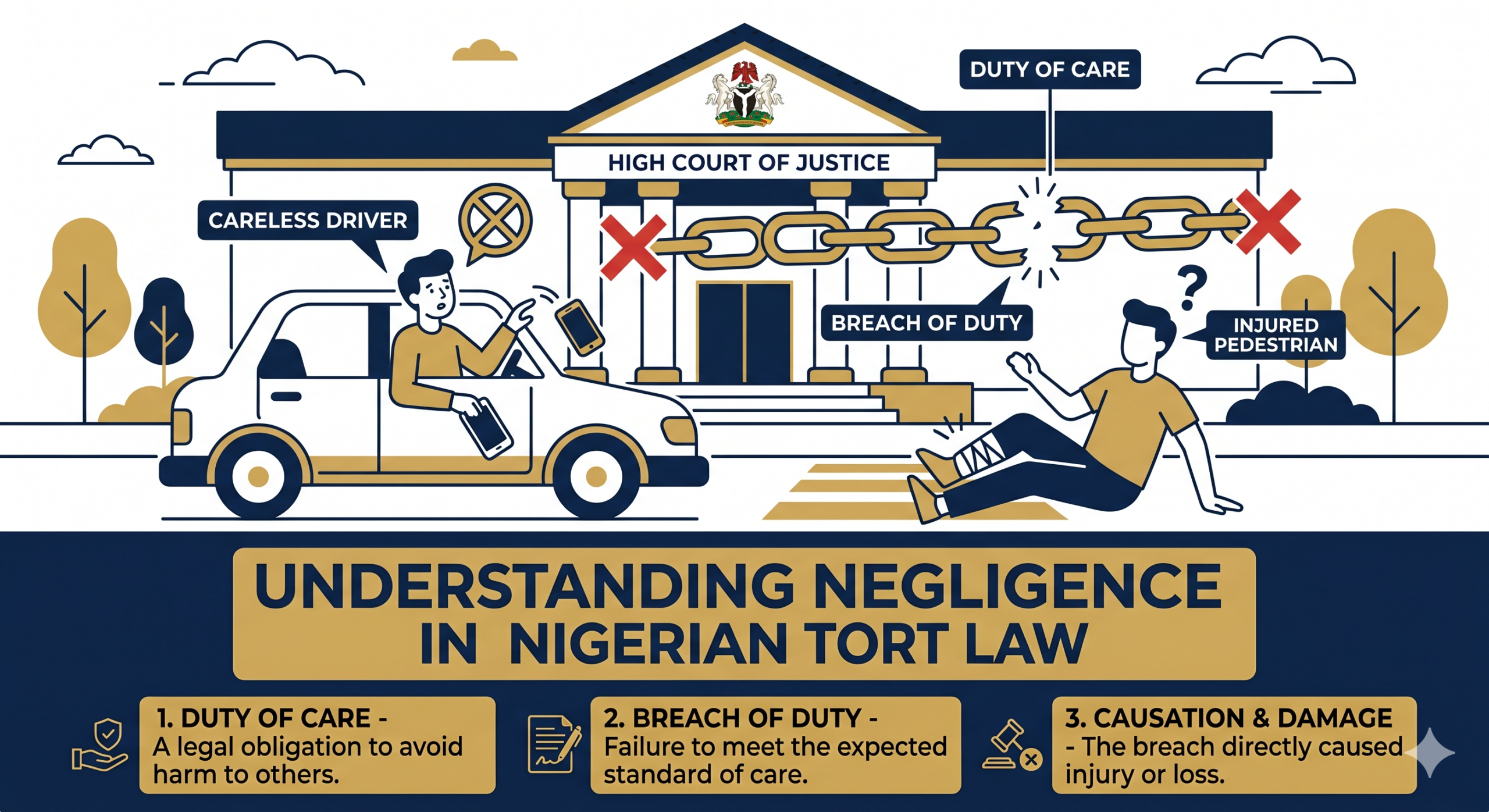
Negligence in Torts: Elements, Duty of Care, and Nigerian Case Law Explained

tort of negligence

Think about the last time you were stuck behind a danfo driver swerving dangerously on the Lagos-Ibadan Expressway. Or think about the reports you have seen of patients dying after surgery at a public hospital due to what their families describe as careless treatment. Or the stories of children electrocuted by exposed NEPA cables left dangling by the roadside. All of these situations have one thing in common: they may give rise to an action in the tort of negligence. Negligence is the single most important tort in Nigerian law today. It provides a legal remedy for persons who suffer harm because...

Continue reading

Mutual Mistake and Common Mistake in Nigerian Contract Law

Imagine you agree to buy a car from someone, and both of you believe the car exists in the seller's garage. Unknown to either of you, the car was stolen the night before. Can this agreement be enforced? This scenario illustrates one of the most important defenses in contract law: mistake. In Nigerian contract law, mistake occurs when one or both parties enter into a contract based on a false belief about important facts. Not every mistake will allow you to escape a contract, but certain types of mistakes are serious enough to make the contract either void (invalid from the...

Continue reading

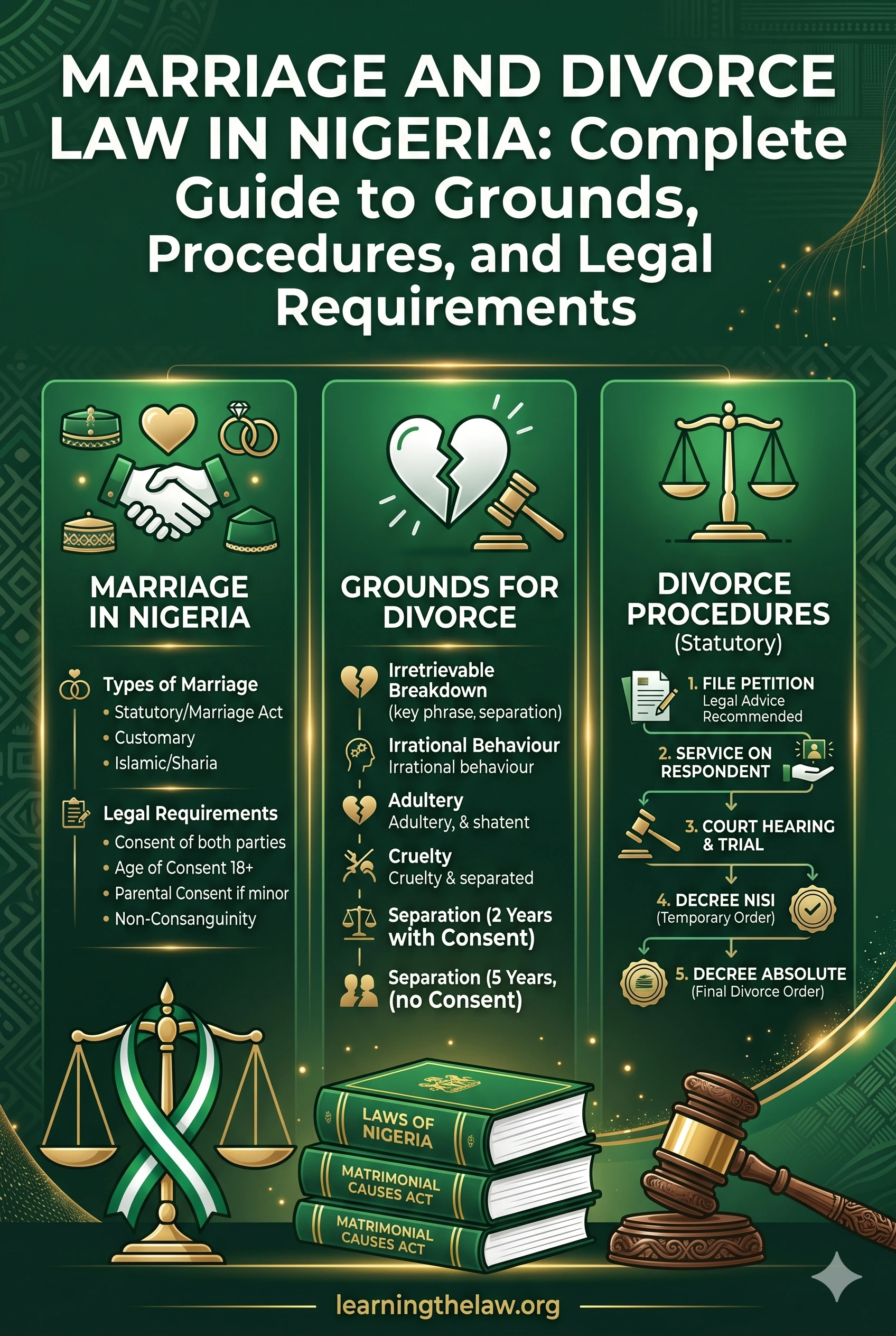
Marriage and Divorce Law in Nigeria: Complete Guide to Grounds, Procedures, and Legal Requirements

Marriage and Divorce Law in Nigeria: Complete Guide to Grounds, Procedures, and Legal Requirements

Nigerian matrimonial law provides a comprehensive framework governing how marriages begin, how they're maintained, and when necessary, how they can legally end. Whether you're planning to marry, experiencing marital difficulties, or considering divorce, understanding these laws protects your rights and helps you make informed decisions. This guide explains everything you need to know about marriage types, divorce procedures, and legal requirements in Nigeria. Understanding the Three Types of Marriage in Nigerian Law Nigeria recognizes three distinct marriage systems, each with its own legal framework, requirements, and implications. Think of these as three different "contracts" you can enter into, each governed by different...

Continue reading

Privity of Contract in Nigerian Law: Meaning, Exceptions, and Examples

Privity of Contract in Nigerian Law

What is Privity of Contract? Privity of contract is a fundamental common law principle establishing that only parties directly involved in a contract possess rights and obligations under that agreement. The doctrine ensures contractual relationships remain exclusive to signatories, preventing third parties from enforcing or being bound by contractual terms. The Nigerian Supreme Court affirmed this principle in Chuba Ikpeazu v. African Continental Bank (1965) NMLR 374, stating that generally, a contract cannot be enforced by a person who is not party to it, even if made for their benefit. Core Principles of Privity The doctrine operates on three essential foundations: 1. Binding Obligations: Only...

Continue reading

Hohfeldian Legal Concepts: Understanding Rights and Duties

Hohfeldian Legal Concepts: Understanding Rights and Duties

Why This Matters Concepts play a significant role in the legal process. Most legal rules and principles are explained in terms of juridical concepts, prominently among which are the concepts of rights and duties.[1] As Ronald Dworkin observed: "Lawyers lean heavily on the connected concepts of legal right and legal obligation. We say that someone has a legal right or duty, and we take that statement as a sound basis for making claims and demands, and for criticizing the acts of public officials. But our understanding of these concepts is remarkably fragile, and we fall into trouble when we try to...

Continue reading

Join our Newsletter

Join 1,000+ law students and professionals. Get our top-rated class notes and legal analysis delivered straight to your inbox every Tuesday and Friday.

We don’t spam! Read our privacy policy for more info.