8:00 - 19:00

Our Opening Hours Mon. - Fri.

975.789.098

Always online

Facebook

Twitter

Search
 

Study Resources

LearningTheLaw > Study Resources (Page 2)

What are the Effects of Pre-Incorporation Contracts under Nigerian Law?

Suppose a group of entrepreneurs intends to open a chain of fast food restaurants across Lagos. They have identified a suitable property in Victoria Island, negotiated terms with the landlord, and need to sign a lease. There is one problem: their company has not yet been incorporated. The Corporate Affairs Commission has not yet issued a certificate. In law, the company does not exist. Can they sign the lease on behalf of the company? If they do, will the company be bound by it once it is incorporated? And if the landlord later disputes the lease, who can he sue? These...

Continue reading

Registration Requirements for LLC in Nigeria: CAMA 2020 Guide

You cannot simply decide one morning that your business is now a company. No matter how long you have been trading, no matter how large your operations, and no matter how many employees you have, a company comes into existence in Nigerian law only when the Corporate Affairs Commission issues a certificate of incorporation. Before that certificate can be issued, a specific set of conditions must be satisfied. These are the legal requirements for forming an LLC in Nigeria, and they are statutory: imposed by the Companies and Allied Matters Act 2020, and neither the Commission nor any applicant has...

Continue reading

Types of Business Organisations in Nigeria: Sole Proprietorship, Partnership, and Companies

Imagine two final-year students at the University of Ibadan who decide to start a small tech consultancy after graduation. They have the idea, the skills, and the drive. What they have not yet decided is what legal form their business should take. Should one of them register it as a sole proprietorship in her name alone? Should both of them enter a partnership? Or should they incorporate a company and enjoy limited liability from the outset? Each option carries different legal consequences for ownership, liability, taxation, and management. This is not merely a theoretical exercise. The choice of business form is...

Continue reading

The Corporate Affairs Commission (CAC): Functions, Powers, and Legal Status

Every business in Nigeria, whether a small sole proprietorship operating a provision store in Onitsha or a multinational company listed on the Nigerian Exchange Group, must pass through the same door before it can be said to exist in the eyes of the law. That door is the Corporate Affairs Commission. It is impossible to study Nigerian company law seriously without understanding what the CAC is, what it does, how it is constituted, and what powers it wields. This article addresses each of those questions in turn. The Establishment of the CAC Before 1990, the registration and administration of companies in Nigeria...

Continue reading

The Development of Company Law in Nigeria: Ordinances, Acts, and the Road to CAMA

Before tracing its development, it helps to be clear about what company law actually governs. At its core, company law is the body of rules that determines how groups of persons may organise themselves for business purposes, how such organisations acquire legal personality, how they are governed and managed, how their members' interests are protected, and how they come to an end.¹ In the Nigerian context, the subject is inseparable from the broader question of how the economy is organised. Every registered company, from a small private firm with two shareholders to a publicly listed conglomerate traded on the Nigerian Exchange...

Continue reading

History of Company Law in Nigeria: From Trade by Barter to CAMA 2020

Long before a single ordinance was drafted, before any company was registered, before the term "corporate personality" entered the Nigerian legal vocabulary, commerce existed. The Yoruba marketplace, the trans-Saharan trade routes of the Hausa-Fulani north, the Igbo long-distance trading networks: these were sophisticated systems of exchange, credit, and commercial trust operating entirely outside any written legal framework. Trade was by barter. Obligation was enforced by custom, community, and reputation. There was no concept of a company. There was no need for one. That world was not inferior. It was simply different. And it was this world that colonial contact transformed, first...

Continue reading

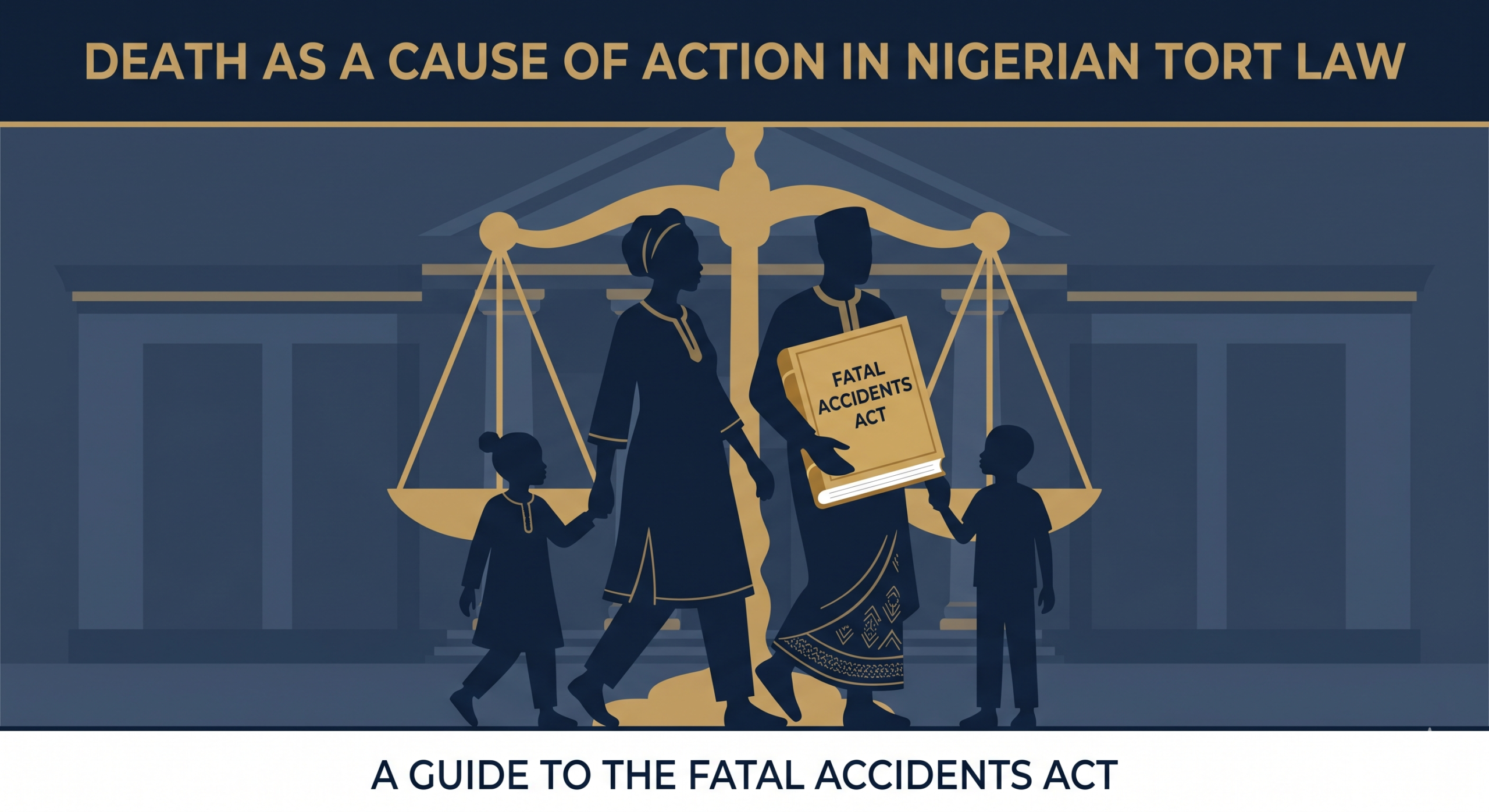
Death as a Cause of Action in Law: What Families of Accident Victims Can Claim

Death as a Cause of Action in Law

In June 2012, Dana Airlines Flight 992 crashed into a densely populated residential area at Iju-Ishaga, Lagos, killing all 153 persons on board and 10 people on the ground. Among the dead were fathers, mothers, breadwinners, and children. Their families were left not only with grief but with the immediate, crushing financial reality of lost income and lost support. The law's response to this tragedy illustrates one of the most important and underappreciated areas of Nigerian tort law: death as a cause of action. The question is not just whether someone is criminally responsible for the deaths. The question that tort...

Continue reading

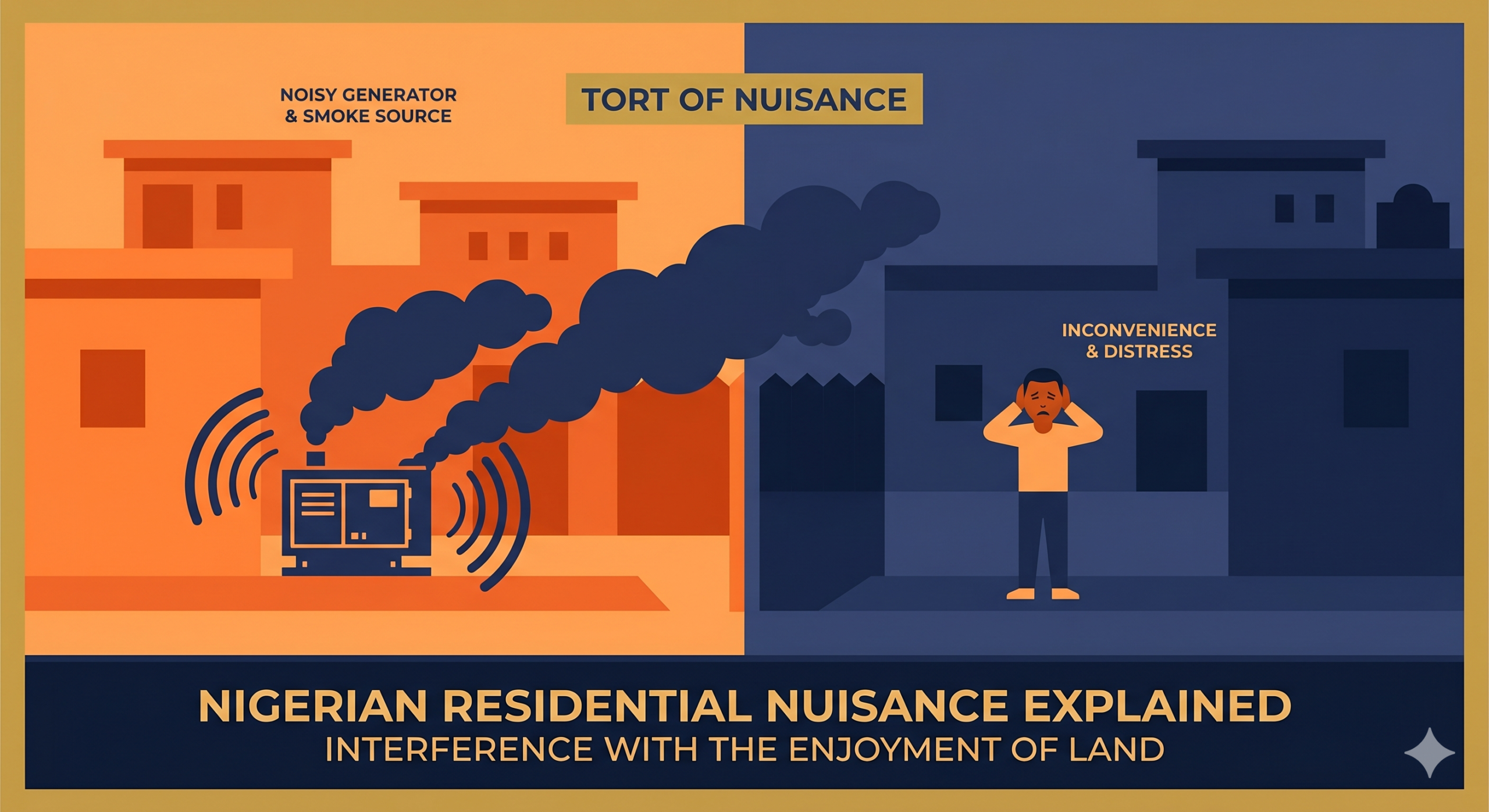
The Tort of Nuisance in Nigerian Law: Generator Noise, Oil Spills, and Your Legal Rights

tort of nuisance Nigeria

Picture this. You have just moved into a quiet residential estate in Lekki. Three weeks later, your neighbour sets up a commercial generator that runs from 6am to 11pm, six days a week. The fumes drift through your windows. Your children cannot sleep. Your concentration at work is shattered. You complain, informally. Nothing changes. Or consider a different scenario. An oil company has been operating a pipeline through your community in Bayelsa for two decades. Over time, there have been spills. The farmland your family depends on is contaminated. Fish have disappeared from the creeks. The water is no longer safe....

Continue reading

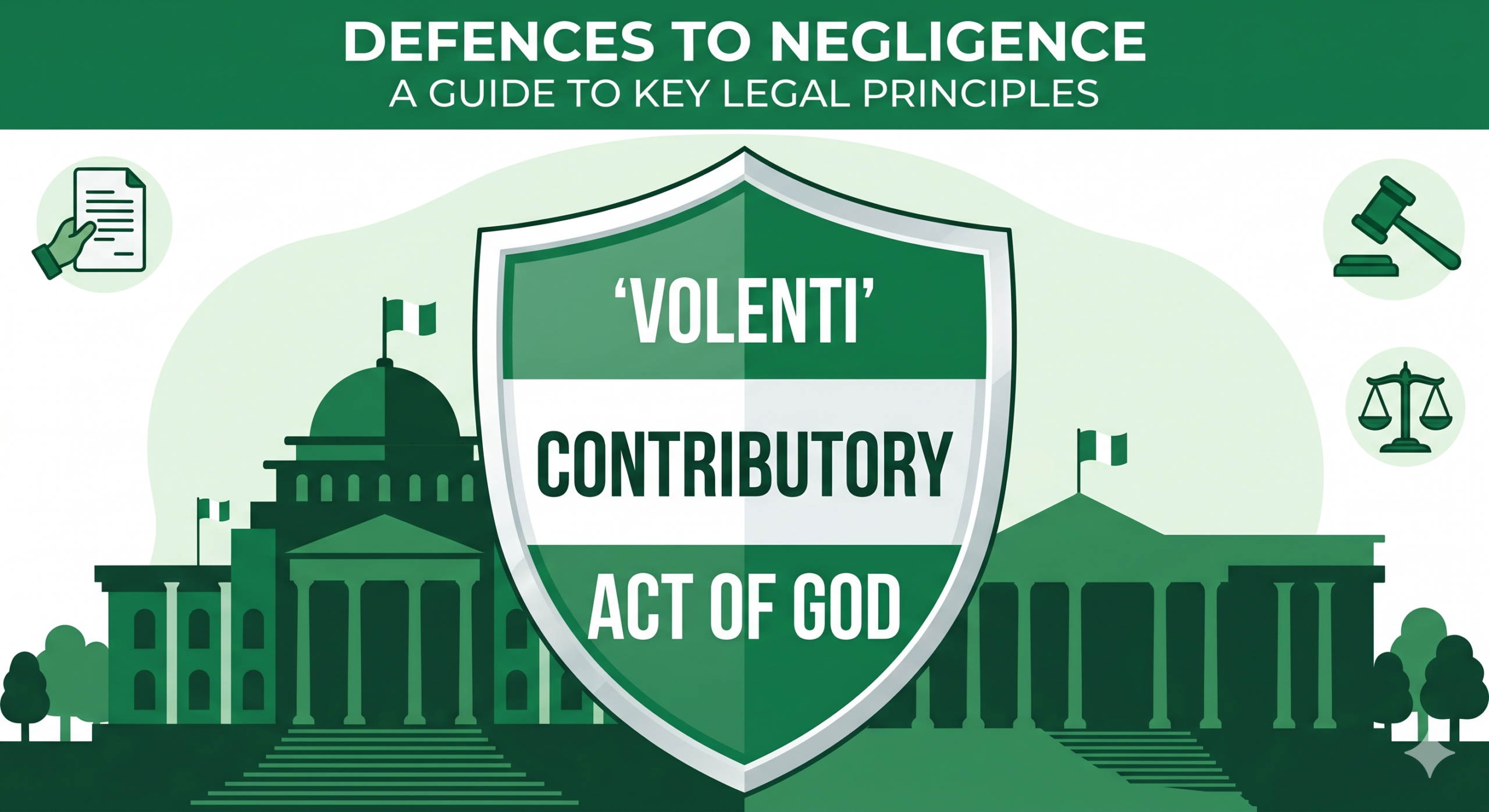
Defences to Negligence in Tort Law: Volenti, Contributory Negligence and More

defences to negligence Nigeria

Imagine you are knocked down by a danfo bus on Ikorodu Road, Lagos. You have a broken leg, medical bills, and two weeks of lost income. You instruct a lawyer, who confirms that the bus driver was clearly negligent. You file your claim, confident in the outcome. Then the defendant's lawyer stands up and says: "Yes, our client was negligent. But the plaintiff was crossing at the wrong point on the road, wearing dark clothing at night, without looking left or right." Suddenly, your apparently straightforward case has a complication. This is what defences to negligence do. They either completely defeat a...

Continue reading

Negligence in Torts: Elements, Duty of Care, and Nigerian Case Law Explained

tort of negligence

Think about the last time you were stuck behind a danfo driver swerving dangerously on the Lagos-Ibadan Expressway. Or think about the reports you have seen of patients dying after surgery at a public hospital due to what their families describe as careless treatment. Or the stories of children electrocuted by exposed NEPA cables left dangling by the roadside. All of these situations have one thing in common: they may give rise to an action in the tort of negligence. Negligence is the single most important tort in Nigerian law today. It provides a legal remedy for persons who suffer harm because...

Continue reading

Join our Newsletter

Join 1,000+ law students and professionals. Get our top-rated class notes and legal analysis delivered straight to your inbox every Tuesday and Friday.

We don’t spam! Read our privacy policy for more info.