

Void and Voidable Marriages in Nigeria: Nullity, Grounds, and Bars
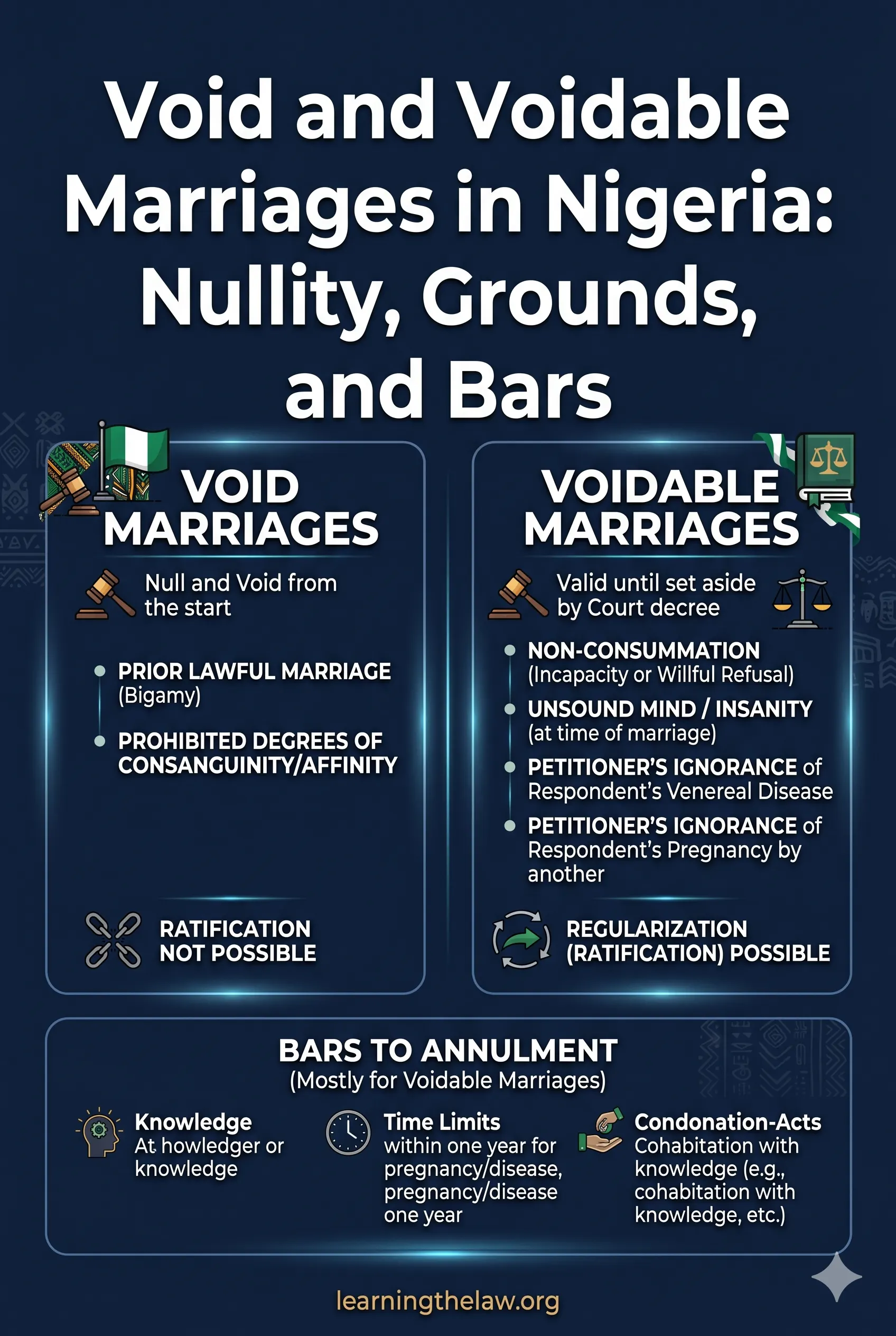
Before reading this article, ensure you understand the three types of marriage recognised under Nigerian law. For that foundation, see our Marriage and Divorce Law in Nigeria guide. This article focuses on nullity — what it means when a marriage is legally defective from the start, and the doctrinal distinction between marriages that are void and those that are merely voidable.
What is Nullity?
Nullity is concerned with marriages that are legally blemished from the outset. It is conceptually distinct from divorce. Divorce terminates a valid, subsisting marriage. Nullity, by contrast, is a declaration that the marriage either never existed in law (void) or is capable of being set aside because of a defect present at the time of celebration (voidable).
Because nullity addresses marriages defective at their inception, it is treated alongside capacity and formation rather than alongside divorce — even though both result in the parties being free to remarry.
Nullity remains a practically important remedy for persons whose religious convictions prevent them from seeking divorce, or where technical grounds exist that render the marriage susceptible to annulment.
The result of successful nullity proceedings is an annulment of the marriage. Annulment effectively wipes out the marriage because of a fundamental obstacle to its legal existence.
Part I: Void Marriages
What is a Void Marriage?
A void marriage is one that is void ab initio — from the very beginning. It produces no legal consequences whatsoever. In the eyes of the law, no marriage ever existed. The parties never acquired the legal status of husband and wife.
Key characteristics of a void marriage:
- No decree is technically required to establish that the marriage is void. It is null without any court order.
- However, a decree of nullity is practically useful because it gives the court jurisdiction to make ancillary orders — property settlement, maintenance, and custody — equivalent to those available in divorce.
- A third party may bring proceedings to establish the nullity of a void marriage. There is no requirement that only the parties themselves can challenge it.
- Where one party is dead, the surviving party — or even a third party with a legal interest — may still seek a declaration that the marriage was void, because the nullity exists independently of the parties’ deaths.
- A void marriage does not require both parties to be alive for nullity proceedings to be valid.
Grounds for Void Marriage — Section 3(1) MCA
Under Section 3(1) of the Matrimonial Causes Act 1970, a marriage is void in the following cases:
Ground 1: Prior Subsisting Marriage — Section 3(1)(a)
A marriage is void where, at the time of the ceremony, either party was already lawfully married to another person. This reflects the monogamous nature of statutory marriage under the Marriage Act.
See also Section 33(1) of the Marriage Act which makes it a criminal offence (bigamy) to go through a marriage ceremony while knowingly already married.
In Onwudijoh v. Onwidijoh (1957) 11 ERLR, the existence of a prior valid marriage was held to render the subsequent ceremony an absolute nullity.
Customary law intersection: A man validly married under customary law retains capacity to marry under customary law polygamously. However, once he contracts a statutory marriage, he acquires the incapacity of a monogamist and cannot contract any further marriage — whether statutory or customary — during the subsistence of the statutory marriage. See our forthcoming article on Double Deck Marriage for how this interacts with the conversion theory.
Ground 2: Prohibited Degrees of Relationship — Section 3(1)(b) and Schedule 1 MCA
A marriage is void where the parties are within the prohibited degrees of consanguinity (blood relationship) or affinity (relationship by marriage). Schedule 1 to the MCA sets out the prohibited relationships in full.
Rationale for the prohibition:
- Increased likelihood of inherited genetic disorders in children born of closely related parents
- Risk of sexual exploitation by a dominant family member
- Public perception that sexual relations within the family sphere are socially and morally unacceptable
- Preservation of proper familial structures
Consanguinity bars marriage between direct line relatives (parent/child, grandparent/grandchild) and certain collateral relatives (siblings, aunt/nephew, uncle/niece).
Affinity extends prohibitions to step-relations and in-laws in specified circumstances — for example, a man may not marry his former wife’s daughter or his former wife’s mother.
Ground 3: Failure to Comply with Formalities — Section 3(1)(c) and Section 33(2) MA
A marriage may be void where the parties disregarded the formal requirements for the celebration of marriage. Section 3(1)(c) MCA must be read together with Section 33(2)(a–d) of the Marriage Act, which specifies the circumstances in which non-compliance with formalities voids the marriage.
Not every procedural irregularity voids a marriage. The failure must relate to a prescribed and essential requirement — for example, celebration without a licensed marriage officer, celebration outside permitted hours without lawful authority, or failure to publish notice. Minor administrative errors that do not go to the substance of the ceremony will not void the marriage.
Ground 4: Lack of Consent — Section 3(1)(d)(i) MCA
A marriage is void where either party did not validly consent to it — whether because the consent was obtained through duress, fraud, mistake, or unsoundness of mind, or otherwise.
Duress:
Duress operates where fear is so overbearing that the party has no true freedom to consent. The petitioner must prove that their will was overborne by a fear of danger to life, limb, or liberty. A threat of social embarrassment or family disapproval alone is generally insufficient.
In Singh v. Singh [1971] 2 ALL ER 828, the court held that cultural or social pressure, without a direct threat to life, limb, or liberty, does not constitute duress sufficient to void a marriage.
In Aiyegbusi v. Aiyegbusi Suit No. I/238/71, the Nigerian court applied the same principle, and in Agbo v. Udo (cited in Sagay’s text at p.83), the threshold for duress vitiating consent was similarly maintained at the high level of overpowering fear.
Mistake:
A mistake as to the nature of the ceremony can invalidate consent. A party who did not know they were going through a marriage ceremony — for example, believing it was a religious conversion rite — could not have consented to marriage.
In Mehta v. Mehta [1945] 2 ALL ER 690, one party believed the ceremony was a conversion to Hinduism rather than a marriage. The marriage was annulled for lack of consent.
In Valier v. Valier (1925) 133 LT 830, the ceremony was conducted in a language the petitioner did not understand, and nullity was granted on the ground that there was no true consent.
A mistake as to the identity of the other party (not merely their attributes or qualities) may also vitiate consent. Discovering after marriage that your spouse has undesirable qualities does not amount to a vitiating mistake — the law draws a firm line between identity and attribute.
Unsoundness of mind:
A party who, at the time of the ceremony, lacked the mental capacity to understand the nature and effect of the marriage could not validly consent. The question is whether the party understood the nature of the ceremony at the relevant time. See In the Estate of Park [1953] 2 ALL ER 1411, where the court considered the mental state of the party at the precise moment of marriage.
Ground 5: Either Party Under Marriageable Age — Section 3(1)(d)(iii) MCA
A marriage is void where either party was not of marriageable age at the time of the ceremony.
Section 3(1)(d)(iii) should be distinguished from Section 18 of the Marriage Act, which requires parental or guardian consent where a party intending to marry is under 21 years but is not a widow or widower. Absence of parental consent under Section 18 does not in itself void the marriage — it is a separate matter from marriageable age under the MCA.
Ground 6: Same-Sex Marriage — Section 3(1)(e) MCA
A marriage is void where the parties are not respectively male and female. Nigerian law does not recognise same-sex marriage. This ground renders any purported marriage between persons of the same sex void ab initio.
Distinction Between Void and Voidable Marriages (Summary Table)
| Point | Void | Voidable |
|---|---|---|
| Legal status | Never existed in law | Valid and subsisting until annulled |
| Decree required? | Not technically necessary, but useful for ancillary orders | Yes — only a decree of nullity annuls it |
| Third party standing | Third parties may challenge | Only parties to the marriage may petition |
| Death of a party | Nullity may be sought after death | Petition abates on death of either party |
| Void ab initio? | Yes | No — valid unless and until annulled |
| Remarriage without decree | Possible (marriage never existed) | Not permissible before annulment |
Part II: Voidable Marriages
What is a Voidable Marriage?
A voidable marriage is one that is valid and subsisting until annulled by a decree of nullity — Section 5 MCA 1970. Unlike a void marriage, a voidable marriage has full legal force. The parties are legally married, with all the rights and obligations that entails, until a court formally annuls it.
Key characteristics:
- Only the parties to the marriage can petition for nullity of a voidable marriage. Third parties have no standing.
- The petition abates on the death of either party — it cannot proceed after one party has died.
- Annulment is not automatic — it requires a court decree.
- Before a decree is granted, the court must consider whether any of the bars under Section 37 MCA apply.
Grounds for Voidable Marriage — Section 5(1) MCA
Ground 1: Incapacity to Consummate — Section 5(1)(a)
A marriage is voidable where either party is permanently and incurably incapable of consummating the marriage.
What is consummation?
As established in D-E v. D-A (1845) 1 Robinson Report 279, consummation must be “ordinary and complete and not partial and imperfect.” For a man, impotence — the inability to achieve or sustain penetration — means he cannot consummate. For a woman, incapacity arises where a physical malformation of her sexual organs prevents penetration: W v. W (1967) 3 ALL ER 178.
In K v. W, the husband’s penetration during intercourse lasted only a short time without emission inside or outside the wife. The court held the question of consummation is primarily one of fact and granted a decree of nullity on the ground of incapacity.
In R v. R (1952) 1 ALL ER 1194, it was held that a marriage is not consummated where the husband, though capable of some penetration, cannot sustain an erection long enough for ordinary and complete intercourse.
Sterility is irrelevant to consummation. If penetration is achieved, the marriage is consummated even if one or both parties are sterile: S v. S (No 2) (1962) 13 ALL ER 55. This is an important distinction — incapacity to have children is not the same as incapacity to consummate.
A party may petition on their own incapacity. Nullity based on incapacity to consummate is not restricted to complaints about the other spouse — you may seek annulment on the ground of your own incapacity: Harthan v. Harthan (1948) 2 ALL ER 639.
Incapacity vs. Wilful Refusal:
This distinction is critical. Incapacity to consummate (physical inability) is a ground for nullity (voidable marriage). Wilful and persistent refusal to consummate (deliberate choice not to) is a fact establishing irretrievable breakdown under Section 15(2)(a) MCA — a ground for dissolution, not nullity. Confusion between the two is a common exam error.
Both may be pleaded in the alternative, as in Dorcas Fajemisin v. Emmanuel Fajemisin, where the wife alleged the husband was impotent and alternatively that he had wilfully refused to consummate the marriage. The court annulled on the ground of impotence.
Contemporary relevance:
The continued retention of this ground has been questioned academically. In modern relationships, most couples will have discovered sexual incompatibility before marriage. The ground also presents conceptual difficulties in jurisdictions recognising same-sex marriage. In Nigeria, the ground remains operative.
Ground 2: Mental Disorder — Section 5(1)(b) MCA
A marriage is voidable where, at the time of the ceremony, either party was:
- Of unsound mind; or
- A mental defective; or
- Subject to recurrent attacks of epilepsy or insanity
The mental disorder must be of such a kind or to such an extent that the respondent is unfit for the responsibilities of marriage: Section 5(2) MCA. This is a higher threshold than mere mental illness — the disorder must specifically impair the capacity to discharge the obligations of marriage.
In Bennet v. Bennet (1969) 1 ALL ER 539, the court considered what constitutes unfitness for the responsibilities of marriage under the equivalent English provision.
Distinguish from lack of consent (void ground): Where a party lacked capacity to consent at the time of the ceremony, the marriage is void under Section 3(1)(d)(i). Where a party had sufficient capacity to consent but suffered from a mental disorder rendering them unfit for marital responsibilities, the marriage is merely voidable under Section 5(1)(b). The line between the two can be fine — the question in each case is the precise nature and degree of the mental condition at the time of the ceremony.
Ground 3: Venereal Disease in Communicable Form — Section 5(1)(c) MCA
A marriage is voidable where, at the time of the marriage, the respondent was suffering from venereal disease in a communicable form.
Requirements:
- The disease must have been present at the time of the marriage ceremony, not merely subsequently
- It must be in a communicable form at that time
- The petitioner must have been unaware of this fact at the time of the marriage — knowledge by the petitioner defeats this ground
- The petition must be filed not later than twelve months after the date of the marriage: Section 37(b) MCA
The practical relevance of this ground has diminished given modern advances in the diagnosis and treatment of sexually transmitted infections. Its continued presence in the statute has attracted academic criticism.
Ground 4: Pregnancy by Another — Section 5(1)(d) MCA
A marriage is voidable where, at the time of the ceremony, the respondent wife was pregnant by a person other than the husband-petitioner.
Requirements:
- The pregnancy must have existed at the time of the marriage
- The petitioner-husband must have been unaware of the pregnancy at the time
- The petition must be brought within twelve months of the marriage: Section 37(b) MCA
Note: Only the husband may petition on this ground. A wife cannot petition for nullity on the basis that her husband has impregnated another woman — the ground is expressly directed at the wife’s pregnancy by a third party.
The twelve-month time limit has been criticised. Paternity may not become apparent until years later — for instance, when a medical emergency reveals genetic incompatibility between the husband and the child. By that time, the one-year window will long have closed.
Bars to Nullity of Voidable Marriages — Section 37 MCA
Even where a ground for voidable marriage is established, the court may be barred from granting the decree by the operation of the bars under Section 37 MCA. These bars apply only to voidable marriages — they have no application to void marriages.
Bar 1: Knowledge of Defect — Section 37(a)
A petition founded on the respondent’s venereal disease or pregnancy by a third party will fail unless the petitioner can satisfy the court that, at the time of the ceremony, they were ignorant of the facts alleged.
This bar is absolute for those two grounds. Knowledge of the defect at the time of marriage destroys the rationale for annulment — you cannot complain of something you knowingly accepted.
Bar 2: Time — Section 37(b)
For proceedings founded on mental disorder, venereal disease, or pregnancy by a third party, it is an absolute bar that proceedings were not instituted within twelve months of the marriage.
This is a strict limitation — the court has no discretion to extend it. If twelve months have elapsed, those grounds are lost regardless of how meritorious the petitioner’s case might otherwise be.
The statutory time limit for pregnancy by a third party has been especially criticised. Paternity issues may surface years after marriage — long after the twelve-month window closes. Law reform bodies have noted this inadequacy.
Note that the twelve-month bar does not apply to incapacity to consummate or mental disorder where the latter is relied on independently of the time bar ground.
Bar 3: Approbation — Section 37(c)
This section codifies the equitable bar of approbation. The respondent may defeat the petition by satisfying the court that:
- The petitioner, knowing it was open to them to have the marriage avoided, so conducted themselves in relation to the respondent as to lead the respondent reasonably to believe that no petition would be brought; and
- It would be unjust to the respondent to grant the decree in the circumstances.
In essence, if the petitioner behaved in a manner that induced the respondent to believe the marriage would continue — thereby causing the respondent to alter their position in reliance on that belief — it would be unjust to allow the petitioner to turn around and seek annulment.
Relevant cases on approbation include:
- Aldridge v. Aldridge (1888) 13 PD 210
- Tindall v. Tindall (1953) 1 ALL ER 139
- Petit v. Petit (1962) 3 ALL ER 539
- Slater v. Slater (1953) 1 ALL ER 246
- Stocker v. Stocker (1966) 2 ALL ER 147
Approbation requires more than mere delay in filing — the petitioner must have actively conducted themselves in a way inducing reasonable reliance by the respondent.
Key Distinctions at a Glance
Void vs. Voidable: Core Differences
The practical importance of correctly classifying a marriage as void or voidable cannot be overstated:
Bars: The bars under Section 37 (knowledge, time, approbation) apply only to voidable marriages. They have no application to void marriages. A marriage that is void cannot be “saved” by the petitioner’s knowledge, delay, or conduct — it was never valid in the first place.
Condonation and nullity: As established in Etebu v. Etebu, condonation bars divorce proceedings but does not bar nullity proceedings. A void or voidable marriage is not validated by the parties resuming marital relations. Their conduct cannot breathe legal life into a marriage that is legally defective.
Third party challenge: Only void marriages may be challenged by third parties. Voidable marriages can only be challenged by the parties themselves.
Death: Nullity of a void marriage may be sought even after the death of one or both parties (where property interests are at stake). A petition to annul a voidable marriage abates on the death of either party.
Ancillary relief: A decree of nullity — whether for void or voidable marriage — gives the court jurisdiction to make ancillary orders for property, maintenance, and custody under the MCA, in the same way as a decree of divorce.
Nullity vs. Divorce
| Point | Nullity | Divorce |
|---|---|---|
| What it addresses | Defect present at time of marriage | Valid marriage broken down |
| Effect | Declares marriage never existed / cancels it | Terminates a valid marriage |
| Timing of defect | At ceremony | After ceremony |
| Religious acceptability | More acceptable to some religions | Less acceptable to some religions |
| Irretrievable breakdown required? | No | Yes — s.15(1) MCA |
| Bars | ss.3 and 37 MCA | ss.26 and 28 MCA (condonation, connivance, collusion) |
Recommended Cases Summary
| Case | Point |
|---|---|
| D-E v. D-A (1845) 1 Robinson Report 279 | Consummation must be “ordinary and complete” |
| W v. W (1967) 3 ALL ER 178 | Female incapacity — physical malformation |
| Harthan v. Harthan (1948) 2 ALL ER 639 | Party may petition on own incapacity |
| R v. R (1952) 1 ALL ER 1194 | Brief penetration without sustained erection = no consummation |
| S v. S (No 2) (1962) 13 ALL ER 55 | Sterility irrelevant to consummation |
| K v. W | Consummation is primarily a question of fact |
| Dorcas Fajemisin v. Emmanuel Fajemisin | Incapacity and wilful refusal pleaded in the alternative |
| Bennet v. Bennet (1969) 1 ALL ER 539 | Mental disorder — unfitness for marital responsibilities |
| In the Estate of Park (1953) 2 ALL ER 1411 | Mental capacity assessed at time of ceremony |
| Singh v. Singh (1971) 2 ALL ER 828 | Social/cultural pressure alone ≠ duress |
| Mehta v. Mehta (1945) 2 ALL ER 690 | Mistake as to nature of ceremony vitiates consent |
| Valier v. Valier (1925) 133 LT 830 | Language barrier negating consent |
| Onwudijoh v. Onwidijoh (1957) 11 ERLR | Prior subsisting marriage = void ab initio |
| Aldridge v. Aldridge (1888) 13 PD 210 | Approbation bar |
| Etebu v. Etebu | Condonation bars divorce; does not bar nullity |
Recommended Reading
- Nwogugu, E.I., Family Law in Nigeria (3rd ed.) HEBN Publishers, Ibadan, 2015
- Sagay, Itse, Nigerian Family Law, Malthouse Press, Lagos, 1999 — pp. 83 et seq.
- Matrimonial Causes Act, Cap M7, LFN 2004 — Sections 3, 5, 37
- Marriage Act, Cap M6, LFN 2004 — Sections 18, 33
This article is part of the Family Law II (LPP 306) series on learningthelaw.org. For dissolution of statutory marriage and the bars to divorce, see our 300L note on Dissolution of Statutory Marriage. For the introductory treatment of marriage types, see the Marriage and Divorce Law in Nigeria guide.

Kolawole Adebowale is a law graduate of the University of Ibadan with a specialization in intellectual property law, digital patent enforcement, and software law. His research focuses on the intersection of technology and IP protection in Nigeria’s emerging digital economy, with comparative analysis spanning multiple jurisdictions. He is a member of the Law Students Association of Nigeria (LAWSAN) and the IP Association.