

Mistake of Fact and Claim of Right in Nigerian Criminal Law
People act based on what they think is real. Sometimes they’re wrong. A hunter shoots at a bush thinking it’s an animal, but hits a person. Someone takes money thinking it’s theirs. The act was deliberate, but based on a wrong belief.
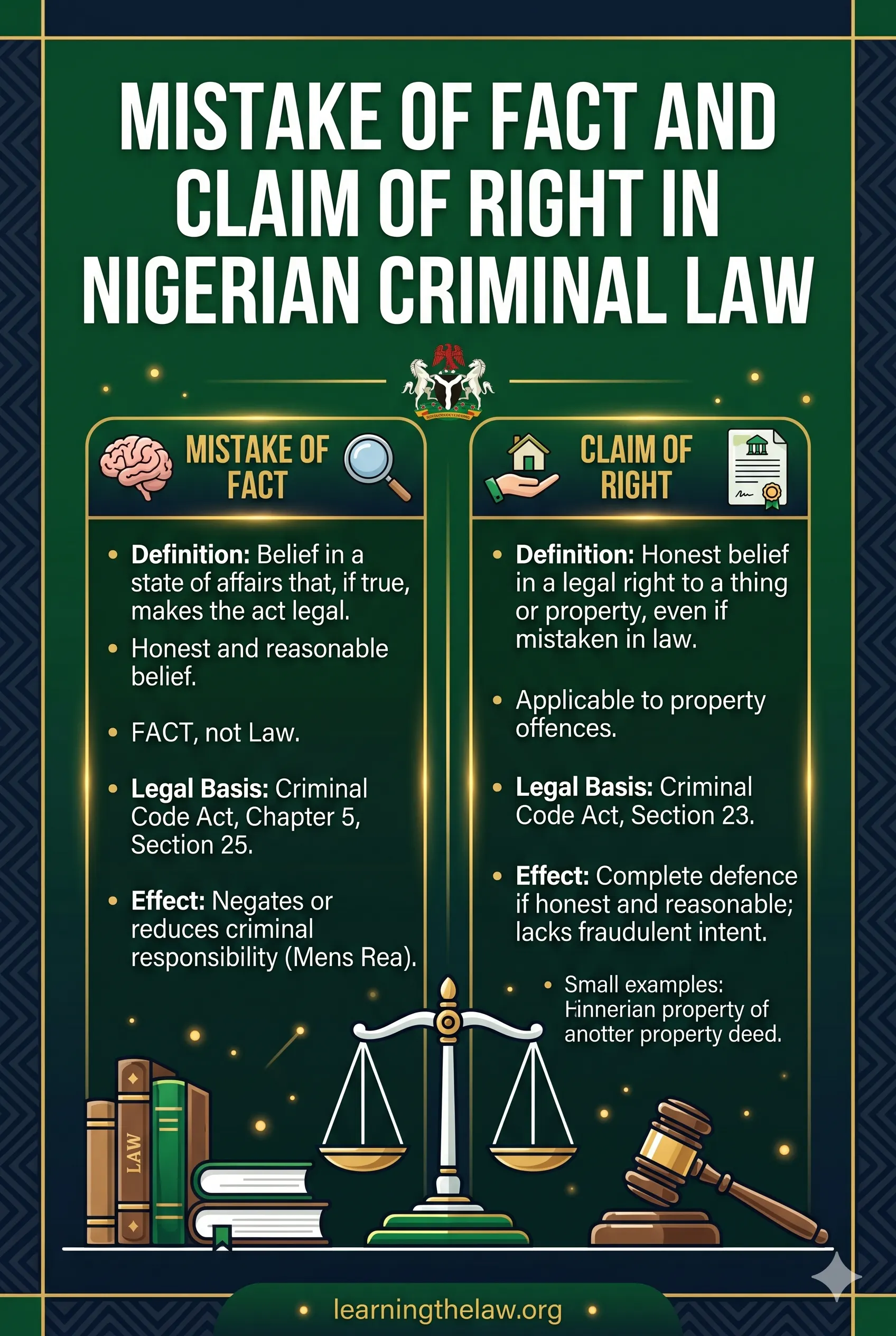
Nigerian law handles these errors through Mistake of Fact (Section 25) and Bona Fide Claim of Right (Section 23).
Mistake of Fact (Section 25)
Section 25 provides the defense:
“A person who does or omits to do an act under an honest and reasonable, but mistaken belief… is not criminally responsible… to any greater extent than if the real state of things had been such as he believed to exist”.[^1]
This defense requires:
- Honest belief: Your belief must be genuine.
- Reasonable belief: A reasonable person in your position would have the same belief.
- Mistake of fact: It must be about facts, not law (Section 22) or consequences (Section 24).
When Reasonableness Kills the Defense
The requirement that your belief be reasonable destroys many defenses, especially those involving superstition.
R v Gadam: The accused killed a woman he believed was a witch causing his wife’s illness. The court accepted he honestly believed she was a witch, but ruled the belief unreasonable. Accepting belief in witchcraft as reasonable would be dangerous.[^2]
Osaremwindan Aiguokhian v The State: A hunter shot a deer. While cutting it up, he claimed it “turned into” a human. The Supreme Court called this a “fairy tale” and an “insult to intelligence.” Reasonable people don’t believe in transformation. Despite his possible honesty, the belief was objectively unreasonable, so he was convicted.[^3]
Claim of Right (Section 23)
For property crimes (stealing, malicious damage), the law is more forgiving. Section 23 says:
“A person is not criminally responsible… for an act done… with respect to any property in the exercise of an honest claim of right and without intention to defraud”.[^4]
The Key Difference
Unlike Section 25, Section 23 doesn’t require your belief to be reasonable.
Honesty is enough: If you honestly believe property is yours, you can’t be guilty of stealing—even if your belief is legally wrong or unreasonable. Stealing requires “intent to defraud,” which disappears when you have an honest claim of right.
Case study (Chidiebele Gabriel Okonkwo v State): The accused had fake money. He claimed he believed it was real because previous notes passed tests. The court said his belief was honest (and reasonable in this case), so the defense worked.[^5]
Adepoju v State: A nanny claimed a “claim of right” to property stolen from her employer’s landlady. The court said she couldn’t honestly believe the property was hers or her employer’s, given her position. Honesty must be plausible.[^6]
Mistake of Law (Section 22)
Don’t confuse mistake of fact with mistake of law. Section 22 codifies ignorantia juris non excusat—ignorance of the law is no excuse. Thinking an act is legal when it’s not gives no defense, unless the statute specifically requires knowledge of the law (e.g., “knowingly” breaking a law).
Conclusion
Sections 23 and 25 show a balanced approach. When life is at stake (Section 25), your mistakes must be reasonable. You can’t kill based on superstition or “fairy tales” like transformation (Aiguokhian). But for property crimes (Section 23), the law accepts human error, protecting honest but mistaken people from criminal conviction. Criminal liability requires a blameworthy mind, not just a wrong one.
[^1]: Criminal Code Act, Cap C38, Laws of the Federation of Nigeria 2004, s 25.
[^2]: R v Gadam (1954) 14 WACA 220.
[^3]: Osaremwindan Aiguokhian v The State (2004) All FWLR (Pt 186) 249.
[^4]: Criminal Code Act (n 1) s 23.
[^5]: Chidiebele Gabriel Okonkwo v State (2012) LPELR-9749(CA).
[^6]: Adepoju v State (2018) LPELR-44326(CA).

Kolawole Adebowale is a law graduate of the University of Ibadan with a specialization in intellectual property law, digital patent enforcement, and software law. His research focuses on the intersection of technology and IP protection in Nigeria’s emerging digital economy, with comparative analysis spanning multiple jurisdictions. He is a member of the Law Students Association of Nigeria (LAWSAN) and the IP Association.