

Alibi in Nigerian Criminal Law: The Defence of Being Elsewhere
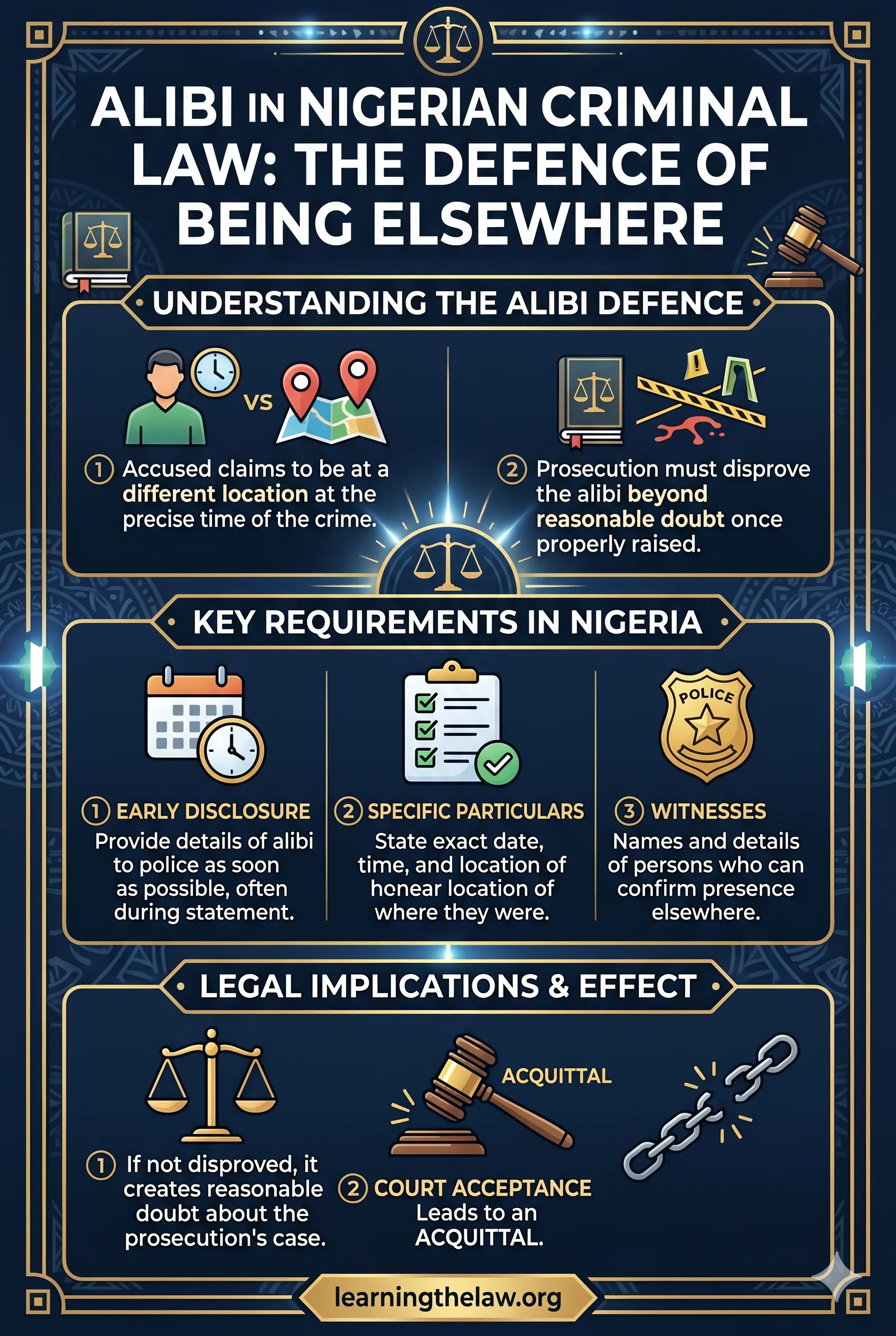
Understanding the Radical Defence That Can Destroy the Prosecution’s Case Completely
Have you ever watched a crime thriller where someone accused of murder proves they were at a restaurant across town when the crime happened? That’s alibi in action. But in real Nigerian courtrooms, claiming “I wasn’t there” isn’t as simple as it sounds. The law demands precision, corroboration, and timely disclosure. Get it right, and you walk free. Get it wrong, and your alibi “collapses like a pack of cards.”
This guide explains everything you need to know about the defence of alibi under Nigerian criminal law—what it is, how it works, when it succeeds, and why it fails.
1. What Is Alibi? Understanding the Basic Concept
The Simple Definition
Alibi is a Latin word meaning “elsewhere.”[^1] In criminal law, it’s a defence where the accused person says: “I could not have committed this crime because I was somewhere else when it happened.”
It’s not just saying “I didn’t do it.” It’s saying “I couldn’t have done it because I was physically absent from the crime scene.”
What Makes Alibi “Radical”
The Supreme Court in State v. Odomo (2019) described alibi as a “radical defence.”[^1] Here’s what that means:
Unlike other defences (like provocation or self-defence) that admit you did something but offer an excuse, alibi denies the entire foundation of the prosecution’s case. If you were genuinely elsewhere, you cannot possibly be guilty.
Think of it this way: Other defences are like saying “Yes, I hit him, but he attacked me first.” Alibi says “I wasn’t even in Lagos that day—I was in Abuja attending my sister’s wedding.”
Not a Statutory Defence
Interestingly, alibi is not written into the Criminal Code as a specific section like insanity (Section 28) or intoxication (Section 29). As the Court noted in Olaiya Opeyemi v. State (2019), “Alibi is not a statutory defence.”[^1]
Instead, it exists as a logical consequence of the prosecution’s burden of proof. The prosecution must prove you were present at the crime scene and committed the offence. If they can’t prove presence, they can’t prove guilt.
2. How Alibi Works in Practice
The Burden of Proof
Here’s a fundamental principle: The prosecution always bears the burden of proving guilt beyond reasonable doubt. This never shifts.
However, when you raise alibi, you take on an evidential burden—meaning you must provide enough evidence to make your claim worth investigating.[^1]
What This Means
You don’t have to prove your alibi is true. You must simply provide sufficient details so the police can investigate it. Once you do this:
- If your alibi checks out → the prosecution’s case collapses
- If your alibi is weak or false → you may be disbelieved, strengthening the prosecution’s case
The Three Critical Requirements
For alibi to have any chance of success, you must satisfy three requirements:
1. Timeous Plea (Raise It Early)
You must raise alibi at the earliest opportunity—typically when making your statement to the police during investigation.[^1]
Why? The police need time to verify your claim. If you only mention it at trial (months or years later), courts view it as an afterthought—a desperate lie fabricated to escape justice.
2. Specific Location
Saying “I was somewhere else” is legally worthless. You must specify:
- Exact place: Not just “I was in Okene” but “I was at St. Mary’s Hospital, Okene, Ward 3”
- Exact time: The timeline must cover the “relevant time of crime”[^1]—no gaps that could allow you to commit the offence
3. Corroboration (People Who Can Confirm)
This is crucial. You must name people who were with you and can verify your whereabouts.[^1]
The Supreme Court in Abdulrahman v. State (2019) stated clearly: “the time, place, and people with whom the accused was must be proffered.”[^1] Without these details, your alibi is “at large”—too vague to investigate.
3. Why Alibi Often Fails: Lessons from Nigerian Cases
Let’s examine real cases where alibi failed, and understand why.
Case 1: Utto v. State (2022) – The Uncorroborated Travel Story
Facts: Utto and three others were charged with armed robbery at a hotel. The victim (PW2) positively identified Utto. In his defence, Utto said he had traveled to Ugep, Cross River State, on the date of the crime.
The Fatal Flaw: Utto “did not mention anyone who saw him or was with him at Ugep and he also did not call any witness.”[^1]
Court’s Decision: Alibi rejected. The Court held that a bare assertion of travel, without corroborating witnesses or specific verifiable details, cannot stand against positive identification.
Lesson: Saying “I traveled” means nothing without proof. No witnesses? No alibi.
Case 2: Abdulrahman v. State (2019) – The Vague Health Story
Facts: Abdulrahman was accused of a crime. He claimed to be in Okene attending to health challenges.
The Fatal Flaw: He failed to provide:
- A specific address in Okene
- Names of people who could confirm his presence
- Medical records or hospital details
Court’s Decision: Alibi rejected. The Supreme Court emphasized that without these particulars, the alibi was “at large” and unworthy of investigation.[^1]
Lesson: “I was dealing with health issues” is not an alibi. Where exactly? Which hospital? Who treated you? Who saw you?
Case 3: Zebulon v. State (2019) – The Specific Timeline That Still Failed
Facts: Zebulon was charged with conspiracy and armed robbery. In his extra-judicial statement, he provided a specific timeline: “I left my office at 19:00 hours and was at home in the Itowolo Area of Ikorodu by 21:00 hours”—the time the robbery allegedly occurred.[^1]
Result: Despite the specific timeline and location, Zebulon was convicted and sentenced to death.
Lesson: Even a specific alibi can fail if the prosecution’s evidence (like eyewitness identification) is stronger. Specificity is necessary but not sufficient.
Case 4: Segun v. State (2022) – The Belated Alibi
Facts: Segun led a mob to invade a police station and lynch victims. He raised alibi for the first time during trial—not during police investigation.[^1]
Court’s Decision: The Court stated the definitive rule: “Where an accused person is fixed at the scene of crime, the defence of alibi is demolished and will collapse like a pack of cards.”[^1]
Lesson: Two problems killed this alibi:
- It was raised too late (at trial, not during investigation)
- Prosecution witnesses had already fixed him to the scene
4. When Alibi Can Succeed: The Requirements
Now let’s understand what it takes to succeed.
The Six-Point Checklist
| Requirement | What You Must Do | Example |
|---|---|---|
| 1. Early Disclosure | Raise it in your police statement | “Officer, on January 15th when this happened, I was in Abuja” |
| 2. Specific Location | Provide exact address/place | “I was at Transcorp Hilton, Room 407” |
| 3. Specific Time | Cover the entire period of the crime | “I checked in at 2pm, never left the hotel until 10am next day” |
| 4. Named Witnesses | Give names of people who saw you | “Mr. Adebayo Okonkwo, the hotel manager, can confirm this” |
| 5. Activities | Describe what you were doing | “I was attending a business conference—here’s my registration badge” |
| 6. Verifiability | Provide evidence police can check | Hotel receipts, CCTV footage, signed attendance sheets |
The “Official Record” Alibi
Some locations are particularly strong for alibi because they have official records:
- Police station: If you were reporting a crime, there’s a station diary entry
- Hospital: Medical records, admission registers
- Court: Case files, court records
- School/University: Attendance registers, exam records
- Airport: Passenger manifests, boarding passes
In State v. Odomo (2019), the accused claimed he was reporting a fight to the Village Chief and then went to a police station.[^1] This is strong because police stations keep records. However, even this failed when the prosecution presented stronger evidence fixing him to the crime scene.
5. The Conflict: Alibi vs. Eyewitness Identification
What happens when your alibi says “I wasn’t there” but an eyewitness says “I saw him do it”?
The General Rule
Where there is positive identification by credible witnesses, alibi collapses.[^1]
The Supreme Court in Segun v. State put it bluntly: When an accused is fixed at the scene by prosecution witnesses, the alibi “will collapse like a pack of cards.”[^1]
Why Eyewitness Testimony Usually Wins
Courts reason like this:
- The eyewitness has no reason to lie (usually)
- They saw you with their own eyes
- Your alibi might be fabricated to escape justice
- If your alibi was true, why didn’t you raise it immediately when arrested?
Example: The Gbekude Scenario
Consider this teaching scenario from Nigerian law classes:[^1]
Facts: Gbekude is a cloth seller in Ibadan. Everyone knows he closes his shop late every evening to avoid going home to his nagging wife. On January 19, 2020, his wife is murdered at home. He’s arrested and charged. He pleads alibi, claiming he was at his shop.
The Problem: Witnesses testify that Gbekude “did not show up” at his shop on January 19th—the very day he claims to have been there.[^1]
Analysis: This is devastating. His alibi directly contradicts established fact. Market witnesses can confirm he was absent from his usual location. This doesn’t just defeat his alibi—it suggests consciousness of guilt (he’s lying, so he probably did it).
6. Comparing Nigeria and England: The Seven-Day Notice Rule
Nigerian law doesn’t have a specific statutory deadline for raising alibi, but English law does.
The English Position
Under Section 11 of the Criminal Justice Act 1967 (England), a defendant charged with an indictable offence must give seven days’ notice of alibi particulars if they intend to rely on it at trial.[^1]
The notice must include:
- Details of the alibi
- Names and addresses of witnesses
The Nigerian Position
Nigeria has no such statutory deadline. However, case law establishes:
- Alibi should be raised during police investigation (when making your statement)
- Raising it for the first time at trial is fatal to the defence
- The emphasis is on giving police adequate time to investigate
Burden of Proof: A Key Difference
- England: The accused must establish alibi on a balance of probabilities (more likely than not true)[^1]
- Nigeria: The accused only needs to raise alibi with sufficient particularity; if the prosecution fails to negative it, the accused must be discharged[^1]
This means the standard is lower in Nigeria—you don’t have to prove your alibi is probably true, just provide enough details for investigation.
7. Practical Examples: How to Raise Alibi Properly
Let’s see how you should (and shouldn’t) raise alibi.
Example 1: The Proper Way
Scenario: You’re arrested on Monday for a robbery that happened on Saturday night at 10pm in Ikeja, Lagos.
Your Statement to Police:
“Officer, I could not have committed this robbery. On Saturday, December 2nd, 2023, I was in Abuja attending my cousin’s wedding at the Sheraton Hotel. I arrived at the hotel at 4pm for the reception. The event lasted until midnight. I can provide the following witnesses:
- Mr. Chukwudi Okonkwo (the groom) – Phone: 080XXXXXXXX
- Mrs. Ngozi Adeyemi (my aunt) – Phone: 080XXXXXXXX
- Pastor Emmanuel Bello (who conducted the ceremony) – Phone: 080XXXXXXXX
I also have photos from the event with timestamps, and my flight ticket from Lagos to Abuja (departed 1pm Saturday) and return flight (departed 8am Sunday). Here are copies.”
Why This Works:
- ✅ Raised immediately upon arrest
- ✅ Specific location (Sheraton Hotel, Abuja)
- ✅ Specific time covering the period of crime
- ✅ Named witnesses with contact information
- ✅ Documentary evidence provided
- ✅ Police can verify everything
Example 2: The Wrong Way
Scenario: Same facts, but at trial (6 months later), your lawyer says:
“My lord, the defendant wishes to inform this honourable court that he was not in Lagos on the day in question. He was traveling.”
Why This Fails:
- ❌ Raised for the first time at trial (too late)
- ❌ No specific location (“traveling” where?)
- ❌ No specific timeline
- ❌ No witnesses named
- ❌ No verifiable details
- ❌ Appears fabricated
8. Common Mistakes and How to Avoid Them
Mistake 1: Vague Locations
Wrong: “I was in Abuja.”
Right: “I was at the Transcorp Hilton Hotel, Room 407, Maitama, Abuja.”
Mistake 2: Time Gaps
Wrong: “I was at home in the evening.”
Right: “I was at home from 6pm to 10pm. The alleged robbery was at 8pm. My neighbor Mr. Adeyemi visited me from 7pm to 9pm and can confirm I never left.”
Mistake 3: No Corroboration
Wrong: “I was alone in my room reading.”
Right: “I was in my room, but I spoke with my landlord Mr. Okafor at 8:15pm when he knocked to collect rent. He saw me there.”
Mistake 4: Conflicting Details
Wrong: You tell police you were in Ibadan, but your phone records show calls made from Lagos.
Right: Ensure your story matches objective evidence (phone records, bank transactions, CCTV).
9. Why Courts Are Skeptical of Alibi
Nigerian courts approach alibi with healthy skepticism because:
Reason 1: Easy to Fabricate
Anyone can claim “I was somewhere else.” Without verification, it’s just words.
Reason 2: Late Disclosure Suggests Fabrication
If you were truly elsewhere, you’d shout it from the rooftops the moment you were arrested. Silence during investigation, then suddenly raising alibi at trial, looks like you thought of the lie later.
Reason 3: False Alibis Damage Credibility
If your alibi is proven false, courts may infer:
- You lied because you’re guilty
- If you’re innocent, why lie?
- This damages your credibility on everything else
Reason 4: Positive Identification Beats Weak Alibi
When credible witnesses say “I saw him do it” and you say “I wasn’t there” without proof, courts believe the witnesses.
10. Special Situations and Advanced Issues
Can You Raise Alibi for Part of the Crime?
Question: What if you were at the scene for part of the time, but not during the actual commission of the offence?
Answer: This is risky. Courts may find that your presence at any point near the crime establishes opportunity. Better to admit presence but offer a different defence (e.g., “I was there but didn’t participate”).
Multiple Defendants, Different Alibis
Scenario: You and two co-defendants are charged together. You raise alibi. They don’t.
Result: Your alibi stands or falls on its own merits. However, if one co-defendant testifies and contradicts your alibi, you’re in trouble.
Can the Prosecution Raise Alibi Evidence?
Yes! If during investigation, witnesses tell police you were elsewhere, the prosecution must disclose this (it’s exculpatory evidence). Failure to do so can be grounds for appeal.
Conclusion: The High-Stakes Nature of Alibi
Alibi is called a “radical defence” for good reason—it offers total exoneration if successful. However, it’s also a double-edged sword. A failed alibi doesn’t just fail to help you; it actively harms your defence by suggesting you lied.
Key Takeaways
- Raise it early: The moment you’re arrested, if you have an alibi, tell the police everything.
- Be specific: Exact location, exact time, exact witnesses. Vagueness kills alibi.
- Provide evidence: Names, phone numbers, documents—anything that lets police verify your story.
- Don’t lie: A false alibi is worse than no alibi. If caught lying, courts assume guilt.
- Understand the stakes: Alibi is all-or-nothing. It either destroys the prosecution’s case or collapses like a pack of cards.
- Know the test: Can your claim be investigated and verified? If not, it’s worthless.
When You Need Legal Advice
If you’re accused of a crime and believe you have an alibi:
- Tell your lawyer immediately with all details
- Gather evidence (receipts, photos, witness contacts)
- Let your lawyer decide whether to raise it—don’t announce it yourself to police without legal advice
- Be prepared to prove it with documents and witnesses
Remember: In Nigerian criminal law, the prosecution must prove you committed the crime beyond reasonable doubt. A properly raised, specific, and verifiable alibi can make that impossible. But a vague, late, or fabricated alibi can seal your fate.
Related Topics
- Legal Reasoning in Judicial Process
- Legal Reasoning and Approach to Problems
- Sources of Law in Nigeria
- Methods of Social Control Through Law
References
[^1]: The sources for this article are derived from the lecture materials on Alibi, including judicial pronouncements in State v. Odomo (2019), Olaiya Opeyemi v. State (2019), Utto v. State (2022), Abdulrahman v. State (2019), Zebulon v. State (2019), and Segun v. State (2022). Additional reference was made to Section 11 of the English Criminal Justice Act 1967 for comparative analysis.
This article is part of the LPI 301 Criminal Law series for law students. It is designed as a comprehensive study resource and should not be considered legal advice for specific situations. Always consult a qualified legal practitioner for advice on your particular circumstances.

Kolawole Adebowale is a law graduate of the University of Ibadan with a specialization in intellectual property law, digital patent enforcement, and software law. His research focuses on the intersection of technology and IP protection in Nigeria’s emerging digital economy, with comparative analysis spanning multiple jurisdictions. He is a member of the Law Students Association of Nigeria (LAWSAN) and the IP Association.