

Federalism in Nigeria: Understanding Federal System, Division of Powers and Constitutional Principles
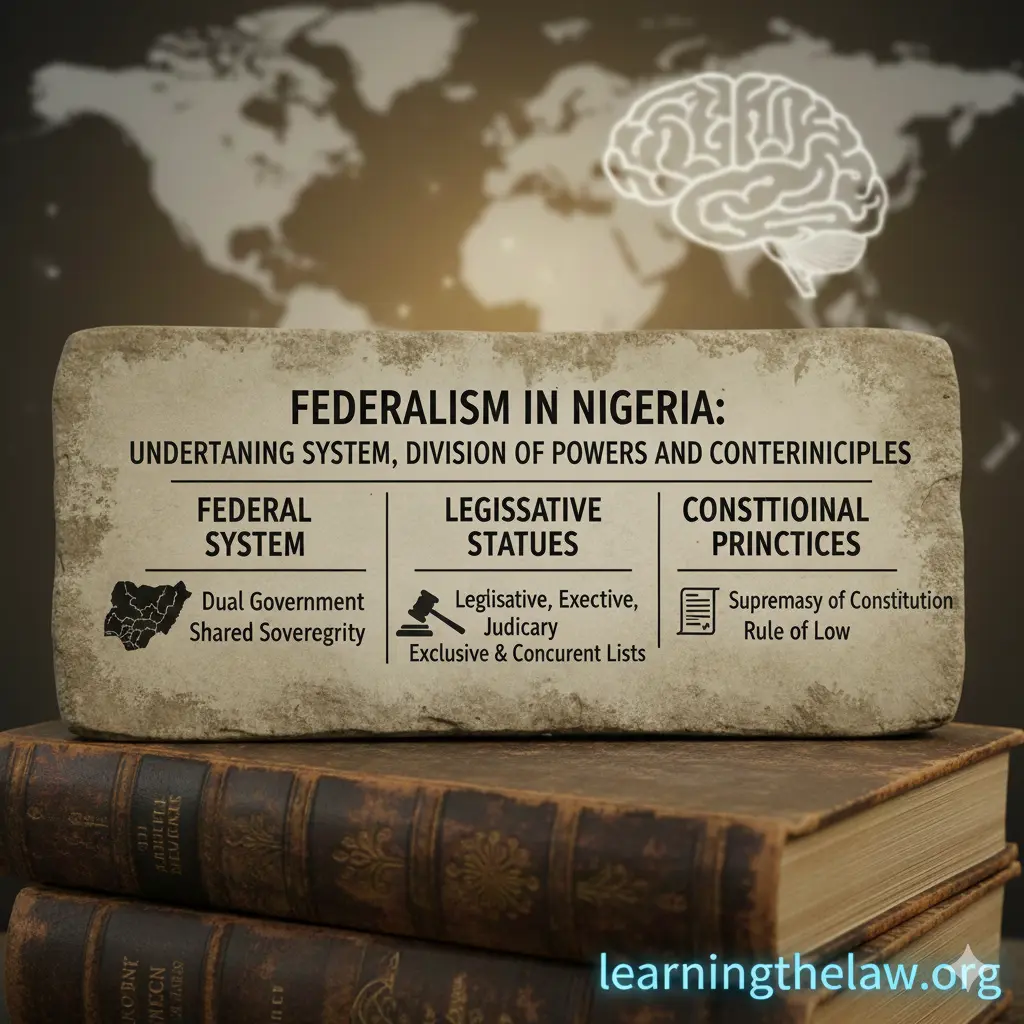
Federalism according to Black’s Law Dictionary is defined as ‘a league or compact between two or more states to become united under the central government’.1
K.C. Wheare defined federalism as ‘the method of dividing power so that general and regional governments are each within a sphere co-ordinate and independent’.2 In simpler terms, federalism is a system where power is shared between a central (federal) government and smaller regional governments (states), with each level having its own specific powers and operating independently within its sphere.
Professor Nwabueze provides a more detailed definition: federalism is an arrangement whereby the powers of government within a nation or country are divided between a national, country-wide government, and a number of regionalised governments in such a way that each exists as an entity separately and independently of the other, and operates directly on the persons and property within its territorial area, possessing a will of its own and apparatus for conducting its affairs, sometimes on matters exclusive to it.3
Lord Haldane in Attorney General for Commonwealth of Australia v Colonial Sugar Refinery Co stated that ‘the natural and literal interpretation of the word federal confines its appellation to cases in which states, while agreeing on a measure of delegation of powers to a common government, yet in the main continue to preserve their original constitution’.4 This means that in a true federal system, the states don’t lose their identity or autonomy completely – they retain significant powers and constitutional status even while being part of a larger federation.
Professor Abiola Ojo expresses the view that federalism is capable of different meanings and concepts, depending on the perspective and the background of each person. Many people believe that the federal system of government actually started with the American experiment. However, it is worthy of mention that before America adopted federalism, its practice had been in existence in the Leeward Islands of the Caribbean, which started with a consultative body comprising representatives of the various island legislatures, resulting in a General Assembly of the Leeward Islands that came into being in the 1680s. The Assembly soon developed the character of a federal council legislating on matters of common concern.5 Alexander Hamilton, one of the architects of the federal system of government in America, was born and grew up in one of the islands before he relocated to the New World. This historical context shows that federalism evolved organically from practical needs rather than being invented as an abstract political theory.
BASIS AND JUSTIFICATION OF FEDERALISM
Federalism as a system of government evolved in various nations for different reasons. In most cases, federalism is adopted in nations with vast expanses of land and multi-ethnic peoples, or diverse religions, historical, political or other backgrounds.6 The diversity itself creates a practical need for a system that can accommodate different groups while maintaining unity.
In the United States of America, adoption of federalism was part of the outcome of the war of independence, which led to the Articles of Confederation that gave powers to the confederate states and the federation. This arrangement later translated to the constitution which gave more powers to the federal government. The thirteen original American colonies were already functioning as separate entities, so federalism was the natural compromise between complete independence and total unification.
In Nigeria, the federal system of government came about as a result of the multi-ethnic nature of the country and the agitation of minorities for a system of government that would guarantee continuity and give them a sense of belonging.7 With over 250 ethnic groups, Nigeria needed a system that would prevent domination by any single group while ensuring national cohesion. The three major ethnic groups (Hausa-Fulani, Yoruba, and Igbo) plus numerous minority groups made federalism a practical necessity rather than just a political choice.
ESSENTIALS OF FEDERALISM
For a federal system to function properly and be considered a true federation, certain essential elements must be present.
Voluntary Submission of Autonomy
From the various definitions of federalism, especially that of Wheare, for there to be a true and sustainable federation, there must be a voluntary submission of some of the powers which formerly belonged to the various federating states or units to the central government, thus presupposing the existence of a democracy.8 The key word here is “voluntary” – the component units should willingly agree to cede certain powers to the central government, rather than being forced into a federation.
The experience in Nigeria differs from the situation in America. A federal system created by the mechanical drawing of borders, which made strange bedfellows of different ethnic groupings with different histories, languages, traditions or religious beliefs does not augur well for the continuance of the federation. Nigeria’s federalism was largely imposed during colonial rule through administrative convenience rather than arising from voluntary association of pre-existing states. The Amalgamation of 1914, which joined the Northern and Southern Protectorates, was a decision made by the British colonial government, not by the affected peoples themselves.
In nations like the United States and Switzerland where federation has thrived for centuries, it is due to the fact that such is based on a voluntary submission of powers to the central government. The American states, for instance, were independent colonies that chose to unite, and even then, they retained significant autonomy. Where there is no voluntary submission of powers by the federating states at the beginning or as the basis of a federation, there would be the need for a sovereign national conference, or at least a conference of nationalities, for the purpose of renegotiating the basis of the federation. This explains the periodic calls in Nigeria for a national conference to discuss the terms of our federation.
Co-operation Among Various Levels of Government
Wheare in his definition of federalism encouraged the concept of dualism in federal arrangements – the idea that federal and state governments operate in completely separate spheres. However, dualism in a federal arrangement has become unworkable under modern systems of governance because of the increasing need for government to be involved in the political, economic and social life of the people, and because of certain types of disasters or problems which may traditionally be within a state, but are of national significance or proportions, and cannot be handled by the state alone.9
Examples include environmental disasters such as erosion in the eastern part of Nigeria, oil spillages in the mid-western regions and the Niger-Delta areas, and the great gullies created as a result of tin-mining in the middle belt regions. These problems affect specific states but have national implications and often require federal resources and intervention. Similarly, issues like terrorism (Boko Haram in the Northeast), banditry (in the Northwest), and kidnapping affect specific regions but require coordinated national response. As a result, there is an increasing need for co-operation among the various levels of government. Modern federalism is therefore characterized by intergovernmental cooperation rather than strict separation.
Division of Powers
The concept of federalism was firmly entrenched in the 1979 and 1999 Constitutions respectively in the way they divided the sovereignty of the nation between the federal, states, and local governments in Nigeria. Generally, one of the basic principles of federalism is the allocation of political powers between the various levels of government in society, in such a way that constitutional limitations are placed on the exercise of such powers.10 Division of powers in a federation is done under a supreme constitution, which serves as the referee between the different levels of government.
Legislative Powers
The manner of dividing legislative powers among the various component units in a federation is the greatest mirror of the extent to which they are autonomous and independent. Section 4(1) of the 1999 Constitution vests the legislative powers of the federal or central government in the National Assembly, made up of Senate and the House of Representatives. The National Assembly has power to make laws for the peace, order and good government of the federation or any part thereof, with respect to matters included in the Exclusive Legislative List, and the exercise of this power shall be to the exclusion of the state legislatures.11
The Exclusive Legislative List contains 68 items on which only the federal government can legislate. These include defence, foreign affairs, currency, aviation, railways, immigration, and other matters of national importance that require uniform treatment across the country.
Section 4(6) of the 1999 Constitution vests the legislative powers of a State of the federation in the House of Assembly of the State which shall have power to make laws for peace, order and good government of the State or any part thereof with respect to any matters included in the Concurrent Legislative List but not on any matters included in the Exclusive Legislative List.12
The Concurrent Legislative List contains items on which both federal and state governments can legislate, though federal law prevails in case of conflict. These include items like education, health, agriculture, and industrial development.
The Doctrine of Covering the Field
Worthy of note is the provision of section 4(5) of the 1999 Constitution which states that ‘if any Law enacted by the House of Assembly of a State is inconsistent with any law validly made by the National Assembly, the law made by the National Assembly shall prevail, and that other Law shall to the extent of the inconsistency be void’.13
This subsection applies to any matters included in the concurrent legislative lists because State Houses of Assembly are precluded from making laws on matters included in the Exclusive Legislative List. In Attorney General (Ogun State) v Attorney General (Federation), Fatayi Williams JSC stated that:
It is of course, settled law, based on the doctrine of covering the field that if Parliament enacts a law in respect of any matter in which both Parliament and a Regional legislature are empowered to make laws, and a Regional legislature enacts an identical law on the same subject matter, the law made by the Parliament shall prevail. That made by the Regional legislature shall become irrelevant and therefore impliedly repealed.14
The court went on to state that once it appears from the provisions of the federal laws that the intention is to cover the whole field on the particular matter, with respect to the entire Federation, then, the state law on the matter is inconsistent and invalid. This doctrine essentially means that when the federal government has comprehensively legislated on a matter in the Concurrent List, states cannot pass conflicting laws even though they technically have legislative power over that matter.
Executive Powers
Section 5(1) of the 1999 Constitution vests the executive powers of the federation in the President, while section 5(2) vests the executive powers of the state in the Governor.15 Executive power refers to the power to implement and enforce laws. Just as legislative powers are divided, so too are executive powers distributed between federal and state governments, with each responsible for implementing laws within their respective jurisdictions.
Judicial Powers
Section 6(1) vests the judicial powers of the federation in the courts established for the federation, while section 6(2) vests the judicial powers of the State in the courts established by the states.16 Nigeria has both federal courts (like the Federal High Court, Court of Appeal, and Supreme Court) and state courts (like State High Courts, Customary Courts, and Sharia Courts in some states). This dual court system reflects the federal nature of the country, though the Supreme Court remains the final court of appeal for all matters.
Independence and Autonomy
One major ingredient of a true federation is the independence and autonomy of various units making up the federation. This means each component unit must be able to operate without interference from or control by any other unit. In other words, the relationship between the centre and the states or among the various states must not be one of superiority or inferiority.17
This does not mean there cannot be co-operation between them. Instead, diversity in certain areas is encouraged, taking into consideration the peculiarities of the component units. For instance, states can have different educational curricula to reflect local needs, different agricultural policies suited to their climate and terrain, and different approaches to local government administration. However, in practice, Nigeria’s federalism has been criticized as being overly centralized, with the federal government controlling most resources and exercising significant influence over states through its control of revenue allocation.
Equality of Size and Power
Equality of size and power means that there should be no state which is so big as to make others easily susceptible to its whims. The relationship each state has with the central government must not be based on any preference, otherwise it may eventually lead to the overthrow of the federal system.
In Nigeria, this principle is somewhat violated by the vast differences in size and population among states. For instance, Kano State has a population exceeding 13 million, while Bayelsa State has less than 2 million. Lagos State generates more internally generated revenue than most other states combined. These disparities create practical challenges for true federalism, as some states wield disproportionate political and economic influence.
Supremacy of the Constitution
According to K.C. Wheare:
If the general and regional governments are to be co-ordinate with each other, neither must be in a position to override the terms of their agreement about the powers and status which each tier is to enjoy. So far as this agreement regulates their relations with each other, it must be supreme.18
The reason for the requirement of a supreme constitution as a precondition to a true federation is to make sure that the tiers of government abide by the terms of the basis of their relationship. In other words, everyone must be bound by the terms of the agreement which must not be easily subjected to change except with the agreement of the majority making the union.
In Nigeria, the Constitution is supreme over all other laws and governmental actions. Section 1(1) of the 1999 Constitution declares that “This Constitution is supreme and its provisions shall have binding force on all authorities and persons throughout the Federal Republic of Nigeria.” This supremacy is what prevents any level of government from exceeding its constitutional powers.
Independent Judiciary
An important requirement for a supreme constitution is the need for an independent judiciary to make impartial pronouncements on the extent and scope of the rights of various tiers, in cases of conflict especially between the central government and any state government. The extent of the independence of the judiciary is determined by issues such as appointment, dismissal, remuneration, and conditions of service of officers of the judiciary who are not to be subject to the whims and caprices of the other arms of government or any other individuals.19
The judiciary acts as the umpire in the federal system, interpreting the Constitution when disputes arise about which level of government has power over a particular matter. Cases like Attorney General of Ogun State v Attorney General of the Federation demonstrate how courts resolve federal-state conflicts. For the judiciary to perform this role effectively, judges must be independent and not subject to pressure from any government. This is why judges enjoy security of tenure and cannot be easily removed from office.
CONCLUSION
Federalism remains a fundamental constitutional principle designed to accommodate diversity while maintaining unity. The Nigerian federal system, though influenced by colonial experiences and the American model, has developed unique characteristics shaped by the country’s multi-ethnic composition and historical evolution. The effectiveness of federalism in Nigeria depends on adherence to its essential principles, including voluntary submission of autonomy, co-operation among governmental levels, proper division of powers, constitutional supremacy, and judicial independence.
However, Nigerian federalism faces practical challenges including over-centralization of power at the federal level, unequal distribution of resources, and disparities in size and capacity among states. Addressing these challenges requires continuous dialogue, constitutional reform where necessary, and genuine commitment to the federal principle by all stakeholders.
REFERENCES
Footnotes
-
Black’s Law Dictionary (11th edn, Thomson Reuters 2019). ↩
-
KC Wheare, Federal Government (4th edn, Oxford University Press 1963) 10. ↩
-
BO Nwabueze, Federalism in Nigeria under the Presidential Constitution (Sweet & Maxwell 1983) 1-2. ↩
-
Attorney General for Commonwealth of Australia v Colonial Sugar Refinery Co [1914] AC 237 (PC). ↩
-
Abiola Ojo, Constitutional Law and Military Rule in Nigeria (Evans Brothers 1987) 65-68. ↩
-
Wheare (n 2) 35-40. ↩
-
E Malemi, The Nigerian Constitutional Law (Princeton Publishing Co 2005) 125-130. ↩
-
Wheare (n 2) 10-15. ↩
-
ibid 20-25. ↩
-
Nwabueze (n 3) 45-52. ↩
-
Constitution of the Federal Republic of Nigeria 1999 (as amended), s 4(1). ↩
-
ibid s 4(6). ↩
-
ibid s 4(5). ↩
-
Attorney General (Ogun State) v Attorney General (Federation) (1982) 3 NCLR 166, 236. ↩
-
Constitution of the Federal Republic of Nigeria 1999 (as amended), ss 5(1)-(2). ↩
-
ibid ss 6(1)-(2). ↩
-
Wheare (n 2) 85-90. ↩
-
ibid 54. ↩
-
Nwabueze (n 3) 198-205. ↩
