
Keir v Leeman (1846) 9 QB 371: When an Agreement to Drop Charges Becomes Illegal
Suppose a creditor has secured a judgment against a debtor, and in the process of enforcing it, the debtor’s associates commit riot and attack a police officer. The creditor lays criminal charges. A third party then offers to pay the outstanding debt if the creditor drops the prosecution. The creditor agrees, abandons the charges, and the third party refuses to pay. Can the creditor sue to recover?
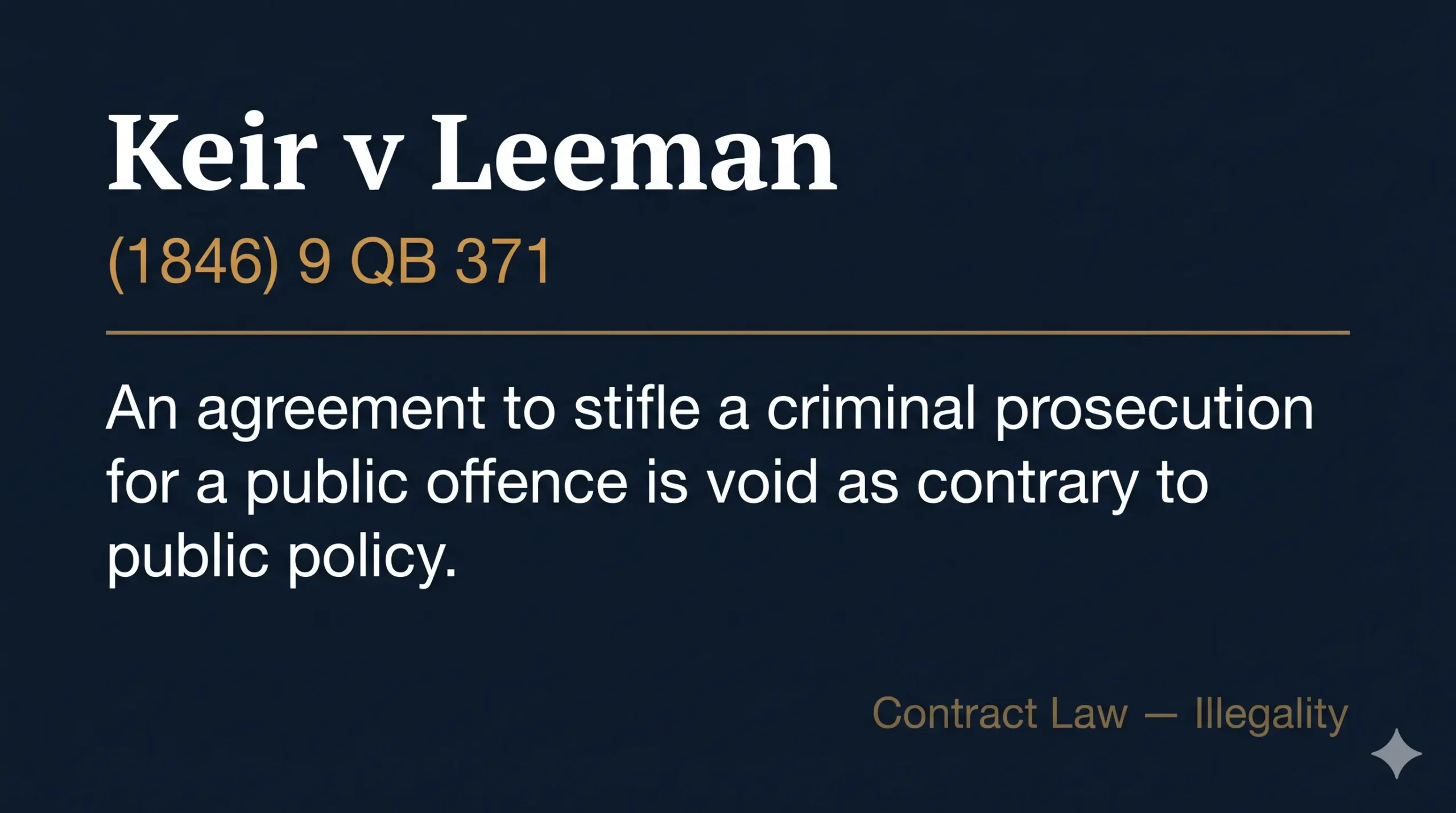
That is precisely the question resolved in Keir v Leeman (1846) 9 QB 371. The answer was no. The Keir v Leeman agreement to stifle prosecution was held void as contrary to public policy, and neither party could seek the court’s assistance to enforce it.
Citation
Keir v Leeman (1844) 6 QB 308, affirmed (1846) 9 QB 371, 115 ER 1315 (Exchequer Chamber).
For the primary source, see the case report on vLex UK.
Background and Facts
Keir, the plaintiff, had obtained a judgment against a man named George Emmitt for £150. To enforce it, he issued a writ of fieri facias (fi. fa.), directing the sheriff to seize and sell Emmitt’s goods in satisfaction of the debt.
While the sheriff’s officers were executing the writ, Emmitt and associates intervened unlawfully. They committed riot, assaulted a constable carrying out his official duty, assaulted others helping the constable, and committed further simple assaults. The object was to obstruct the execution of the writ.
Keir responded by indicting Emmitt and the others for these offences.
Two third parties, Leeman and Pearson, then approached Keir with a proposal. In consideration of Keir withdrawing the prosecution and proceeding no further, they promised to pay:
- The outstanding balance of the judgment debt remaining unsatisfied against Emmitt; and
- The costs of the criminal prosecution.
Keir agreed. With the assent of the judge at the assizes, he forbore from prosecuting further and the charges were dropped.
Leeman and Pearson then refused to honour their promise.
Keir brought an action in assumpsit to recover the sums promised.
The Legal Issue
Was the Keir v Leeman agreement to stifle prosecution a valid and enforceable contract, or was it void as contrary to public policy on account of its illegal consideration?
The Court’s Decision on the Agreement to Stifle Prosecution
At the Queen’s Bench (1844) 6 QB 308, Lord Denman CJ held the agreement illegal and void. His Lordship distinguished two categories of criminal offences:
- Private offences, such as a simple common assault affecting primarily the victim. The law permits a compromise of such a prosecution because the wrong is in substance personal.
- Public offences, such as riot and obstruction of a public officer. These affect the community at large and cannot be made the subject of a private bargain between any parties.
Lord Denman CJ held:
“In the present instance the offence is not confined to personal injury, but it is accompanied with riot and obstruction of a public officer in execution of his duty. These are matters of public concern and therefore not legally subject of a compromise.”1
The Exchequer Chamber (1846) 9 QB 371 affirmed the Queen’s Bench. Tyndal CJ reinforced the rule:
“Indeed it is very remarkable what very little authority there is to be found . . . for the principle that any compromise of a misdemeanour or indeed of any public offence can be otherwise than illegal and any promise founded on such a consideration otherwise than void.”2
The agreement was entirely void. The fact that the judge at the assizes had consented to the withdrawal of the prosecution made no difference to the civil unenforceability of the contract.
Ratio Decidendi
The ratio of Keir v Leeman rests on two propositions:
- An agreement to stifle prosecution for a public offence is void as contrary to public policy, regardless of who the parties are.
- Whether an offence is “public” depends on whether it affects the community beyond the immediate parties. Riot, obstruction of law enforcement, and resistance to judicial process are paradigm public offences.
Why the Rule Against Stifling Prosecution Exists
Criminal prosecutions for public offences are not the private property of the prosecutor. Where an offence threatens public order or the authority of a court order, the state has an independent interest in the matter being prosecuted. A private agreement to abandon that prosecution in exchange for money defeats that public interest.
Permitting such bargains would allow private parties to purchase immunity from the consequences of public wrongdoing. The rule in Keir v Leeman prevents this by rendering the agreement void ab initio: the promise to pay and the promise to drop charges are both unenforceable.
Scope: Which Offences Are Public?
The distinction drawn in Keir v Leeman has been applied as follows:
- Simple common assault — a private offence. Capable of compromise.3
- Riot — a public offence. No valid compromise.
- Obstruction of a public officer — a public offence. Same result.
- Fraud, forgery, and corruption — public offences incapable of compromise.
The rule does not bar an accused from voluntarily compensating a victim. What it bars is a contractual arrangement in which the withdrawal of charges forms the consideration for payment.
Application in Nigerian Contract Law
The Keir v Leeman agreement to stifle prosecution principle applies in Nigeria through the reception of English common law under the Interpretation Act.4 Nigerian courts apply the same public policy rule against such agreements.
In practice, the most common Nigerian scenario involves agreements to pay police officers or prosecutors to drop criminal charges. Such agreements are void, and money paid under them cannot be recovered. The same applies where a third party contracts with a complainant to procure the withdrawal of a public prosecution.
This principle sits within the broader category of contracts prejudicial to the administration of justice, which includes agreements to suppress evidence and agreements to obstruct court proceedings. For a full treatment of this category and its relationship to other grounds of illegality, see our article on Illegality and Public Policy in Contract Law.
For background on the formation requirements that must first be satisfied before illegality becomes relevant, see our notes on Formation of Contract.
Examiner’s Note
Keir v Leeman arises in problem questions involving:
- An accused person or third party offering payment to a complainant in exchange for withdrawal of charges
- Offences that are public in character (riot, obstruction of officers, fraud)
- A subsequent attempt by either party to enforce the bargain
Exam approach: Identify the illegal consideration (an agreement to stifle prosecution for a public offence); apply Keir v Leeman to hold the contract void; note that neither party can enforce it and money already paid may not be recoverable.
Footnotes
-
Keir v Leeman (1844) 6 QB 308, 316 per Lord Denman CJ. ↩
-
Keir v Leeman (1846) 9 QB 371, 394 per Tyndal CJ. ↩
-
See the distinction drawn in Keir v Leeman (1844) 6 QB 308 between simple assault (private) and riot with obstruction of a public officer (public). ↩
-
Interpretation Act, Cap I23, Laws of the Federation of Nigeria 2004, s 32; see also the High Court Law of various states which preserves the application of common law and equity. ↩
-
See generally Ekeagbara v Ikpeazu [2016] 10 NWLR (Pt 1521) 515 on public policy and the administration of justice in Nigerian courts. ↩

Kolawole Adebowale is a law graduate of the University of Ibadan with a specialization in intellectual property law, digital patent enforcement, and software law. His research focuses on the intersection of technology and IP protection in Nigeria’s emerging digital economy, with comparative analysis spanning multiple jurisdictions. He is a member of the Law Students Association of Nigeria (LAWSAN) and the IP Association.