

Sources of Constitutional Law In Nigeria: A Comprehensive Guide
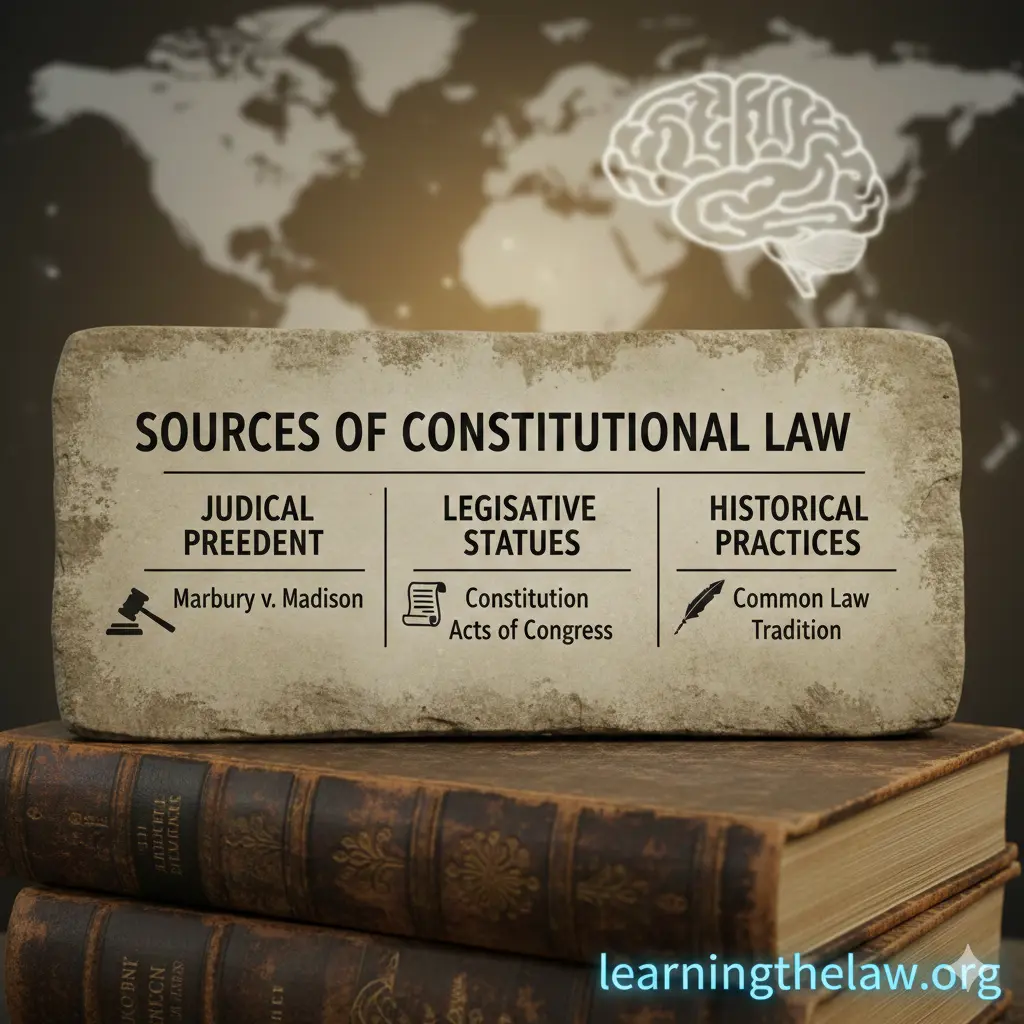
INTRODUCTION: UNDERSTANDING SOURCES OF CONSTITUTIONAL LAW
When we talk about “sources” of constitutional law, we are referring to the origins or channels from which constitutional rules are created, developed, and given authority. Think of it like asking: “Where do the rules that govern our country come from?” The answer is not simple because constitutional rules don’t come from just one place – they come from multiple sources, each contributing to the overall constitutional framework of a nation.
Constitutional law derives its authority from various origins or channels through which constitutional rules are framed or developed. The sources of constitutional law represent the foundation upon which a state’s constitutional framework is built. These sources vary across jurisdictions and constitutional systems, reflecting each nation’s unique historical, political, and legal experiences.1
Understanding these sources is crucial because it helps us know why certain provisions exist in our Constitution, how they came to be, and what influences shaped them. For Nigeria, as for many other nations, the Constitution we have today is a product of many different influences and experiences over time.
1. HISTORICAL AND POLITICAL EXPERIENCES
What This Means
Imagine that a country’s past experiences shape its future laws, just like your personal experiences shape who you are today. A country that has gone through war might have constitutional provisions about how to avoid future conflicts. A country that gained independence from colonial rule might have provisions protecting sovereignty and self-determination.
How This Works
The experiences of a state play a crucial role in shaping its constitutional rules and provisions. For most written constitutions, the making of the constitution follows a fundamental political event such as:
- The conferment of independence on a former colony (as seen in many Commonwealth countries like Nigeria, Ghana, and Kenya)
- A successful revolution (as in the United States and France)
- A reconstruction of a country’s institutions following a war (as in Germany and Japan after World War II)
The Nigerian Example
In Nigeria, constitutional provisions over time have been largely influenced by the country’s historical and political experiences. Let’s look at some specific examples:
Colonial Experience: Nigeria’s colonial experience under British rule influenced provisions relating to the structure of states and the land mass of each state within the country. The way Nigeria is divided into states today reflects both our pre-colonial ethnic divisions and the administrative convenience of colonial rulers.
Parliamentary System: The parliamentary system constitutions of 1960 and 1963 at both regional and central governments during independence reflect Nigeria’s colonial experiences and common law influence. We adopted a Westminster-style parliamentary system because that was what the British colonizers practiced, and it was what Nigerian leaders were familiar with at independence.2
Military Rule: Similarly, experiences with military incursion into government have influenced constitutional provisions in successive constitutions. For instance, the strong presidency we have today (as opposed to the parliamentary system we started with) was partly shaped by military governance, where power was concentrated in one person – the military head of state.
2. HISTORICAL LEGAL DOCUMENTS
What This Means
Some very old legal documents from other countries (especially England) have influenced constitutional provisions around the world, including in Nigeria. These documents were groundbreaking in their time and established fundamental principles that we still use today.
Key Historical Documents
Historical legal documents such as:
- Magna Carta (1215): This medieval English document was one of the first to limit the power of the king and establish that even rulers must follow the law. It introduced ideas like “no taxation without representation” and the right to a fair trial.
- Petition of Rights (1628): This document further limited the king’s power, particularly regarding taxation and the arbitrary imprisonment of citizens.
- Bill of Rights (1689): This established important principles like free speech in Parliament, the right to petition the monarch, and limits on cruel and unusual punishment.
- Habeas Corpus Act 1679: This law protects against unlawful detention by requiring that anyone arrested must be brought before a court to determine if their detention is lawful.
These foundational documents have largely influenced provisions regarding fundamental human rights in many constitutions.3 These historical documents established principles that continue to shape constitutional law across common law jurisdictions.
Why This Matters for Nigeria
When Nigeria’s Constitution protects your fundamental rights (like freedom from unlawful detention, right to fair trial, etc.) in Chapter IV of the 1999 Constitution, these provisions trace their ancestry back to these ancient English documents. The concept didn’t just appear out of nowhere – it evolved over centuries.
3. ENACTMENTS AND LEGISLATION
What “Enactments” Means
An “enactment” is simply a law that has been formally passed by a legislative body (like the National Assembly in Nigeria or Parliament in Britain). Think of it as the official process of turning a proposed law into actual law.
Acts of Parliament
In Britain (Parliamentary Supremacy System):
In parliamentary supremacy systems like Great Britain, Acts of Parliament and legislation made by ministers and other authorities upon whom Parliament confers the power to legislate form parts of the constitution. This means that in Britain, if Parliament passes a law today, that law becomes part of their constitution immediately. Examples include the Acts of Parliament of 1911 and 1949, and Acts of Settlement 1701.4
This is possible because Britain has an “unwritten” or “uncodified” constitution – there’s no single document called “The Constitution.” Instead, their constitution is made up of many different laws, conventions, and practices accumulated over centuries.
In Nigeria (Written Constitution System):
Nigeria operates differently. We have a written constitution – a single supreme document called the Constitution of the Federal Republic of Nigeria (CFRN) 1999 (as amended).
In Nigeria, amendments to the Constitution may be made through specially prescribed law-making procedures under sections 8 and 9.5 However, unlike Great Britain, this does not make ordinary Acts of the legislature part of the constitution.
Key Difference: In Nigeria, there’s a clear distinction between:
- Constitutional law (the Constitution itself, which is supreme)
- Ordinary legislation (regular laws passed by the National Assembly or State Houses of Assembly)
An ordinary law passed by the National Assembly does not automatically become part of the Constitution. To amend the Constitution requires a special procedure involving both the National Assembly and State Houses of Assembly.
Military Decrees and Edicts
What Are Military Decrees?
During military rule in Nigeria (1966-1979 and 1983-1999), the country was not governed by elected representatives but by military officers. These military rulers made laws through “decrees” (at the federal level) and “edicts” (at the state level). These were not passed through democratic processes but were simply promulgated (announced) by the military government.
How Military Decrees Influenced Nigeria’s Constitution:
Military decrees and edicts have influenced provisions of the Nigerian constitution in significant ways. For instance:
Example 1 – National Youth Service Corps (NYSC): The NYSC scheme was created by a military decree. Even though it wasn’t part of the deliberations when Nigerians were drafting the 1979 Constitution, it was included in the final Constitution and remains there today.
Example 2 – Land Use Act: The Land Use Act (Decree No. 6 of 1978) was not part of the deliberations of the 1978 constituent assembly but was subsequently included in the CFRN 1979 and has featured in successive constitutions.6 Today, this Act (which gives state governors control over land) is so entrenched in the Constitution that it cannot be easily removed.
Example 3 – State Creation: The present federal structure of states within the federation is attributed to military decrees:
- Decree No. 14 of 1967 created 12 states (from the original 4 regions)
- Decree No. 170 of 1976 created 19 states
- This structure is currently recognised in the CFRN 1999 (as amended), which now has 36 states plus the Federal Capital Territory.
4. DELIBERATIONS OF CONSTITUTIONAL CONFERENCES AND CONSTITUENT ASSEMBLIES
What Is a Constituent Assembly?
A constituent assembly is essentially a special group of people elected specifically to write or adopt a constitution. Think of it as a “constitution-writing team” chosen by the people.
Key Characteristics:
- It’s an assembly specially elected (not just regular politicians doing extra work)
- It’s specifically mandated by the people to adopt a constitution
- Its job is to institute a framework of government on behalf of the people
As Professor BO Nwabueze noted, only the people by means of popular and free election can confer constituent power because it is only to them that the exercise of power belongs.7 This is important because it emphasizes that the power to make a constitution comes from the people, not from the government or military.
How Does It Work?
A constituent assembly represents a group of elected people from the constituent parts of a country who represent the people’s interest and are saddled with the responsibility of making a constitution. Here’s the typical process:
- Election: People from different parts of the country are elected to serve in the assembly
- Deliberation: The assembly works on various documents and precedents (looking at what other countries have done, what worked in the past, etc.)
- Debate: Members debate various provisions – should we have a presidential or parliamentary system? How many states should we have? What rights should citizens have?
- Voting: The assembly votes on different provisions
- Drafting: They fashion out a constitution
- Approval: The constitution may be:
- Approved in a referendum by the people to whom it will apply, OR
- Submitted to the government for passage into law (with or without amendment)
Working with Constitutional Drafting Committees
In some instances, a constitutional conference or constituent assembly works together with a constitutional drafting committee (CDC). The process typically works like this:
- CDC creates initial draft: A smaller group of experts (lawyers, academics, etc.) creates a first draft of the constitution
- Constituent Assembly reviews: The larger constituent assembly (representing the people) reviews this draft
- Deliberation and amendments: The assembly deliberates on the draft, suggests changes, debates controversial provisions
- Final draft: A final draft is produced based on the recommendations of the conference or assembly
Nigerian Example:
The Nigerian Constituent Assembly (1977-1978) consisted of 230 members who worked together with the Constitution Drafting Committee of 1975. Here’s how it worked:8
- 1975: The Constitution Drafting Committee (a group of 49 experts) was set up to create a draft constitution
- 1976: The CDC submitted their draft to the military government
- 1977-1978: A Constituent Assembly of 230 elected members was convened to review and debate the draft
- 1979: After the Assembly’s deliberations, the final constitution was promulgated as the CFRN 1979
This process was also used in creating the USA Constitution of 1787, where a Constitutional Convention (similar to our constituent assembly) deliberated on drafts and produced the final constitution.
Why This Matters
This source is important because it emphasizes popular participation in constitution-making. A constitution imposed by military force or colonial power is different from one created through the deliberations of people’s representatives. The legitimacy of a constitution partly depends on whether the people (through their representatives) had a say in making it.
5. CONSTITUTIONAL CONVENTIONS
What Are Conventions?
Constitutional conventions are unwritten rules that govern how government operates. They’re not laws (you can’t be punished in court for breaking them), but they’re followed because people consider them binding and important for the smooth running of government.
Think of conventions like social etiquette – it’s not illegal to not say “thank you” when someone helps you, but people expect it and you’d be considered rude if you don’t. Similarly, conventions aren’t legally enforceable, but breaking them can cause political problems.
Formal Definition
Conventions are long-standing practices and rules which may not necessarily have the force of law but have become entrenched in the governance of a state as a result of long usage. Hood Philips describes conventions as ‘rules of political practice which are regarded as binding by those to whom they apply but which are not laws, as they are not enforced by the courts or legislature’.9
Key Features:
- They are NOT laws
- Courts do NOT enforce them
- But they ARE regarded as binding
- They are rules of practice regulating political institutions
Examples from Britain
In the United Kingdom, conventions form the most important part of the constitution, with several constitutional conventions relating to the principle of collective ministerial responsibility, the appointment of ministers, and other aspects which form part of the structure and operation of Parliament.10
Example: Legally, the British Queen can refuse to sign a bill into law. However, by convention, she always signs bills that Parliament approves, because refusing would mean an unelected monarch is overriding elected representatives.
6. CUSTOMS
What Are Customs?
Customs are practices which, by common adoption and long unvarying habits, have come to have the force of law.11
Customs vs. Conventions: What’s the Difference?
While related to conventions, customs differ in that they have acquired legal force through consistent and prolonged observance.
- Conventions = Binding practices that are NOT law
- Customs = Practices that HAVE BECOME law through long usage
Think of it this way: If people do something the same way for so long that everyone accepts it as “the way things must be done,” it can eventually become a custom with legal force.
7. JUDICIAL PRECEDENTS
What Are Judicial Precedents?
A judicial precedent is a court decision that establishes a principle or rule that courts must follow in future cases dealing with similar facts or issues. In simple terms: when a court (especially a higher court) makes a decision, that decision becomes a guide for how similar cases should be decided in the future.
How Precedents Become Constitutional Law
In Great Britain, judicial precedents which establish constitutional principles form part of the constitution. Case laws from court decisions expounding the common law or interpreting Acts of Parliament may form part of the constitution.
Example: The ancient case of Proclamation 1610 established the law-making power of the monarch through Parliament.12 This court decision became a constitutional principle that is still followed today.
Judicial Precedents in the European Context
Until Brexit was concluded, decisions of the European Court of Justice in relation to the European Union were an important source of Britain’s constitutional law.13 This shows how even international court decisions can become sources of constitutional law when a country is part of an international organization.
What This Means for Nigeria
In Nigeria, while we have a written constitution, court decisions interpreting constitutional provisions also become important. When the Supreme Court interprets a section of the Constitution, that interpretation guides how everyone (including lower courts and government) should understand that provision.
8. CONSTITUTIONS OF OTHER COUNTRIES AND PREVIOUS CONSTITUTIONS
Learning from Other Countries
Constitutions of other countries, such as the United States Constitution of 1787, have served as models for other countries in making their constitutions with respect to constitutional principles such as federalism and presidential systems of government.14
Why Copy From Others?
When creating a new constitution, it makes sense to look at what has worked (or not worked) in other countries. Why reinvent the wheel when you can learn from others’ successes and failures?
Nigerian Example:
Nigeria’s presidential system is largely modeled after the American system. We have:
- A President (like America)
- A Senate and House of Representatives (like America’s Congress)
- Separation of powers between Executive, Legislature, and Judiciary (like America)
- A Federal system with states (like America)
We didn’t just copy blindly – we adapted these ideas to fit our own circumstances, but the American Constitution was definitely a major influence.
Learning from Our Own Past
Previous constitutions of a state may also influence provisions in subsequent constitutions. Past Nigerian constitutions have repeatedly featured some provisions successively, demonstrating the continuity of certain constitutional principles across different constitutional eras.
Why This Happens:
If something worked well in the 1979 Constitution, it makes sense to keep it in the 1999 Constitution. Conversely, if something caused problems, the new constitution might try to fix it. Each constitution learns from the previous one.
9. WORKS OF EMINENT WRITERS, JURISTS AND PHILOSOPHERS
The Power of Ideas
Intellectual works and writings of eminent jurists, political thinkers, philosophers, and constitutional law writers on constitutional principles have largely influenced several constitutions.15
Key Thinkers and Their Ideas
1. John Locke (1632-1704):
- English philosopher who wrote about natural rights and government by consent
- His ideas about separation of powers influenced many constitutions
- He argued that people have natural rights to life, liberty, and property
2. Baron de Montesquieu (1689-1755):
- French political philosopher
- Famous for his theory of separation of powers (dividing government into Executive, Legislative, and Judicial branches)
- His book “The Spirit of Laws” influenced the American Constitution and many others
3. A.V. Dicey (1835-1922):
- British jurist famous for his work on the rule of law
- His writings on constitutional law are still cited today
- His concept of “rule of law” has become a fundamental constitutional principle worldwide
Why Books Matter for Constitutions
These thinkers didn’t write constitutions themselves, but their ideas about how government should work, how to protect individual rights, and how to prevent tyranny became the theoretical foundation for many constitutional provisions. When Nigerian lawyers and politicians were drafting our constitutions, they were guided by these philosophical ideas.
10. RULES OF INTERNATIONAL LAW
What Is International Law?
International law consists of rules that govern relationships between countries and establish standards that all countries should follow. These rules come from:
- International humanitarian law (IHL): Rules about how wars should be fought and how civilians and prisoners should be treated
- International human rights law (IHRL): Rules about basic rights that all humans should enjoy, regardless of which country they live in
- Customary international law: Practices that have become accepted as law through consistent state practice
How International Law Influences National Constitutions
Rules contained in various international and regional treaties and conventions also influence constitutional rules and provisions.
Nigerian Example:
In Nigeria, provisions from human rights documents such as the United Nations Declaration of Human Rights 1948 are reflected in Chapter Four of the CFRN 1999 (as amended).16
When you read about your right to life (Section 33), right to dignity (Section 34), right to personal liberty (Section 35), etc. in the Nigerian Constitution, these rights didn’t just appear from nowhere – they were influenced by international human rights documents.
Important Note: Domestication Requirement
However, it is important to note the provisions of section 12 of the CFRN, which requires domestication of any international or regional treaty in Nigeria before it can take effect in the country, though not as constitutional rule but as operational law.17
What Does “Domestication” Mean?
This means that even if Nigeria signs an international treaty, that treaty doesn’t automatically become law in Nigeria. The National Assembly must pass a law (called an “Act”) to bring that international treaty into Nigerian law. Until that happens, Nigerian courts cannot directly enforce the international treaty.
Example: Nigeria signed the African Charter on Human and Peoples’ Rights. However, it only became enforceable in Nigerian courts after the National Assembly passed the African Charter on Human and Peoples’ Rights (Ratification and Enforcement) Act.
CONCLUSION
The sources identified in this discussion are by no means exhaustive, as there are other identifiable sources from various constitutions. The constitutional rules of a state may be derived from more than one of the sources identified above. The multiplicity of sources reflects the complex nature of constitutional development and the various influences that shape a nation’s fundamental legal framework.
REFERENCES
Footnotes
-
PAO Oluyede, Constitutional Law in Nigeria (Evans Brothers 1992) 15-18. ↩
-
E Malemi, The Nigerian Constitutional Law (Princeton Publishing Co 2005) 45-52. ↩
-
AW Bradley, KD Ewing and CJS Knight, Constitutional and Administrative Law (16th edn, Pearson Education Limited 2015) 8-12. ↩
-
ibid 89-95. ↩
-
Constitution of the Federal Republic of Nigeria 1999 (as amended), ss 8-9. ↩
-
Malemi (n 2) 98-105. ↩
-
BO Nwabueze, Constitutional Democracy in Africa (Spectrum Books 2003) vol 1, 23. ↩
-
Malemi (n 2) 112-118. ↩
-
O Hood Phillips and P Jackson, Constitutional and Administrative Law (8th edn, Sweet & Maxwell 2001) 125. ↩
-
Bradley, Ewing and Knight (n 3) 45-58. ↩
-
Oluyede (n 1) 28. ↩
-
Case of Proclamations (1610) 12 Co Rep 74. ↩
-
Bradley, Ewing and Knight (n 3) 156-162. ↩
-
Malemi (n 2) 35-42. ↩
-
AV Dicey, Introduction to the Study of the Law of the Constitution (10th edn, Macmillan 1959) 187-195; Montesquieu, The Spirit of Laws (Thomas Nugent tr, Hafner Publishing 1949) Book XI. ↩
-
Constitution of the Federal Republic of Nigeria 1999 (as amended), ss 33-46. ↩
-
ibid s 12. ↩
