

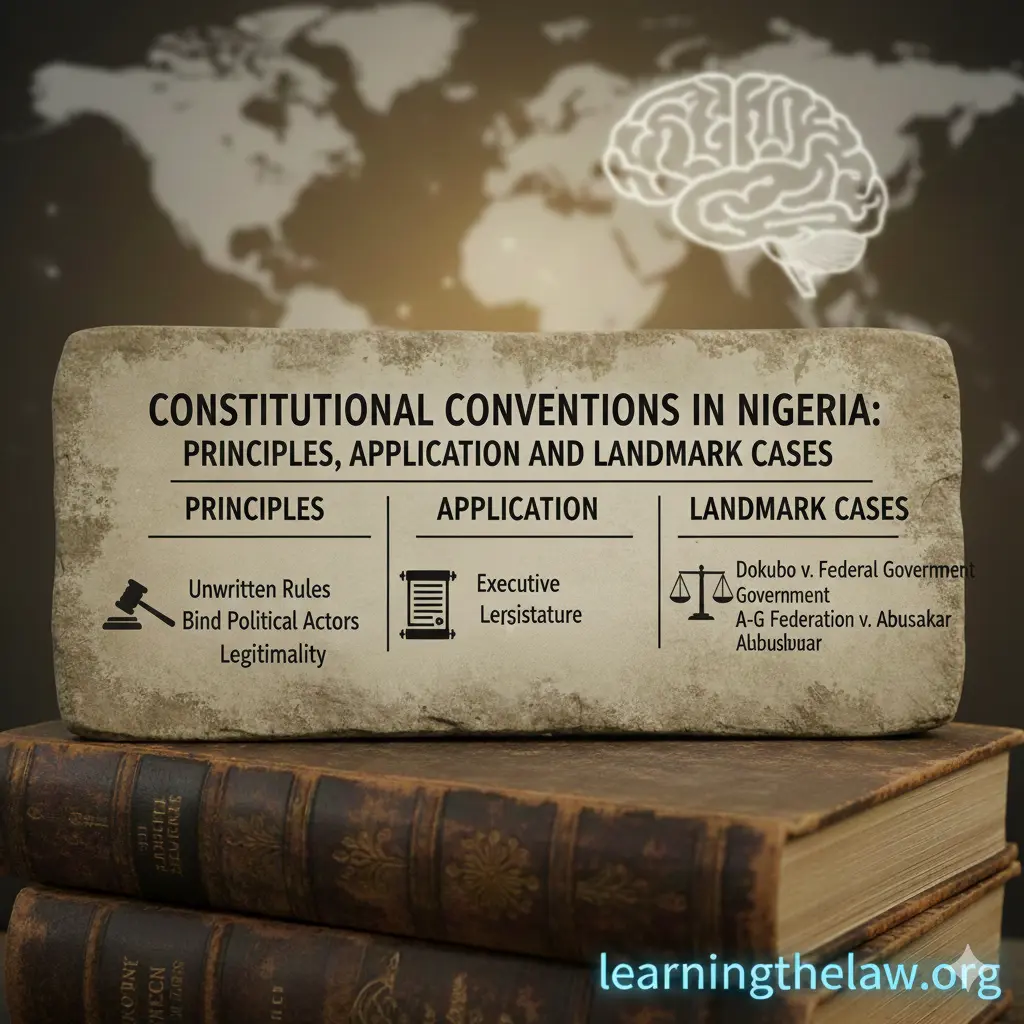
Constitutional Conventions in Nigeria: Principles, Application and Landmark Cases
Britain operates an unwritten constitution and many of the operations of the government do not have formal legal documentation. Hence, there are conventional rules guiding the operations of the government and its relationship with the sovereign/crown. The Cabinet and the Prime Minister/Parliament are conventional institutions, and the formal rules of the constitution only deal with marginal aspects of these institutions.1
Constitutional conventions are the non-legal rules of governmental operations. Not only do conventions supplement the legal rules, some of them are significantly constitutional rules.2 Think of conventions as unwritten customs that everyone in government follows, even though there’s no law forcing them to do so. They’re like the unspoken rules of a game that everyone respects because breaking them would disrupt how government works.
UNDERSTANDING CONSTITUTIONAL CONVENTIONS
AV Dicey used the term ‘convention’ to include understandings, habits, practices, customs, maxims and precepts. He distinguished conventions from law by positing that laws were enforced by the courts, whereas conventions were not.3 Dicey stated further that despite not being enforced by the courts, conventions are very important as they regulate the whole of the remaining discretionary powers of the Crown, whether exercised by the sovereign or ministers. He stated that conventions ‘enable a rigid legal framework – and all laws tend to be rigid – to be kept up with changing social needs and changing political ideas’.4
Ivor Jennings is of the view that conventions ‘provide the flesh which clothes the dry bones of the law’.5 This metaphor captures the essence of conventions perfectly – laws provide the skeleton of government, but conventions add the living tissue that makes it function smoothly.
According to KC Wheare, convention means ‘a binding rule, a rule of behaviour accepted as obligatory by those concerned in the working of the constitution’.6 Notice that Wheare calls it a “binding rule” even though it’s not a law. This is the paradox of conventions – they’re binding in practice but not in law.
Hood Phillips defined convention as ‘rules of political practice which are regarded as binding by those to whom they apply, but which are not laws as they are not enforced by the courts or by the Houses of Parliament’.7 The key distinction is enforcement: laws can be enforced by courts through penalties and sanctions, while conventions are enforced only by political pressure and public opinion.
Convention in this constitutional sense is quite different from its meaning in international law, where a convention is a synonym for a treaty, or binding agreement between states. In constitutional law, we’re talking about practices that have become accepted ways of doing things in government.
THE SCOPE OF CONSTITUTIONAL CONVENTIONS
For Dicey, conventions regulate the privileges of Parliament. In addition to the Crown’s discretionary powers, which include the relations between the sovereign and Parliament, and the sovereign and the government (Cabinet), conventions also extend to include:8
The relations between the executive and Parliament form a crucial area regulated by conventions. For instance, while there’s no law requiring ministers to answer questions in Parliament, convention requires that they do so. The relationship between the two Houses of Parliament is also governed by conventions, such as the understanding that the House of Lords will not oppose legislation promised in the government’s election manifesto (the Salisbury Convention).
The relationship between the judiciary and both the government (Cabinet) and Parliament is another area where conventions operate. By convention, judges don’t publicly criticize government policy, and Parliament doesn’t criticize individual judicial decisions during ongoing cases. The relationship between the United Kingdom and the other members of the Commonwealth also involves numerous conventions about consultation and cooperation.
In other words, many important rules of constitutional behaviour, which are observed by the Queen, ministers, members of Parliament and judges are contained neither in Acts nor in judicial decisions. Disputes which arise out of these rules rarely lead to action in the courts and judicial sanctions are not applicable for their breaches. Despite the fact that the United Kingdom does not have a written constitution, conventional rules have done a lot to the sustainability of governance in this jurisdiction.
KEY CONVENTIONS IN THE BRITISH SYSTEM
Royal Assent to Bills
Constitutional development has moved power from the sovereign to the minister, not as servants of the Crown, but as representatives of the people. The formal legal position is that a Bill could be refused royal assent by the sovereign and thus not become a statute. However, there is a convention to the effect that royal assent should be given to Bills which have been approved by the Houses of Parliament.9
The reason it is felt inappropriate for the sovereign to refuse royal assent is that the British constitutional arrangements take the form of a responsible and representative democracy. The sovereign is not responsible to the people and so the real exercise of power should be placed with those who are – the ministers. Royal assent is given by the Queen on the advice of her ministers. Where the Bill has been passed by both Houses of Parliament, the royal assent will be given as a matter of course. The last time a British monarch refused royal assent was in 1708, showing how firmly this convention is established.
Government Confidence and Elections
In Britain, general election is governed by detailed statutory rules, but no legal rule regulates the conduct of the Prime Minister when the result of the election is known. By a long-standing conventional rule, the government must have the confidence of a majority in the Commons.10
Therefore, when it is clear from the election results that the Prime Minister on whose advice the election was called has lost the election and another party has been successful, he or she must resign immediately without waiting for the new Parliament to meet. This happened in 2010 when Gordon Brown resigned after the Labour Party lost the election, even before the new Parliament convened.
Where the result of the election gives no party an overall majority in the Commons, the Prime Minister may continue in office for so long as is necessary to discover whether he or she is able to form a coalition or to govern with the support of other parties. This situation arose in 2010 when no party won an outright majority, and David Cameron’s Conservative Party formed a coalition with the Liberal Democrats.
Ministerial Appointments
Under the British system, ministers are appointed by the sovereign on the advice of the prime minister. In law, the Queen has unlimited power to appoint whom she pleases to be her ministers. However, the principle of ministerial responsibility (which calls for accountability by government from the electors) requires that a minister should belong to one or other House of Parliament.11
If a non-member is appointed to ministerial office, he or she will receive a life peerage. This convention became firmly established in 1963 by enactment of the Peerage Act 1963.12 It may be supposed that it was the enactment of Peerage Act 1963 which clearly established that the prime minister should sit in the Commons as the more important House of Parliament. Before 1963, Prime Ministers could sit in the House of Lords, but convention now dictates that the Prime Minister must be an elected member of the House of Commons to ensure democratic accountability.
Dissolution of Parliament
The sovereign has power to dismiss the whole government. Although a Parliament may last for a maximum of five years, it is most unusual that this period will elapse before a general election is held. Accordingly, the Parliament must be dissolved and the power to do this is also a personal prerogative of the sovereign. A dissolution will usually be sought when the party in government judges that its chances of re-election are good.13
In practice, the Prime Minister advises the Queen on when to dissolve Parliament, and the Queen follows this advice by convention. This power has now been modified by the Fixed-term Parliaments Act 2011, which scheduled elections every five years, though this Act itself was later repealed, returning some flexibility to the timing of elections.
Ministerial Responsibility
The most important of the conventions regulating relations between the executive and Parliament is that of ministerial responsibility. It may be divided into those aspects which refer to the government as a whole (collective responsibility), and that which applies to individual ministers (individual ministerial responsibility).14
If a government loses a vote of confidence then the convention requires that it should either resign or seek a dissolution of Parliament. This convention underscores the transfer of power from the sovereign to Parliament. The government is composed of the ministers of the Crown, but it is as representatives of the people that they hold office. In 1979, James Callaghan’s Labour government lost a vote of confidence by one vote, and he was required by convention to resign and call a general election.
Individual Ministerial Responsibility
Ministers account for the actions of their departments. If something has gone wrong then the minister is responsible and will explain what happened and why. The minister will be expected to rectify the situation. This may mean changing procedures, bringing disciplinary action against some officials or even resigning if the matter is one for which the minister accepts personal responsibility.15
There has been a development in the principle of ministerial responsibility by the promotion of the distinction between ministerial accountability and ministerial responsibility. A minister is accountable for all the actions of their department, but not necessarily blameworthy. The argument for the distinction is that the growth in government means that ministers cannot personally know of everything which their officials do and so they cannot be personally responsible for it, but as ministers they must come to Parliament and give an account of what their departments do.
This distinction became particularly important after the creation of executive agencies in the 1990s. Ministers argued they were responsible for policy but not for day-to-day operational failures by agency heads. However, this distinction remains controversial, as critics argue it allows ministers to avoid taking responsibility when things go wrong.
CONVENTIONS IN NIGERIA: THE ADEGBENRO v AKINTOLA CASE
The landmark case of Adegbenro v Akintola16 examined the applicability of British constitutional conventions in Nigeria’s written constitution. This case is crucial for understanding how conventions operate (or fail to operate) in countries with written constitutions as opposed to Britain’s unwritten constitution.
Chief SL Akintola was the leader of the Action Group Party and Premier of Western Nigeria. Following a crisis within the Action Group, Chief Akintola lost the support of a majority in the party. On 21 May 1962, the Governor of Western Nigeria, Sir Adesoji Aderemi, purported to remove Chief Akintola from office as Premier and appointed Chief Dauda Adegbenro as the new Premier.
The crisis arose because 66 out of 125 members of the Western Region House of Assembly signed a letter stating they no longer had confidence in Chief Akintola as Premier. The Governor, relying on this letter, removed Akintola from office. However, this removal did not happen on the floor of the House of Assembly – there was no vote of no confidence passed in the Assembly itself.
Section 33(10) of the Western Region Constitution provided:
Subject to the provisions of subsections (8) and (9) of this section, the Ministers of the Government of the Region shall hold office during the Governor’s pleasure: Provided that (a) the Governor shall not remove the Premier from office unless it appears to him that the Premier no longer commands the support of a majority of the members of the House of Assembly…17
Chief Akintola maintained that the Governor could not remove him except on a resolution passed on the floor of the House of Assembly that the Premier no longer enjoyed the support of the majority of the members. He instituted an action in the High Court challenging his removal and seeking an injunction restraining the defendants from usurping his duties.18
The High Court referred two questions to the Federal Supreme Court:
- Whether the Governor could validly exercise power to remove the Premier from office under section 33(10) without prior decision or resolution on the floor of the House of Assembly showing that the Premier no longer commands the support of a majority?
- Whether the Governor could validly exercise his power of removal based on material or information extraneous to the proceedings of the House of Assembly?
The plaintiff contended that section 33(10) was the same as the English Convention, and in light of that, the convention should be interpreted to mean that the removal of a premier from office must first be determined on the floor of the House, and that only in exceptional cases should the governor act outside the House in such manner.19 In other words, Akintola’s lawyers argued that the British convention (where a Prime Minister resigns after losing confidence in Parliament) should be read into the Nigerian Constitution.
Federal Supreme Court Decision
The Federal Supreme Court, in a majority decision, held that in exercising the power to remove the Premier, the governor’s action must be dictated by events in or emanating from the House, and not by a letter signed by a body of members of the House. Therefore, the Constitution of the Western Region contemplated proceedings in the House to determine whether the Premier commanded the support of a majority of the members.20
The court answered:
Question 1: The Governor cannot validly exercise the power to remove the Premier from office under section 33(10) except in consequence of proceedings on the floor of the House, whether in the shape of a vote of no confidence or of defeats on measures of some importance showing that the Premier no longer commanded the support of a majority of the members of the House of Assembly.
Question 2: This question was not answered.
The Federal Supreme Court essentially sided with Akintola, holding that the British convention should apply – the Premier’s loss of confidence should be demonstrated through parliamentary proceedings, not through a private letter.
Dissenting Judgment
Brett FJ, giving his dissenting judgment, held that on a reference to the Federal Supreme Court under section 108 of the Constitution of the Federation, the court was required to construe a written constitution, and not to apply a set of unwritten Conventions. He posited that the wordings of section 33(10) did not entitle the court to hold that the Governor must in every case look to the proceedings of the House of Assembly before acting.21
Brett’s dissent raised a fundamental question: Should a written constitution be interpreted by importing unwritten conventions from another country? He argued that the plain words of the Constitution should be followed, and those words gave the Governor discretion to determine whether the Premier had lost support, without specifying how that determination should be made.
Privy Council Decision
The defendants appealed to the Privy Council in London. The Privy Council held that where, under the written Constitution of Western Nigeria, the power of the Governor to remove a Premier from office was expressly recognised and conditioned, it was the construction of those words, and nothing else that must determine the issue whether the Governor had acted constitutionally or not.22
The Privy Council stated that by the words ‘it appears to him’, employed in section 33(10), the judgment as to the support enjoyed by a Premier was left to the Governor’s own assessment, and there was no limitation as to the material on which he could base his judgment. Therefore, the Privy Council answered both questions in the affirmative, reversing the Federal Supreme Court’s decision.
The Privy Council essentially agreed with Brett’s dissent. They held that in a written constitution, you interpret the words as written. The phrase “it appears to him” gave the Governor personal discretion. If the constitution-makers had wanted to require parliamentary proceedings, they should have said so explicitly. You cannot import British conventions into a written constitution that doesn’t expressly incorporate them.
SIGNIFICANCE OF THE CASE
The Adegbenro v Akintola case remains significant in Nigerian constitutional law as it demonstrates the distinction between conventions in an unwritten constitution (like Britain’s) and express constitutional provisions in a written constitution. The Privy Council’s decision emphasised that where constitutional provisions are express and clear, they must be interpreted according to their ordinary meaning, rather than by importing conventions from another jurisdiction.
This case teaches an important lesson: conventions work in Britain because there is no written constitution to contradict them. In Nigeria, we have a written constitution that is supreme. Where the Constitution speaks clearly, that is what must be followed, regardless of what conventions might suggest. This doesn’t mean conventions have no role in Nigeria – they do exist (for instance, certain protocols between the President and National Assembly). However, these conventions cannot override or contradict express constitutional provisions.
The case also highlights a deeper political lesson about constitutional design. If Nigerian constitution-makers wanted parliamentary democracy to work like Britain’s, they needed to write those conventions into the Constitution explicitly. Leaving things to convention works when you have centuries of stable practice like Britain. In a young democracy with a written constitution, clarity and explicitness in constitutional text are essential.
CONCLUSION
Constitutional conventions play a crucial role in the British constitutional system, filling gaps in the formal legal framework and allowing for constitutional flexibility. They enable the British system to adapt to changing circumstances without constantly amending statutes. The conventions around royal assent, ministerial responsibility, and parliamentary confidence have evolved over centuries to create a functioning democracy despite the absence of a written constitution.
However, the Adegbenro v Akintola case demonstrates that in jurisdictions with written constitutions like Nigeria, express constitutional provisions take precedence over conventional practices. While conventions may inform constitutional interpretation, they cannot override the clear words of a written constitution. This reflects a fundamental difference between constitutional systems: Britain’s reliance on flexibility and tradition versus Nigeria’s reliance on a fixed, written document as the supreme law.
For law students, understanding conventions is important not just for studying British constitutional law, but for appreciating the different ways constitutional systems can function. It also teaches the importance of precise constitutional drafting – if you want a particular practice to be followed, it’s better to write it into the constitution explicitly rather than hoping a convention will develop.
REFERENCES
Footnotes
-
AW Bradley, KD Ewing and CJS Knight, Constitutional and Administrative Law (16th edn, Pearson Education Limited 2015) 23-28. ↩
-
ibid 24. ↩
-
AV Dicey, Introduction to the Study of the Law of the Constitution (10th edn, Macmillan 1959) 23-24. ↩
-
ibid 30. ↩
-
Ivor Jennings, The Law and the Constitution (5th edn, University of London Press 1959) 81. ↩
-
KC Wheare, Modern Constitutions (2nd edn, Oxford University Press 1966) 179-180. ↩
-
O Hood Phillips and P Jackson, Constitutional and Administrative Law (8th edn, Sweet & Maxwell 2001) 125. ↩
-
Dicey (n 3) 417-429. ↩
-
Bradley, Ewing and Knight (n 1) 26-27. ↩
-
ibid 115-118. ↩
-
ibid 98-102. ↩
-
Peerage Act 1963. ↩
-
Bradley, Ewing and Knight (n 1) 145-150. ↩
-
ibid 89-95. ↩
-
ibid 92-94. ↩
-
Adegbenro v Akintola [1963] AC 614 (PC). ↩
-
Western Region Constitution 1960, s 33(10). ↩
-
Adegbenro v Akintola (n 16) 620-622. ↩
-
ibid 628. ↩
-
Adegbenro v Akintola (1962) 1 All NLR 489 (Federal Supreme Court). ↩
-
ibid 502-505 (Brett FJ dissenting). ↩
-
Adegbenro v Akintola (n 16) 631-632. ↩
