

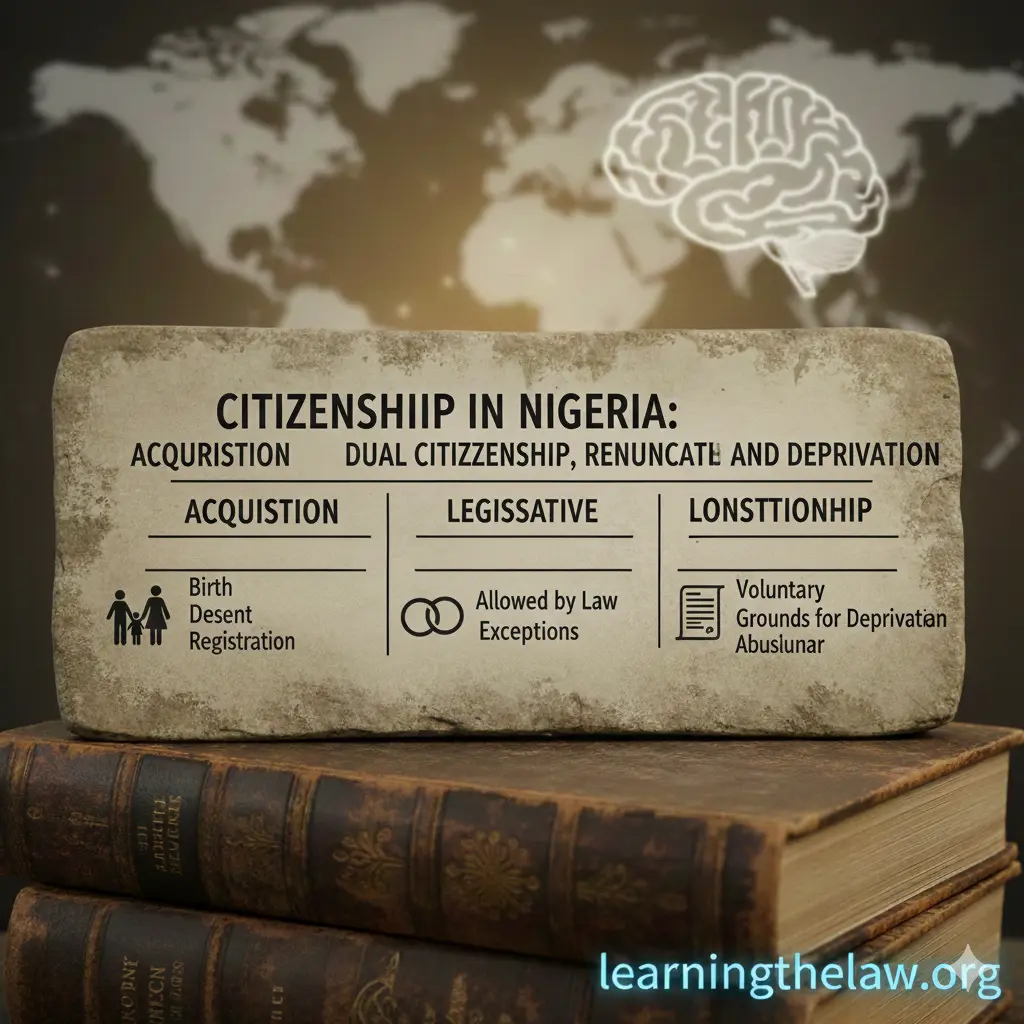
Citizenship in Nigeria: Acquisition, Dual Citizenship, Renunciation and Deprivation
According to the Black’s Law Dictionary, citizenship is defined as the status of being a citizen, the quality of a person’s conduct as a member of a community. A citizen is a person who, by either birth or naturalization, is a member of a political community, owing allegiance to the community and being entitled to enjoy all its civil rights and protections; a member of the civil state, entitled to all its privileges.1
The word citizenship is often used interchangeably with “subject”, “individual”, and “nationality”. It has been defined as pertaining to a person who under the constitution and the laws of a particular state is a member of the political community, owing allegiance and being entitled to the enjoyment of some fundamental rights.
HISTORICAL UNDERSTANDING OF CITIZENSHIP
Under the common law, the idea of the British subject was rooted in the idea of allegiance, the bond which linked a man with his feudal lord. In return for allegiance, a man was entitled to his lord’s protection. No one could divest himself of such allegiance, as it may be regarded as treason. This feudal concept evolved into the modern idea of citizenship, though the element of mutual obligation between citizen and state remains central.
In the case of Herriot v City of Seattle,2 citizens are defined as members of a political community who in their associated capacity, have established or submitted themselves to the dominion of a government for the promotion of their general welfare and protection of their individual as well as collective rights. This definition captures the reciprocal nature of citizenship – citizens submit to government authority, but in return receive protection and benefits.
DIFFERENT CONCEPTS OF CITIZENSHIP
The idea of citizenship was drawn from the classical Greco-Roman tradition that citizenship involved participation in the political process and the acceptance of responsibilities to the community by its members. As expressed in ancient Athens, each individual is interested not only in his own affairs but in the affairs of the state as well. Participation in politics requires a high degree of responsibility and independence of judgment on the part of individuals if it is to produce good government, rather than government in the interests of those with most influence in the political system.3
The second notion of citizenship is derived from Roman tradition: the ideas of civic virtue and good citizenship, often called civic republicanism. This is essentially a social or political rather than a legal concept of citizenship. The core of the theory was the duty of loyalty to the state, responsibility, and respect for political and social procedural values. The good citizen is he who gives at least as much as he takes – both vertically to the state and horizontally to his fellows.
The third notion of citizenship is contained in the liberal approach, which was particularly influential at the end of the nineteenth century and which emphasizes the importance of the legal, or civil, and political rights of the individual. The latter involve rights to participate in the political process – right to vote and stand for political office, and freedom of speech and association. This liberal conception focuses on citizenship as a bundle of rights that protect the individual from state oppression.
The fourth notion of citizenship is the idea of the citizen as an individual, possessing entitlements to basic social benefits from the state in addition to civil and political rights. These were central to Marshall’s theory of citizenship, and were widely accepted in the post Second World War period. This social democratic conception sees citizenship as including not just political and civil rights, but also social and economic rights like healthcare, education, and social security.
CITIZENSHIP IN THE NIGERIAN CONTEXT
From the foregoing, a citizen is the recipient of some basic rights provided for in the constitution and laws of a nation, in return for which certain minimum level of allegiance is expected from him towards the community of which he is a citizen. As has been described in a number of cases, such citizenship cannot be shifted, cancelled or diluted at the will of a federal government, state or any other governmental unit. This protection is particularly important in Nigeria’s federal system where there have historically been tensions between federal and state governments.
Under the various constitutions, citizenship is acquired in different ways, and one of the hallmarks of such citizenship is the right to move around, reside anywhere, exit and enter the particular political community to which a citizen belongs. These rights are enshrined in Section 41 of the 1999 Constitution which guarantees freedom of movement. Note that the idea of citizenship refers only to natural persons in terms of human beings and not to artificial persons, such as companies or industries. Companies may be “incorporated in Nigeria” but they are not “citizens” in the constitutional sense.
Under the various Nigerian Constitutions since 1979, citizenship can be acquired in three ways namely by birth, by naturalization and by registration.4
ACQUISITION OF CITIZENSHIP
Citizenship by Birth
Section 25 of the 1999 Constitution (as amended) provides that citizenship of Nigeria can be acquired through descent from a person or persons who themselves are Nigerians.5
Category 1: Persons Born Before Independence
Every person born in Nigeria before independence is a citizen if either of his parents or any of his grandparents belongs or belonged to a community indigenous to Nigeria. Note that before independence on 1st of October, 1960 there was no country called Nigeria but a colony and protectorate of Nigeria. Some communities which were formerly belonged to Nigeria ceased to belong to it after independence, for example, some parts of Southern Cameroon originally were part of the Protectorate of Nigeria but opted to belong to the present Cameroon following a plebiscite in 1961.
For this purpose, section 31 of the Constitution provides that: a parent or grandparent of a person shall be deemed to be a citizen of Nigeria if at the time of the birth of that person such parent or grandparent would have possessed that status by birth if he had been alive on the date of independence.6 Note that section 31 has the effect of transporting a parent or grandparent born before independence to the independence date and establishing what his status would have been if he had been alive at independence. This legal fiction ensures that people are not denied citizenship because their ancestors died before independence.
Category 2: Persons Born After Independence
Every person born in Nigeria after independence, either of whose parents or any of whose grandparents is a citizen of Nigeria, is automatically a citizen of Nigeria by birth. This is the most common way Nigerians acquire citizenship. If your father or mother is Nigerian, you are automatically Nigerian regardless of where you were born. Similarly, if your grandparents are Nigerian, you can also claim Nigerian citizenship even if your parents were not Nigerian citizens.
It is important to note that the 1999 Constitution creates two classes of citizens. By section 30 of the Constitution, it is only citizens by birth that cannot be deprived of their citizenship under any condition by the president.7 Again, by the provisions of sections 177 and 187(2) of the Constitution, certain political posts such as the president, vice president, governor or deputy governor can only be contested or held by citizens of Nigeria by birth.8 This distinction creates a hierarchy of citizenship that some scholars have criticized as inconsistent with the principle of equality before the law.
Note that section 25(2) says that the date of independence means 1st day of October, 1960.
Citizenship by Registration
By the provisions of section 26 of the 1999 Constitution (as amended), a person to whom the provisions of the section apply may be registered as a citizen of Nigeria, if the president is satisfied that:9
a. he is a person of good character, b. he has shown a clear intention of his desire to be domiciled in Nigeria; and c. he has taken the Oath of Allegiance prescribed in the Second Schedule to the Constitution.
It is worthy of note that two classes of persons can become citizens of Nigeria by registration under section 26 of the 1999 Constitution (as amended). They include:
a. any woman who is or has been married to a citizen of Nigeria; or b. every person of full age and capacity born outside Nigeria any of whose grandparents is a citizen of Nigeria.
The first category recognizes that marriage creates a significant connection to Nigeria. However, this provision has been criticized for gender discrimination because it only applies to foreign women who marry Nigerian men, not to foreign men who marry Nigerian women. A foreign man who marries a Nigerian woman cannot automatically become a Nigerian citizen through registration – he would have to go through the more rigorous naturalization process.
The second category provides an avenue for persons of Nigerian descent (through grandparents) who were born abroad to acquire Nigerian citizenship. This is important for the Nigerian diaspora.
Note that a citizen of Nigeria by registration cannot within ten years of such registration hold any elective or appointive post under the constitution.10 This ten-year waiting period is meant to ensure loyalty and integration before such persons can hold sensitive political or public positions.
Citizenship by Naturalisation
A person who is not a citizen of Nigeria by birth or eligible for citizenship by registration can become a Nigerian citizen through the process of naturalisation. This is the most difficult route to Nigerian citizenship and is reserved for foreigners who have no ancestral connection to Nigeria but wish to become Nigerian.
Subject to the provisions of section 28 of this Constitution, any person who qualified in accordance with the provisions of this section may apply to the President for the grant of a certificate of naturalisation. By virtue of section 27 of the 1999 Constitution (as amended) such a person may apply to the president for the grant of a certificate of naturalisation.11 He must satisfy the president that:
a. he is of full age and capacity, b. he is of good character; c. he has shown a clear intention of his desire to be domiciled in Nigeria, d. he is, in the opinion of the Governor of the State in which he proposes to reside, acceptable to the community in which he is to live permanently and has been assimilated into their way of life, e. he has made, or is capable of making useful contribution to the advancement, progress and well being of Nigeria, f. he has taken the Oath of Allegiance, g. he has, immediately preceding the date of his application (i) resided in Nigeria continuously for fifteen years or (ii) resided continuously for twelve months, and within the twenty years immediately preceding twelve months, he has resided in Nigeria for not less than fifteen years.
Paragraph (d) above is particularly significant – it requires the Governor’s certification that the applicant is acceptable to the local community and has been assimilated into their way of life. This reflects Nigeria’s communal traditions and ensures that naturalised citizens have genuine integration into Nigerian society, not just paper citizenship.
The residence requirements in paragraph (g) are very stringent – essentially requiring 15 years of residence in Nigeria. This long period ensures that only people with deep commitment to Nigeria can be naturalised.
DUAL CITIZENSHIP
By the provisions of section 28 of the 1999 Constitution (as amended) a citizen of Nigeria by birth can acquire the citizenship of another country without renouncing his Nigeria citizenship.12 This is a significant change from earlier constitutional provisions which prohibited dual citizenship. The recognition of dual citizenship acknowledges the reality of globalisation and the fact that many Nigerians live abroad.
In the same way, citizens of Nigeria by registration or naturalisation can retain their citizenship by birth and still acquire Nigerian citizenship. They must however, within twelve months of the grant of the certificate of registration or naturalisation, renounce the citizenship of any other country other than that of the citizenship of their birth.
This means that if you become Nigerian by registration or naturalisation, you can keep your birth citizenship (the citizenship of the country where you were born) but you must renounce any other citizenship you may have acquired. For example, if a British citizen born in Britain becomes Nigerian by naturalisation, he can keep his British citizenship and Nigerian citizenship, but if he had previously acquired French citizenship, he would have to renounce the French citizenship.
RENUNCIATION OF CITIZENSHIP
By the provisions of section 29(1) of the 1999 Constitution (as amended) a Nigerian citizen of full age can renounce his citizenship.13 Such a person must make a declaration of renunciation in the prescribed manner, and the declaration shall be registered, after which the person ceases to be a citizen of Nigeria.
Note that the president may withhold such registration of renunciation if:
a. the declaration is made during any war in which Nigeria is physically involved; or b. in his opinion, it is otherwise contrary to public policy.
The first ground ensures that citizens cannot renounce their citizenship to evade military service or other war-related obligations. The second ground gives the President broad discretion to prevent renunciation when it would be contrary to national interest.
Full age, for the purpose of section 29(1) of the 1999 Constitution, means the age of eighteen years and above. Any woman who is married shall be deemed to be of full age.14 This last provision has been controversial. It implies that a girl under 18 who is married is deemed to be of “full age” for purposes of renouncing citizenship, which some argue could facilitate child marriage by allowing underage girls to renounce citizenship as part of marriage arrangements.
DEPRIVATION OF CITIZENSHIP
The president may deprive a person, other than a citizen of Nigeria by birth or by registration, of his citizenship, if he is satisfied that such a person has, within a period of seven years after becoming naturalised, been sentenced to imprisonment for a term of not less than three years.15
This provision only applies to citizens by naturalisation. Citizens by birth cannot be deprived of citizenship under any circumstances, and citizens by registration are also protected from deprivation. This protection reflects the principle that citizenship by birth is a fundamental right that cannot be taken away.
The seven-year period creates a probationary phase for naturalised citizens. If within seven years of naturalisation they commit a serious crime (one carrying three or more years imprisonment), they can lose their Nigerian citizenship. After seven years, this ground for deprivation no longer applies.
The president shall also deprive a person, other than a person who is a citizen of Nigeria by birth, if he is satisfied from the records of proceedings of a court of law or other tribunal, or after due inquiry in accordance with regulations made by him, that:
a. the person has shown himself by act or speech to be disloyal towards the Federal Republic of Nigeria; or b. the person has, during a war in which Nigeria was engaged, unlawfully traded with the enemy or been engaged in or association with any business that was in the opinion of the president carried on in such a manner as to assist the enemy of Nigeria in that war, or unlawfully communicated with such enemy to the detriment of or with intent to cause damage to the interest of Nigeria.16
These grounds for deprivation apply to both citizens by registration and naturalisation. The first ground (disloyalty) is quite broad and could potentially be abused. The second ground (enemy trading during war) is more specific and relates to conduct that directly harms Nigeria’s security interests.
Note that “deprivation” can only occur after either court proceedings or a formal inquiry, providing some procedural protection against arbitrary deprivation of citizenship.
CONCLUSION
The law of citizenship in Nigeria reflects the country’s history and constitutional development. The distinction between citizens by birth and those by registration or naturalisation creates a hierarchy of citizenship rights, with citizens by birth enjoying the strongest protections and widest opportunities. The recognition of dual citizenship in 1999 was a progressive step that acknowledged Nigeria’s diaspora and the realities of globalisation.
However, certain provisions remain controversial, particularly the gender discrimination in citizenship by registration through marriage, the automatic “full age” status of married women regardless of actual age, and the broad grounds for depriving naturalised citizens of citizenship. These issues continue to generate debate among constitutional lawyers and civil society advocates.
For law students, understanding citizenship law is crucial not just for examining who is a Nigerian, but for appreciating how citizenship affects the enjoyment of fundamental rights and the ability to participate in political life. Questions of citizenship often arise in electoral cases where candidates’ eligibility is challenged, and in cases involving deportation or exclusion of persons from Nigeria.
REFERENCES
Footnotes
-
Black’s Law Dictionary (11th edn, Thomson Reuters 2019). ↩
-
Herriot v City of Seattle 81 Wash 2d 48, 500 P.2d 101, 109. ↩
-
AW Bradley, KD Ewing and CJS Knight, Constitutional and Administrative Law (16th edn, Pearson Education Limited 2015) 415-420. ↩
-
Constitution of the Federal Republic of Nigeria 1999 (as amended), ss 25-27. ↩
-
ibid s 25. ↩
-
ibid s 31. ↩
-
ibid s 30. ↩
-
ibid ss 177, 187(2). ↩
-
ibid s 26. ↩
-
ibid s 26(3). ↩
-
ibid s 27. ↩
-
ibid s 28. ↩
-
ibid s 29(1). ↩
-
ibid s 29(4). ↩
-
ibid s 30(1). ↩
-
ibid s 30(2). ↩
