

Ministerial Responsibility in Nigeria: Doctrine, Application and Constitutional Framework
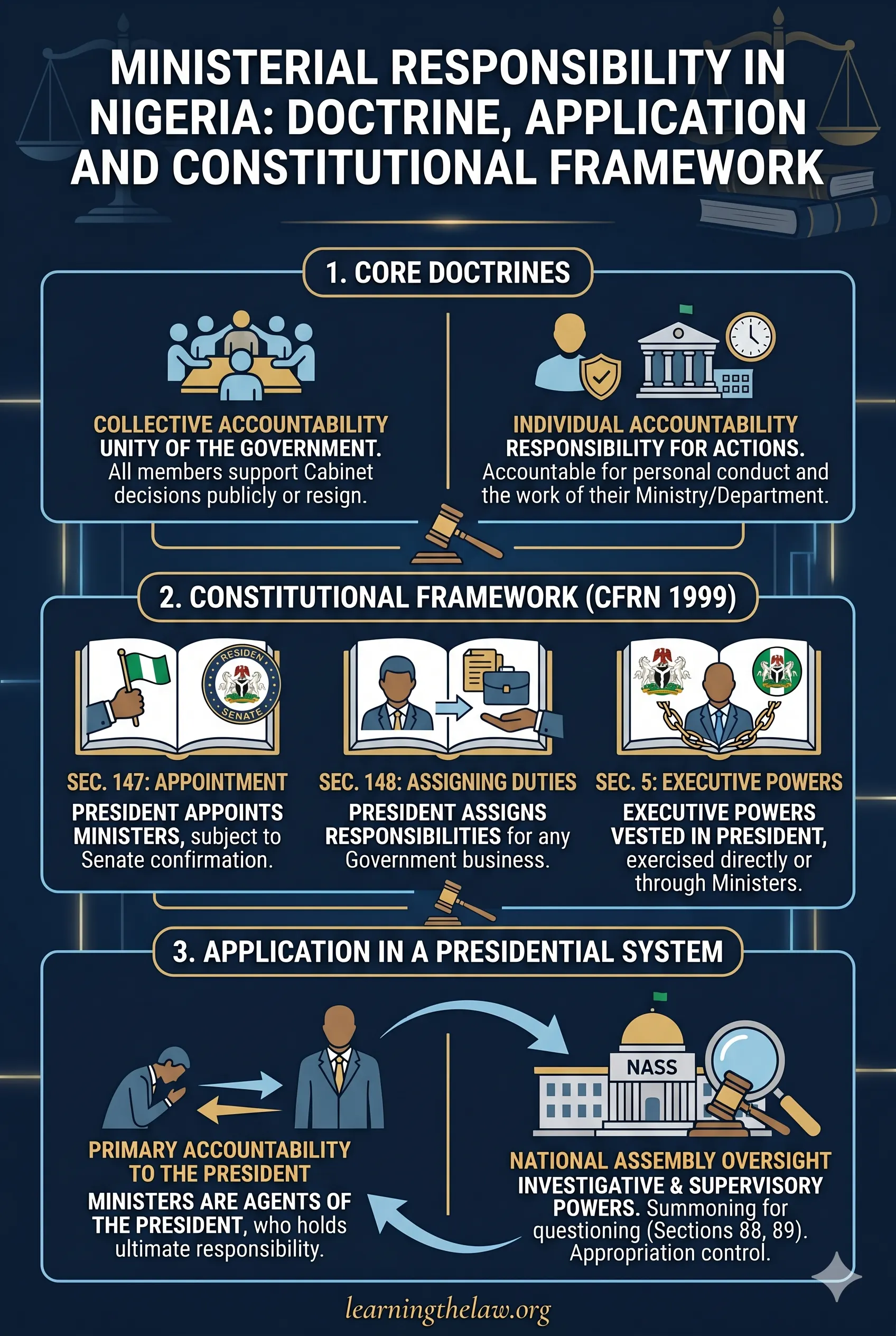
Ministerial responsibility is a fundamental constitutional doctrine that governs the conduct and accountability of ministers in democratic systems. Every act of government is usually done through ministers and their ministries, departments, offices and agencies under the ministry. This doctrine ensures that government officials remain accountable for their actions and policies, both individually and collectively.1
WHO IS A MINISTER?
A minister is:2
- A person at the head of a ministry or department of State
- Usually a member of Cabinet and holds the highest office in the ministry
- A political appointee with his or her tenure in office at the pleasure of the appointor, usually the head of government
- One who usually vacates office on a change of government unless reappointed
THE DOCTRINE OF MINISTERIAL RESPONSIBILITY
The doctrine of ministerial responsibility has two main components: collective responsibility and individual responsibility. This doctrine serves to promote responsibility among members of the executive. Otherwise, everyone would try to exonerate themselves and blame others.3
COLLECTIVE MINISTERIAL RESPONSIBILITY
Collective responsibility is the responsibility of the entire cabinet, first to the parliament and ultimately to the people, for all policies and conduct of the executive arm of government during their tenure in office. It means that every member of the cabinet (ministers) are collectively responsible for all that is decided and all actions taken by the government.4
Key Principles of Collective Responsibility
Collective responsibility connotes that all members of the entire cabinet are collectively responsible for all actions and policies of the executive arm of government. The following principles apply:5
- The responsibility of ministers is first to the parliament and ultimately to the people
- They are liable to be called to question by the parliament as representatives of the people
- They take the blame or praise for the actions of government collectively as a cabinet
- A minister is required to loyally support the policies and actions of government or resign if unable to do so
The principle of collective ministerial responsibility was examined in the English case of Attorney General v Jonathan Cape Ltd.6 This case established that cabinet discussions and documents are confidential, reinforcing the doctrine that ministers must present a united front on government policies.
INDIVIDUAL MINISTERIAL RESPONSIBILITY
A minister is individually responsible for:7
- His or her personal actions
- Acts emanating from any part of his or her ministry or its public agencies
A minister must accept the political consequence of the above by taking the blame or praise for what was done by their department or ministry. This means that if waste, corruption, or any other misbehaviour is found to have occurred within a ministry, the minister is responsible even if the minister had no knowledge of the actions.8
MINISTERIAL RESPONSIBILITY IN PARLIAMENTARY SYSTEMS
Ministerial responsibility is a major characteristic of a parliamentary system of government, such as that operated in Britain. As a result of collective responsibility, the entire government cabinet must resign if a vote of no confidence is passed in parliament.9
In a parliamentary system, ministers are typically members of the legislature, and they bear direct responsibility to parliament. This creates a direct line of accountability between the executive and legislative branches of government.
MINISTERIAL RESPONSIBILITY IN PRESIDENTIAL SYSTEMS
The Nigerian Context
Nigeria operates a presidential system of government as provided for in the Constitution. The President nominates and chooses ministers and formally assigns them portfolios after such persons have been confirmed by the Senate. The ministers are appointed to assist the President in the exercise of executive duties.10
Key Distinctions in Presidential Systems
In an executive presidential system, the ministers are not members of parliament. As such, they do not strictly owe ministerial responsibility to the National Assembly. Rather, they owe their individual ministerial responsibility for the performance of their functions in the various ministries primarily to the President.11
Although the ministers are not directly responsible to the National Assembly, they may still be summoned to explain conduct or matters relating to their ministries. Where the National Assembly strongly disapproves of a minister’s conduct, such a minister may be dropped or reassigned to another ministry.12
Collective Responsibility in Presidential Systems
The doctrine of collective ministerial responsibility exists in a presidential system. Each minister is expected to stay loyal to actions taken by the government. Where a minister is not in support of the government, he or she is expected to resign from government.13
This principle was examined in Tende v AG Federation, where the Court of Appeal considered the extent of ministerial responsibility in Nigeria’s presidential system.14
CONSTITUTIONAL BASIS IN NIGERIA
The Nigerian Constitution provides the framework for ministerial appointments and responsibilities. Section 147 of the 1999 Constitution provides for the appointment of ministers by the President, subject to confirmation by the Senate. Section 148 empowers the President to assign portfolios to ministers and to terminate their appointments.15
The Constitution also provides for the accountability of ministers through various mechanisms, including the power of the National Assembly to summon ministers to appear before it and answer questions concerning matters within their ministerial responsibility.16
ACCOUNTABILITY MECHANISMS
Several mechanisms exist to ensure ministerial accountability in Nigeria:
- Parliamentary Questions: Ministers may be summoned to appear before the National Assembly to answer questions
- Budget Approval: The National Assembly’s power over the budget provides oversight over ministerial expenditure
- Confirmation Hearings: The Senate’s power to confirm ministerial appointments serves as an initial screening mechanism
- Removal Power: The President’s power to remove ministers ensures executive accountability
- Public Scrutiny: Media and civil society oversight provide additional checks on ministerial conduct
DIFFERENCES BETWEEN PARLIAMENTARY AND PRESIDENTIAL SYSTEMS
The key differences in ministerial responsibility between parliamentary and presidential systems include:
Parliamentary System
- Ministers are members of parliament
- Direct responsibility to parliament
- Entire cabinet resigns on vote of no confidence
- Collective responsibility is absolute
- Parliament can force ministerial resignation
Presidential System (Nigeria)
- Ministers are not members of parliament
- Primary responsibility to the President
- Individual ministers may be removed by President
- Collective responsibility to government policies exists
- National Assembly has limited power to force resignation
CHALLENGES AND REFORMS
Despite the constitutional framework, several challenges affect the effective operation of ministerial responsibility in Nigeria:
- Limited enforcement of accountability mechanisms
- Political considerations often override accountability
- Weak parliamentary oversight
- Lack of effective sanctions for ministerial misconduct
- Inadequate transparency in ministerial operations
CONCLUSION
Ministerial responsibility remains a crucial doctrine in ensuring accountability and good governance in Nigeria. While the presidential system adopted by Nigeria differs from the parliamentary model where this doctrine originated, its core principles remain relevant. Ministers must remain accountable both individually for their ministerial actions and collectively for government policies. The effective implementation of this doctrine requires strong institutional frameworks, active parliamentary oversight, and commitment to democratic principles by all stakeholders.
REFERENCES
Footnotes
-
K Mowoe, Constitutional Law in Nigeria (Malthouse Press 2008) 135-138. ↩
-
ibid 136. ↩
-
ibid 138-140. ↩
-
ibid 139. ↩
-
PAO Oluyede, Constitutional Law in Nigeria (Evans Brothers 1992) 178-182. ↩
-
Attorney General v Jonathan Cape Ltd [1975] 3 All ER 484, 495. ↩
-
Mowoe (n 1) 141-143. ↩
-
ibid 142. ↩
-
AW Bradley, KD Ewing and CJS Knight, Constitutional and Administrative Law (17th edn, Pearson 2018) 108-115. ↩
-
E Malemi, The Nigerian Constitutional Law (Princeton Publishing Company 2012) 245-248. ↩
-
ibid 246-247. ↩
-
JA Yakubu, Constitutional Law in Nigeria (Demyaxs Law Books 2003) 198-202. ↩
-
Malemi (n 10) 248-250. ↩
-
Tende v AG Federation (1988) 1 NWLR (Pt 71) 506 (CA). ↩
-
Constitution of the Federal Republic of Nigeria 1999 (as amended), ss 147-148. ↩
-
ibid s 88. ↩

Kolawole Adebowale is a law graduate of the University of Ibadan with a specialization in intellectual property law, digital patent enforcement, and software law. His research focuses on the intersection of technology and IP protection in Nigeria’s emerging digital economy, with comparative analysis spanning multiple jurisdictions. He is a member of the Law Students Association of Nigeria (LAWSAN) and the IP Association.